



True Believers: Why Trans Activism is Fueled by Hatred, Intolerance, and Nonsense
By Mia Hughes
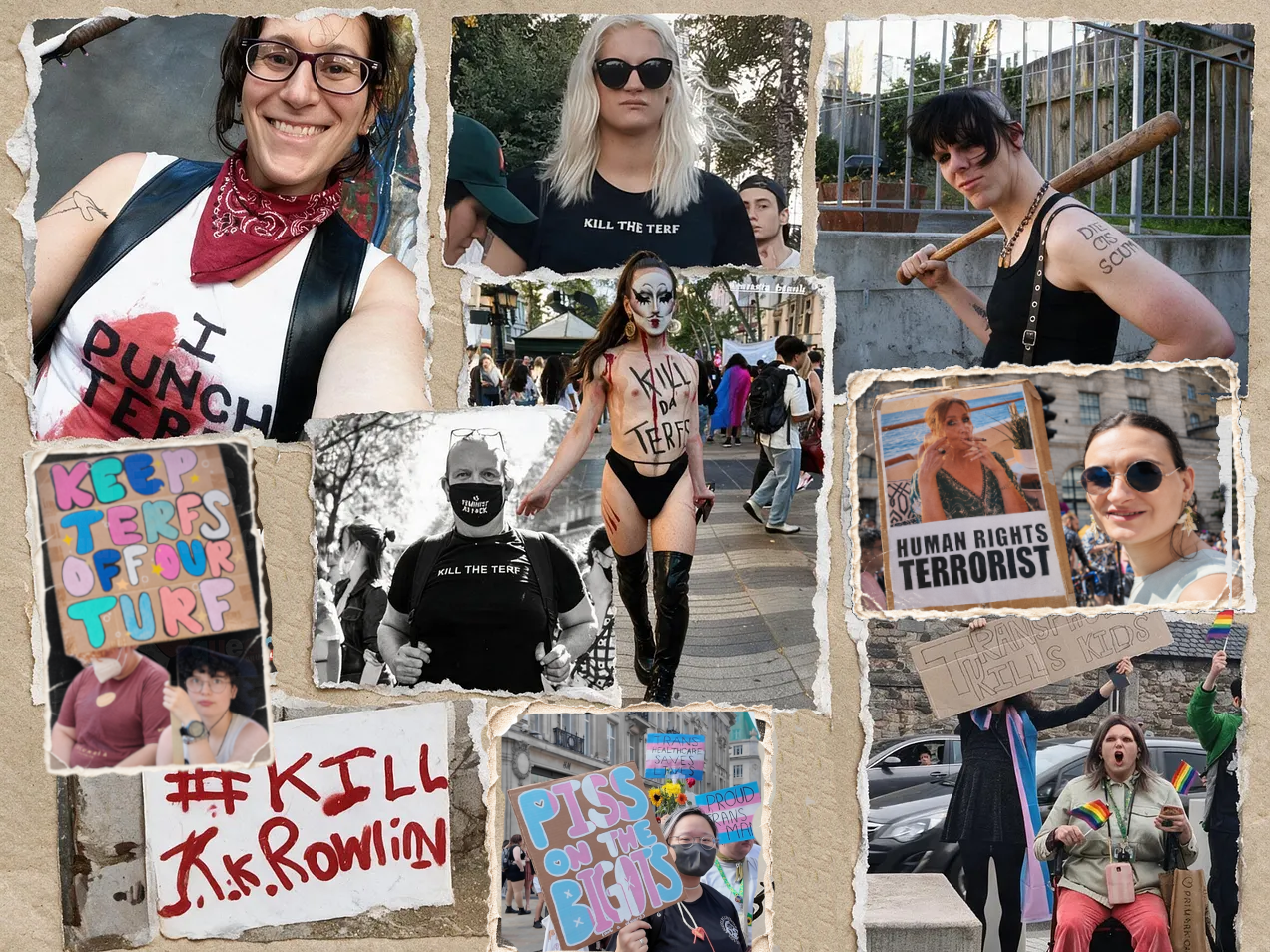
The Western world in the 21st century is one of the strangest moments in human history. This is an era in which saying that women are adult human females is enough to incur the wrath of an angry seething mob, being horrified by the sight of teenage girls displaying mastectomy scars can result in vicious persecution, and stating the obvious—that wanting healthy body parts chopped off is a sign of mental disorder—amounts to one of the most hateful and bigoted views a person could express.
An explanation for how we arrived at such a bizarre moment can be found in the unlikeliest of places: the mid-20th century musings of a self-educated San Francisco dockworker by the name of Eric Hoffer. In the late 1940s, in lodgings so sparse he used a plank of wood as a desk, Hoffer penned The True Believer—one of the most insightful studies into the mind of the fanatic and the psychology of mass movements ever written.
Hoffer wrote in the shadow of the Holocaust, while the world was still reeling from the unimaginable horrors unleashed when millions of ordinary Germans surrendered themselves to a murderous cause. At the time, Stalin ruled the Soviet Union with an iron fist, and Mao had only recently taken power in China, leading Hoffer to warn that “though ours is a godless age, it is the very opposite of irreligious. The true believer is everywhere on the march.”
Today, there is an army of true believers of a very different ilk on the march once again. Festooned in rainbow flags and carrying placards about acceptance and kindness, the transgender rights movement disguises itself as a simple fight for equality and an end to the discrimination of a long-marginalised group. Yet there is a vast difference between ordinary civil rights movements—that have reasonable demands for equal rights, achieve gains through persuasion and compromise, and are typically fought across decades—and a Hofferian mass movement.
A beast of a very different nature, a mass movement recruits the frustrated with the promise of rebirth, demands blind faith and total allegiance to its doctrine, breeds fanaticism, thrives on hatred and intolerance, and seeks to achieve its goals not by open debate and persuasion, but by force.
Building the Intellectual Scaffolding
A movement is pioneered by men of words, materialized by fanatics and consolidated by men of action.
Mass movements do not begin with angry crowds rioting in the streets. They begin with ideas flowing from the pens of fault-finding intellectuals. Long before the storming of the Bastille, men of words such as Voltaire, Diderot and Rousseau discredited the monarchy and church, planting the seeds of liberty, equality, and the sovereignty of the people into the French imagination. And before Lenin and the Bolsheviks, there had to be the writings of Marx and Engels.
For the transgender mass movement, the men of words gathered in Houston, Texas in the early 1990s. To be sure, the Houston group were preceded by decades of intellectuals laying the necessary conceptual groundwork—the likes of Havelock Ellis, Magnus Hirschfeld, Harry Benjamin, Robert Stoller, and John Money, with later contributions from queer theorists such as Judith Butler and Gayle Rubin.
These fringe eccentrics built the intellectual scaffolding for the movement to come, introducing into the public consciousness strange ideas about people trapped in the wrong body, the impossibility of medical sex change, and early versions of the gender identity concept that would later be so essential to the movement.
Yet, those who convened at the Hilton hotel in Houston in August, 1992 were not endocrinologists, sexologists, or psychiatrists. An extraordinary feature of the trans mass movement is that while a medical treatment sits at its core, its founders are not medical professionals. Its men of words are patients demanding the right to dictate their own treatment and define their own diagnosis. And it is essential to understand the unusual nature of this patient cohort in order to understand the mass movement they unleashed.
For the Houston men of words displayed all the traits of individuals in the grips of an overvalued belief—a type of mental disorder involving one powerful fixation that all-consumes the mind. Patients with disorders of overvalued belief do not perceive their belief and its accompanying desires as being the product of a mental disorder and typically react with intense venom at any such suggestion. This is evident in the early Houston activists, who did not recognise their desire to embody the opposite sex as being psychiatric in origin, but instead felt it to be entirely rational and justified and resented the involvement of psychiatry in their care.
From this mistaken belief sprang the doctrine of the transgender mass movement.
The Houston men of words did not set out to fight for equality, acceptance, and an end to the discrimination of trans-identified people. Instead, in order to redefine their desire to be members of the opposite sex as healthy, they put their heads together and formulated a plot to rewrite the most fundamental fact about human biology: the sex binary. In the new reality they concocted, men, women, boys, and girls are defined not by their sexed bodies but by an inner essence called a gender identity. In their envisioned utopia, everyone had the right to self-declare their own gender identity, access spaces in accordance with that identity, and the right to medically alter the body on the basis of this identity, free from psychiatric labels or interference.
In true Hofferian style, these men of words were idealistic dreamers, imagining that “the truths” embodied in their International Bill of Gender Rights would “liberate and empower humankind in ways that transcend the powers of legislatures, judges, government officials and diplomats.” They believed that once their ideas were “understood [and] embraced…the paths of free expression trodden by millions of human beings seeking to define and express their own identities and give meaning to their lives will ultimately determine the course of our culture and civilization.”
And with that grandiose declaration, the stage was set for the fanatics to take charge.
An Army of True Believers
Disorders of overvalued belief are characterised by rigid intensity, single-minded fixation, and an inability to compromise. These key defining traits, when combined with passionate political activism, produce the perfect fanatic—a person of blind faith to a holy cause, who cannot be swayed by reason or half-measures, and who is ready to tear down whatever stands in the movement’s way.
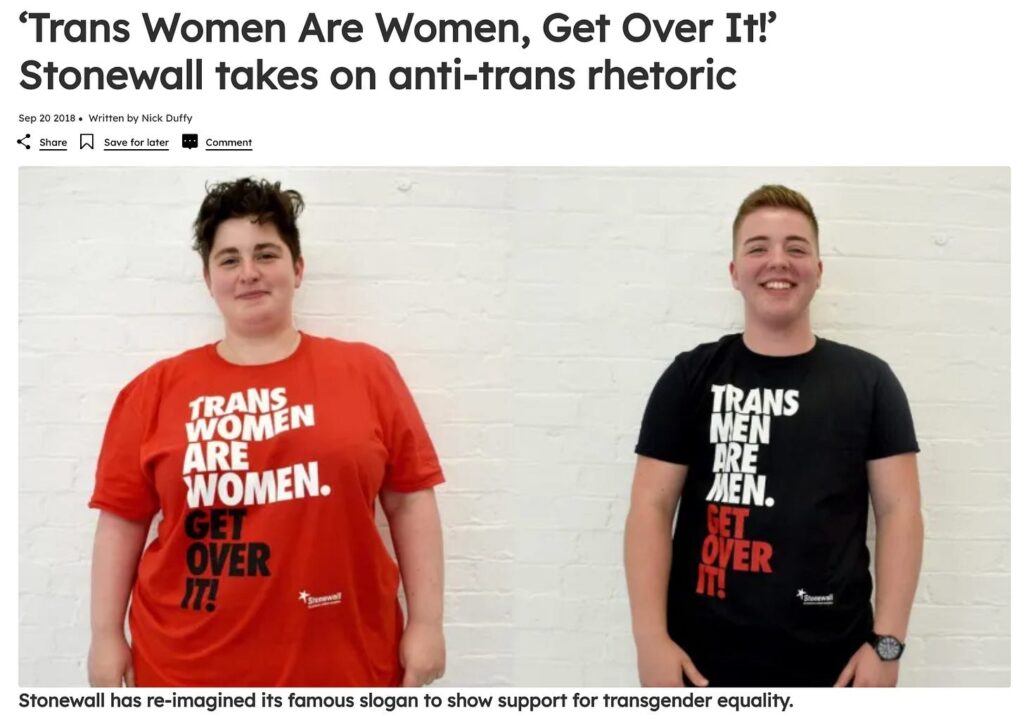
In the mid-2010s, that particular brand of fanaticism made its way into the gay rights NGOs who were conveniently looking for another funding source as the fight for marriage equality was drawing to a close. As a result, those organizations took on the role of Hoffer’s fanatics. Powerful, respected institutions such as Stonewall, GLAAD, and Egale suddenly imposed upon society the new orthodoxy of gender identity as a non-negotiable holy writ, branding any objections or doubt as heresy, and pushing the movement’s doctrine into media, schools, and online spaces with a force no scattered band of individuals could have matched.
From there the movement began drawing in vast numbers of lost souls.
Hoffer understood that “a mass movement…appeals to those who crave to be rid of an unwanted self…Their innermost craving is for a new life—a rebirth—a sense of purpose and worth by an identification with a holy cause.”
The earliest converts, therefore, derive from the same type of humanity: the disaffected—those desperate for change who place the locus of control outside themselves and “blame the world for their failure.”
Though the disaffected are found in all walks of life, they are most frequent in the following categories: (a) the poor, (b) misfits, (c) outcasts, (d) minorities, (e) adolescent youth, (f) the ambitious (whether facing insurmountable obstacles or unlimited opportunities), (g) those in the grip of some vice or obsession, (h) the impotent (in body or mind), (i) the inordinately selfish, (j) the bored, (k) the sinners.
Hoffer separates those drawn into mass movements into two categories: the full converts and the sympathizers. Full converts are completely reborn into a new life inside the collective body; sympathizers remain on the outside, deriving “elements of pride, confidence, and purpose by identifying themselves with the efforts, achievements and prospects of the movement.”
In the transgender movement, there are two categories of full converts: those enticed by the idea of casting off their old, shameful self, who identify as “transgender” and seek the medical rebirth that the movement frames as an unquestionable human right.
Closely bound to those who medically embody the doctrine are the fanatical allies—the true believers who are reborn not in the medical sense but into the collective body of the movement itself. These are the enforcers of the doctrine, who make it their business to police language, mercilessly punish dissent, and treat all opposition as heresy.
Surrounding both inner groups are the sympathizers: the well-meaning masses who add pronouns to their bios and show up to the marches draped in rainbow flags, gaining pride and moral purpose without fully surrendering the self or even understanding the movement’s true mission.
True Believers in White Coats
Mass movements come in many forms, such as religious, political, or nationalist—-but no mass movement in history has had a drastic medical treatment at its core. The closest historical parallel to the trans mass movement is the Skoptsy, an 18th century Russian religious sect which required its members to undergo surgical castration and mastectomies to eliminate their sexual capacity, but this self-mutilation occurred outside of established medical institutions and garnered no official institutional support.
The trans mass movement is unique in the sense that the Houston men of words—themselves possessing a fanatical streak given the nature of their mental disorder—succeeded in embedding their doctrine inside the world’s only professional association dedicated to the care of trans-identified people. Since the mid-2000s, depsychopathologization, or the framing of transgender identification as innate and healthy, has been the guiding principle of the World Professional Association for Transgender Health (WPATH).
The result is an army of true believers wearing white coats and armed with syringes and scalpels, who fail to recognise the mental disorder of their patients and instead collude with its key symptom, providing medical rebirths to all the lost souls who have been lured by the movement’s promise of a new self.
To make matters worse, the fanatical absolutism of the trans movement has shut down all dissent inside the medical world just as it has in wider society, meaning scientific debate and open scrutiny of one of the most radical medical treatments ever invented, one that is being offered to physically healthy adolescents and adults, is considered heretical.
Fact-Proof Screens
All active mass movements strive…to interpose a fact-proof screen between the faithful and the realities of the world.
True believers don’t reason themselves into their conclusions; they arrive there through blind acceptance of a holy writ. And maintaining this total allegiance requires erecting a “fact-proof screen” that blocks out “facts that do not deserve to be seen or heard.”
Hoffer described the fanatical communist able to ignore all unfavourable reports out of Russia, and even to travel inside the Soviet promised land and see the cruel misery first-hand without becoming disillusioned, and the fanatical Japanese in Brazil who for years refused to believe the evidence of Japan’s defeat, treating official news, the Emperor’s broadcast, and even direct communications, as Allied propaganda.
The true believers in our midst today have erected similarly powerful fact-proof screens. This allows trans-identified true believers to ignore the obvious harm of the medical treatments they seek and obtain; it enables the medical and mental health professionals inside the field of gender-affirming careto remain impervious to all unfavourable evidence, international pivots, and rising rates of regret and detransition, and it makes it possible for parents who have transitioned their young children to remain blind to the fact that they have needlessly sacrificed their children’s health in the name of an incoherent political ideology.
Temporary Misfits
Peruse the stories told by the parents of trans-identified adolescents, or the first-hand accounts of detransitioners, and it quickly becomes apparent that the weird, quirky misfits are the youth so often seduced by the promises of this mass movement. Over and over, the story is the same: the loners and the socially awkward, desperately craving companionship and belonging, find their tribe in the welcoming atmosphere of LGBTQ communities and mistake the exhilarating rush of belonging as a sign that their newly adopted transgender identity is indeed their true authentic self.
Yet Hoffer considers the adolescent youth drawn into mass movements only temporary misfits—a class of disaffected people “receptive to the preaching of a proselytizing movement” who “do not always make staunch converts” for they are not “irrevocably estranged from the self.” Still able to conjure up hope for the future, the “slightest evidence of progress and success reconciles them with the world and their selves.” Viewed through this lens, there is a terrible tragedy to the adolescent misfits drawn into the trans mass movement.
Because this movement isn’t just recruiting young people to march in the streets as allies; it’s offering legions of lost and confused youth an exalted absolute truth that explains all their pain and suffering—one that tragically comes packaged with an irreversible medical pathway sold as the miracle cure for all their troubles. Before they’ve even had the chance to emerge on the other side of puberty, fall in love, feel hope for the future and reconcile with themselves, the true believers in gender clinics have permanently carved their adolescent identities into their bodies, meaning they’ll bear the scars of their youthful indiscretion forever.
Hatred as a Unifying Force
Mass movements can rise and spread without belief in a God, but never without belief in a devil.
Hatred is the essential fuel of any mass movement. As Hitler reportedly said when asked whether the Jews must be destroyed: “No…We should have then to invent them. It is essential to have a tangible enemy, not merely an abstract one.” And World War II was barely over when the Soviets selected the democratic West as its chosen enemy to replace the Nazis.
A mass movement needs a concrete, visible, ever-present devil to generate the hatred that binds the true believers together, supplies the energy and passion, and spurs the urgent need for action. An abstract enemy—such as capitalism or transphobia—is a weak substitute for this purpose. The tangible devil is far superior.
For the transgender mass movement, that role is filled by the TERF.
Short for trans-exclusionary radical feminist, for over a decade the acronym has functioned as a dehumanising slur, a pejorative term intended to silence and intimidate any woman who dares object to the demands of modern trans activism or express even the slightest doubt or disbelief in the movement’s doctrine..
Most women labeled as TERFs are neither trans-exclusionary nor radical feminists; indeed, many wouldn’t even consider themselves feminists of any variety. In truth, TERFs are simply women from all walks of life who refuse to give up the safety and protection of single-sex spaces, who insist on using language that reflects reality, and who object to the experimental medicalization of healthy adolescents in the name of an incoherent ideology.

When we lose our individual independence in the corporateness of a mass movement, we find a new freedom—freedom to hate, bully, lie, torture, murder and betray without shame and remorse.
In the era of trans rights, the label TERF functions like a magic spell, transforming ordinary women into the devil (or perhaps witch is more apt) and justifying their merciless persecution. Calls to punch, stab, choke, shoot, rape, and kill TERFs started to appear online around 2014, the year Time magazine announced The Transgender Tipping Point. And it didn’t take long for these threats of violence to spill over into the real world. In 2017, 60-year-old Maria MacLachlan was violently assaulted by a young trans-identified man at a feminist event in London’s Hyde Park. In the aftermath, a trans activist group responded by stating that “punching terfs is the same as punching Nazis” and “violence against terfs is always self defence.”
Hatred is the most accessible and comprehensive of all unifying agents. It pulls and whirls the individual away from his own self…He becomes an anonymous particle quivering with a craving to fuse and coalesce with his like into one flaming mass.
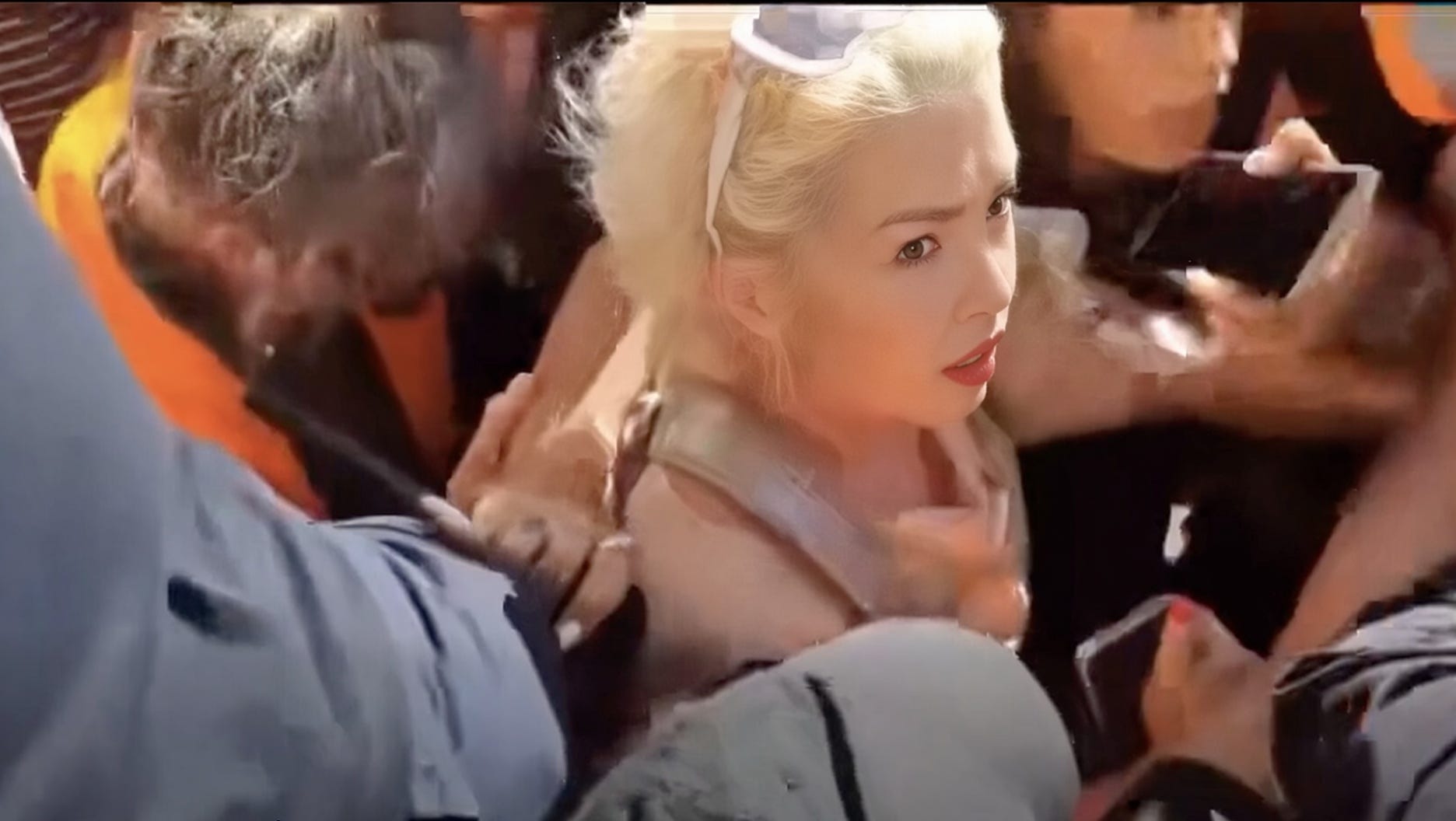
Kellie-Jay Keen found herself surrounded by the flaming mass of hatred Hoffer described when she attempted to hold a Let Women Speak event in an Auckland park in 2023. Meghan Murphy, Kathleen Stock, Jenni Murray, Chimamanda Ngozi Adichie, Rachel Rooney, Allison Bailey, and Maya Forstater are just a few of the other women who have found themselves branded as heretics during this era and facing the wrath of angry mobs—either in the real world or online—for the simple crime of deviating from trans activism’s holy writ. Most famous of all is the persecution of beloved children’s author JK Rowling, who, despite mildly worded tweets and a gorgeously compassionate essay, faced an unprecedented onslaught of abuse and violent threats.
To be sure, men who dare to disagree with the doctrine of the transgender movement have not been spared either. Prominent examples include Chris Elston, aka Billboard Chris, who was viciously attacked on a Montreal street in 2021 for holding a sign saying Children Cannot Consent to Puberty Blockers, and Graham Linehan, creator of Father Ted and one of the most talented comedy writers of the era, who had his career destroyed for the crime of defending women’s rights and objecting to the medicalisation of healthy adolescents.
Yet, hatred is only one unifying force. Nonsense is the other essential ingredient.
United by Nonsense
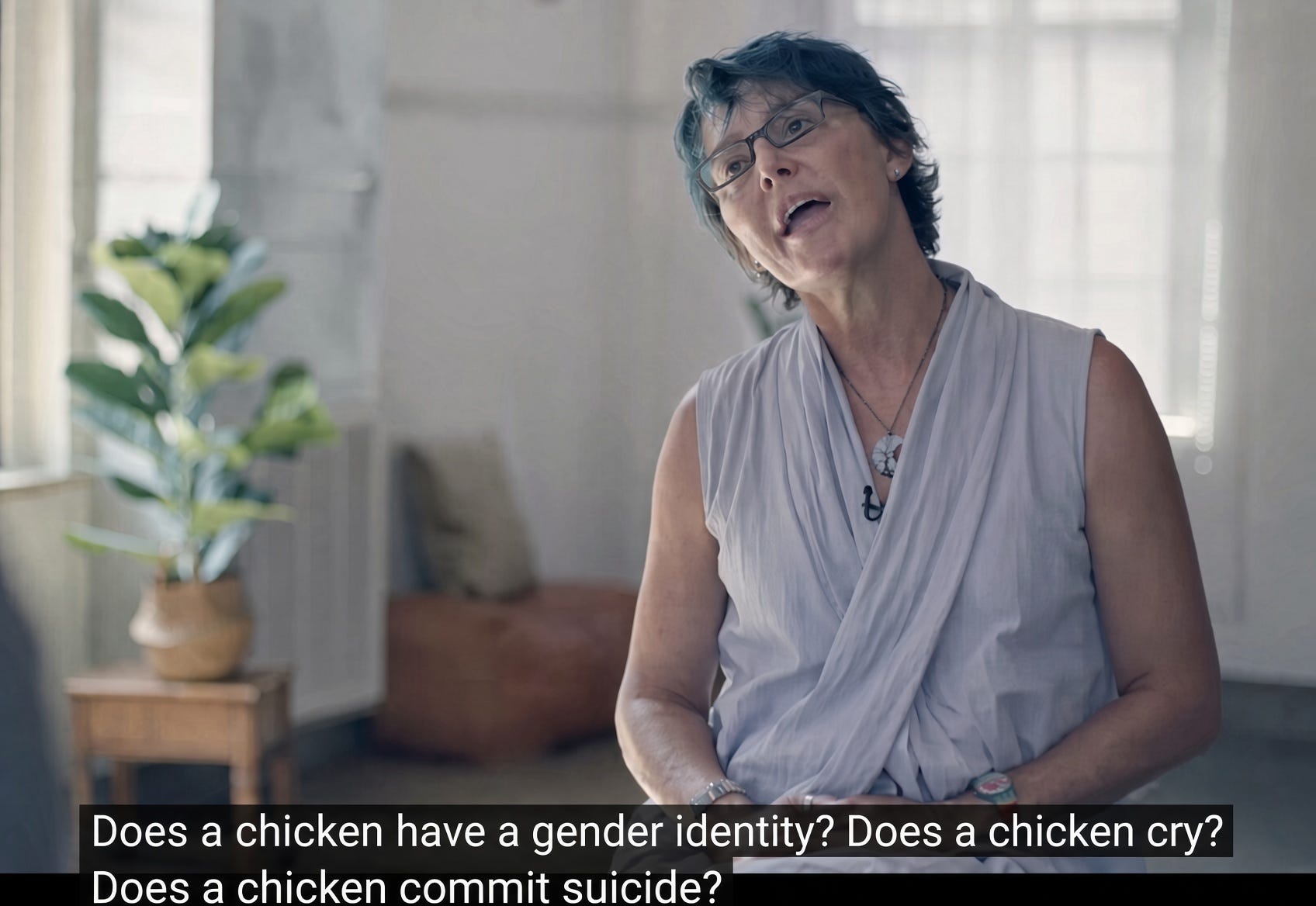
Trans has arguably been so successful as a mass movement precisely because it is built upon a nonsensical belief held by individuals in the grips of a mental disorder. Curtis Yarvin said it best:
“In many ways nonsense is a more effective organizing tool than the truth. Anyone can believe in the truth. To believe in nonsense is an unforgeable demonstration of loyalty. It serves as a political uniform. And if you have a uniform, you have an army.”
Mass movements derive their power from certitude and blind faith, not inquisitiveness and intellectual honesty. When a doctrine is clear and coherent, it opens itself up to doubt and individual judgment—and so loses its power to galvanise the masses. This explains the “illiterate air” Hoffer noted in “the most literate true believer,” who uses “words as if he were ignorant of their true meaning. Hence, too, his taste for quibbling, hair splitting, and scholastic tortuousness.”
The gender debate is replete with examples to support Hoffer’s observation. Take the UN’s attempt, in 2020, at a definition of the word woman that encompasses men:
“Trans women are women at the end of the day. Every woman is a woman. Women are multifaceted, intergenerational, international. They are limitless, formless … women are the world.”
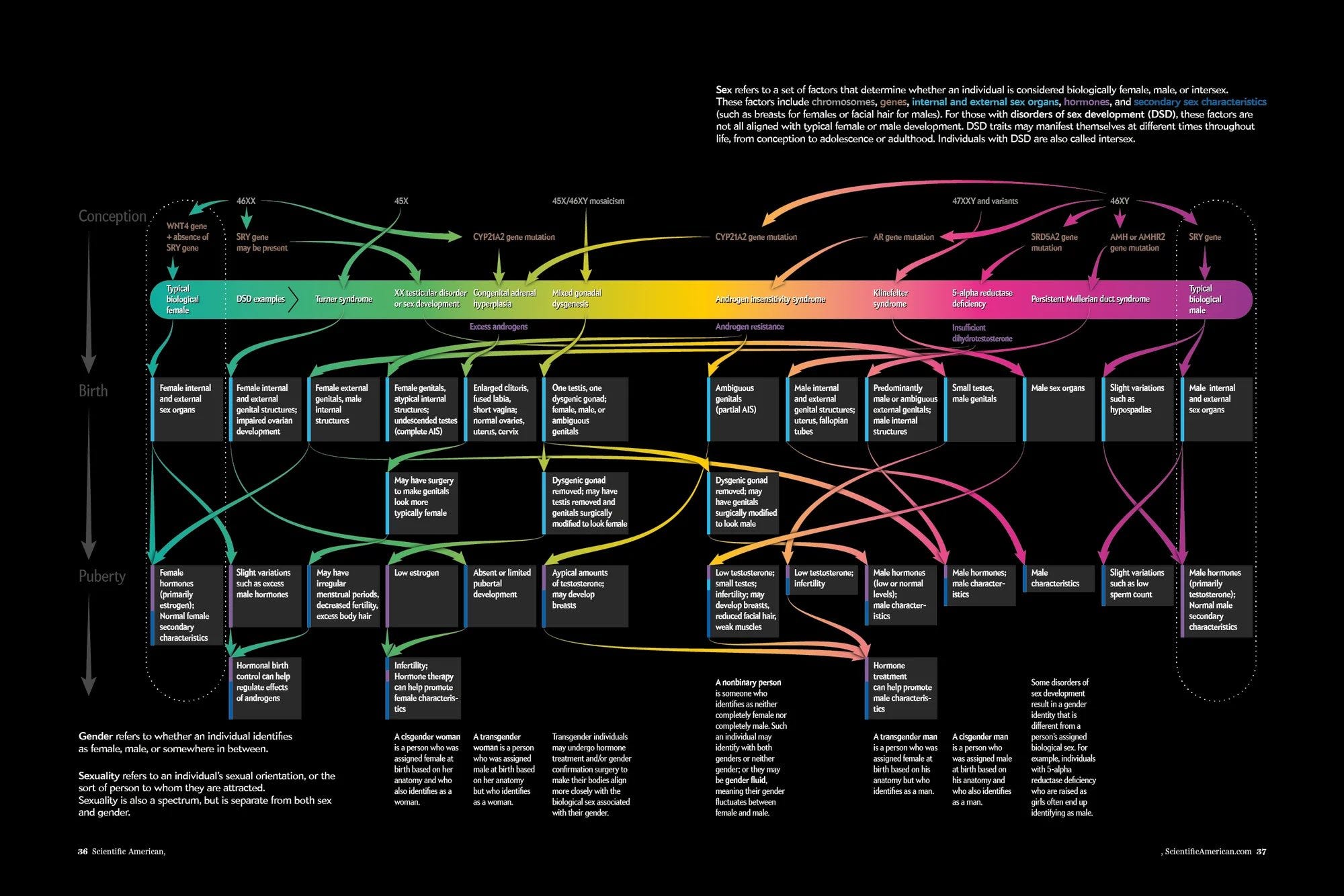
Then there are the complicated, wordy diagrams and books claiming to demonstrate that sex is a spectrum (while still only describing two sexes), or the experts declaring there are five sexes, that sex is “multidimensional” or a “mosaic.”
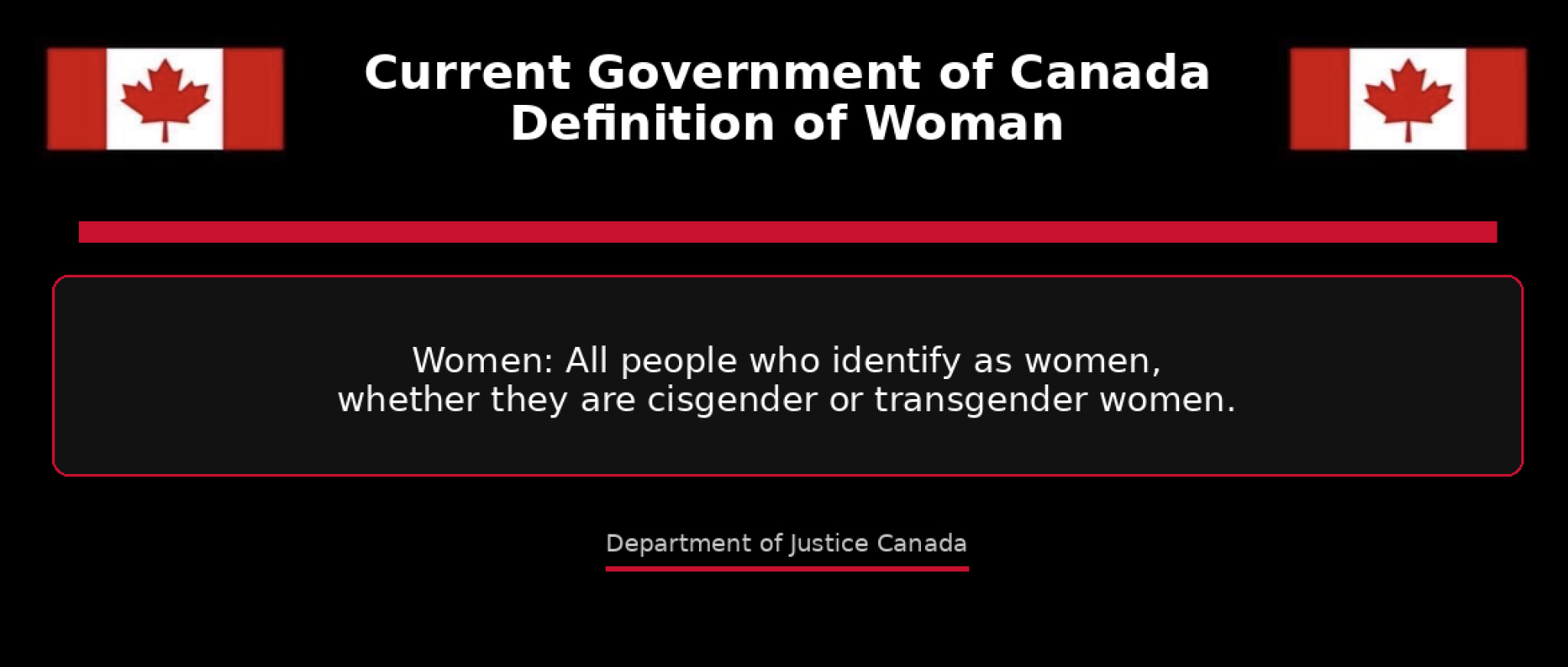
Add to these the scholastic tortuousness of the endlessly circular “a woman is anyone who identifies as a woman,” along with the strange penchant for citing the shared features of chairs and horses to prove that no definition of woman exists, and it really feels as if Hoffer had trans activists in mind when he described this illiterate, quibbling tendency.
But all this makes sense when we remember what started this. A small gang of dedicated individuals who failed to recognise their own mental disorder and instead set about building a new world upon their false belief about themselves. It was surely not their intention to send the whole world mad, but their nonsensical doctrine was the perfect catalyst for a mass movement that would do just that.
Purging the Fanatics
There comes a time in all mass movements when the raw energy dissipates and the passionate hatred dies down. This change heralds the appearance of the men of action, whose job it is to consolidate the gains and ensure the “vigor of the movement is embalmed and sealed in sanctified institutions.” The success of this phase depends upon the ability to purge the fanatics to save the movement from their recklessness and extremism. In 2026, the trans mass movement has arrived at this point, yet this stage diverges from those Hoffer described in one crucial way.
To be sure, trans activists still gather for protests outside any event that they deem heretical, the violent threats from fanatical activist groups remain as disturbing as ever, and there seems to be a frightening uptick in individual acts of extreme violence. But still, the movement as a whole appears to have lost the fervent zeal of the late 2010s and early 2020s.
Where trans diverges though is in the fact that the Houston doctrine was “embalmed and sealed in sanctified institutions” during the active fanatical uprising, in some cases even before the fanatics had assembled the troops. Gender identity began creeping in as a protected characteristic in law in the late 1990s and early 2000s, then was widely embedded in statutes and policies across the world while the true believers were on the march throughout the 2010s.
In this sense, the men of action were merely useful puppets—politicians latching onto a righteous cause to earn easy votes without having any understanding of what they were supporting. None seem to have considered the far-reaching implications of embedding in law a fictional concept that rewrote the most fundamental fact about human existence, obliterating women’s rights and child safeguarding in the process.
In the same way, depsychopathologization was embalmed and sealed into medical and mental health protocols at the behest of small committees of true believers on the inside of medical associations. These prestigious institutions failed to detect the fanaticism driving WPATH and the activists in their own midst, so instead mistakenly trusted that when the world’s leading transgender medical group said being transgender was a healthy natural variation of humanity requiring life-altering medical interventions, the organization was basing that declaration on scientific discovery and not, as happened to be the case, on the whims and desires of the mentally-disordered patient cohort it serves.
While the fanatical activists remain as rigid and intolerant of any compromise as ever, the trans movement as a whole appears to be softening and attempting to salvage what’s left of its gains. In Sweden, 14 trans-identified men recently launched a petition against gender identity laws; WPATH has admitted in court that its Standards of Care are merely opinions on one side of an unsettled scientific debate marked by uncertainty, and even Stonewall, the charity that undoubtedly fueled much of the fanaticism that characterised the last decade, recently attempted to edge its way into a more moderate position.
When asked if he thought the defensive “no debate” position in which Stonewall refused even to acknowledge any conflict between trans rights and women’s rights had been counter-productive, newly installed CEO Simon Blake told The Guardian: “What I recall that period to be was saying that there is a reality which is that trans people exist and that actually trans people should be around the table having the conversation, and that when trans people went around the table in some of those conversations it felt really difficult and therefore (they) didn’t feel able to participate.”
With that comment, Blake unwittingly hit on the very heart of the problem. At the table were true believers who found reality offensive and hateful—individuals only happy if everyone around them is forced to validate the false belief they hold about themselves. It’s therefore hardly surprising that the conversations were difficult and the outcome was a campaign built upon forced compliance that could tolerate no debate.
And because individuals with a rigid conviction that their trans identity is healthy and extreme body modification is an unquestionable human right sit at the core of the movement, there was no room for compromise at the beginning and there is very little room to manoeuvre today. Meaning, this phase of the movement can purge its most extreme fanatics, but it will still have immense difficulty softening its doctrine into one that aligns with reality.
Hopes Loose in the Streets
When hopes and dreams are loose in the streets, it is well for the timid to lock doors, shutter windows and lie low until the wrath has passed. For there is often a monstrous incongruity between the hopes, however noble and tender, and the action which follows them.
As the world emerges from the chaos and confusion wrought by the transgender mass movement, the monstrous incongruity between what well-meaning people thought they were supporting, and the reality of what has occurred, is becoming clear.
Every day, more people wake up to the fact that trans rights was never an ordinary civil rights cause. It was never about equal rights or an end to the discrimination of a long-marginalized group. It was a total rewrite of reality—a movement intent on bending the world around the false belief held by a tiny number of people who didn’t recognise themselves as mentally ill.
Running through the core of the madness, at every twist and turn, lies one simple falsehood: that trans is a healthy variation of human existence and access to extreme body modification is a human right. Failure to recognize the absurdity of that falsehood has resulted in immeasurable harm to so many.
In truth, what was sold as medically necessary, life-saving care has turned out to be an atrocious medical crime committed by true believers blind to the brutality of the procedures they performed. And what the unsuspecting masses thought was a progressive quest for equal rights has in fact resulted in the obliteration of women’s rights, the suppression of scientific scrutiny, the erosion of free expression, and the dismantling of child safeguarding.
Yet the most devastating harm is that inflicted on the very people the movement set out to help. By elevating their mental disorder to an unquestionable eternal truth instead of trying to understand and treat it, the trans mass movement steered vulnerable adolescents and adults into sterility, sexual dysfunction, disfiguring surgeries, and lifelong medical dependence.
Purging a few unruly fanatics will not be enough to find our way out of this predicament. The only option is to abandon the movement’s holy cause entirely and start again, ensuring that whatever comes next is grounded in a deep and nuanced understanding of the mental disorder at the heart of this disaster. The task now is to figure out how to help these people in a meaningful way without repeating the catastrophe that has just occurred under the banner of trans rights.
The block quotes are from Hoffer’s book, The True Believer.
Mia Hughes is Genspect’s Director of Policy and Research, Director of Genspect Canada, author of The WPATH Files, and co-host, with Dr. Stella O’Malley and Bret Alderman, of the Beyond Gender podcast.