




Sex-Affirming Care vs Gender-Affirming Care
By Stella O'Malley
A comparison of the principles and purpose behind two competing models of therapeutic care
Gender-Affirming Care arrived like a bat out of hell as a novel approach for people who identified as transgender. It had no robust, reliable, or replicable evidence base to support it. It had no coherent or well-established therapeutic model underpinning it. There was no new scientific discovery that supported its arrival. There were no giants of psychology who put forward this remarkably unusual and antithetical approach to the therapeutic process. Instead, Gender-Affirming Care arose as a consequence of a political campaign from the World Professional Association for Transgender Health (WPATH) in a bid to build an understanding of trans identity as healthy, normal, and something to be celebrated in public life.
As a rule of thumb, sex refers to the biological reality we are born with, male or female, and it is not something that can be changed. Gender, by contrast, refers to the way we express ourselves, which may be more masculine or more feminine and this can change over a lifetime.
Prior to this, the word ‘affirmation’ emerged as a response to discrimination, particularly in the mid-20th century United States. To affirm someone was to recognise their equal dignity and legal standing in the face of exclusion, laws and customs that denied it. Movements for racial equality, women’s rights, and later gay rights used the language of affirmation to insist that marginalised groups should not merely be tolerated but fully recognised as citizens with the same legal and social standing as others. It was a public, political act aimed at securing rights. Only in the late twentieth and early twenty-first century did it shift into therapy jargon, where it came to mean endorsing personal identity claims. As with many new fashionable words such as “lived experience” or “authentic self”, it was happily accepted as a quick way to demonstrate that you were a therapist who was happy to keep up with contemporary times.
Today, as the number of detransitioners continues to increase, there is a growing discomfort among clinicians who sense that something has gone wrong in contemporary therapeutic culture. ‘Gender-Affirming Care’ in particular is increasingly viewed as a fringe approach, one that sits in direct opposition of the core principles of conventional therapy.
Gender-Affirming Care is dressed in the language of compassion. Yet behind the reassuring vocabulary sits the automatic medicalisation of a person’s sense of identity. We have never before sought to medicalise identity in this way, nor have we tried to use medical technology to create a physical representation of an internal sense of self. Therapy has moved from helping people understand themselves to helping them reshape their bodies and faces so that their appearance reflects an inner psychological reality. This is a very different task, with no real precedent.
Gender-Affirming Care asks the therapist to take a client’s stated identity at face value, to support it and facilitate the client to obtain medical procedures that attempt to somehow translate that inner sense of self onto the body and face. For example, a female-born client may feel deeply uncomfortable with her body and so disconnected from herself that she comes to identify as non-binary. On the surface, the Gender-Affirming Care approach seems humane. The client is distressed and presents with a clear explanation for her suffering, and the therapist agrees. The distress is given a narrative and the narrative is protected. The client goes on to take testosterone and procure a mastectomy. But therapy is not meant to be a place where narratives are protected; it is meant to be a place where they are examined. Nor is therapy supposed to focus on the body – the psyche is more important in psychological work.
If the same client attended a therapist who takes a Sex-Affirming Care approach, the client would have a very different experience, as this approach begins from a different premise. Sex-Affirming Care recognises that the human body is not incidental. It might be an inconvenience to be worked around, but it must be contended with, as our bodies are the foundation of our existence. We are born in our bodies and we die when our bodies die.
Therapists who take a Sex-Affirming Care approach remain grounded in biological reality. They do not deny the existence of the individual’s internal sense of gender, but nor do they deny the limitations of medical procedures. We can rage against the limitations of our bodies, but we cannot deny they exist. We can seek a wide range of medical interventions, but we cannot discount their impact, including infertility, impaired sexual functioning, chronic pain, cardiac problems, osteoporosis, and many other challenges. These consequences matter because therapy, at its best, is a discipline that gently but persistently brings people back into contact with what is real.
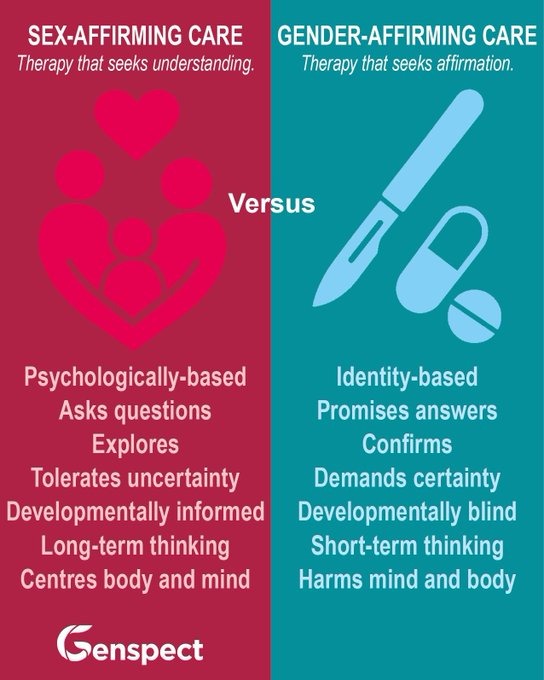
The problem with Gender-Affirming Care is that it prioritises the body and the physical representation of the self over the individual’s internal mind. Identity-based treatment does not query where or how the client has come to this understanding of the self, but rather presumes that our sense of identity is an immutable, subjective sense of self that can only be known to the individual. In the meantime, Sex-Affirming Care is psychologically-based approach that rests upon conventional psychology, where it is understood that our inner workings can lead us into all sorts of difficulties. It rests on the shoulders of giants, from Freud to Jung, Beck to Rogers. Psychologically-based treatment is not infallible, however there is a vast range of theory and a significant evidence base to support it.
The Gender-Affirming therapist moves from affirming the client’s identity to confirming it. It removes agency and collapses the important distinction between empathy and agreement. A therapist should have the skill to communicate that they deeply understand a client’s distress without endorsing the explanation the client has constructed for it. In fact, that is often where the real therapeutic work lies.
Many clients arrive in therapy with powerful convictions about themselves. They might be convinced that they should leave their job or their partner, or that they need to radically change their lives by moving house or relocating to another country. These convictions can feel absolute. They can organise a person’s entire sense of identity – the person may believe they will only be truly happy when a particular outcome is achieved. Yet therapists know that human beings are not always reliable narrators of their own lives, and we seldom experience a prolonged sense of satisfaction once these most desired outcomes are reached.
Most of us use a range of psychological techniques such as avoidance, cognitive distortions, and defence mechanisms to help us come to terms with the difficulties of living. These strategies often help us avoid swallowing some bitter pills about our existence. T. S. Eliot captured this truth when he observed, “Human kind cannot bear very much reality,” in Four Quartets. This is why, if the therapist simply mirrors back what the client presents, they are not carrying out therapy. They are doing a disservice to the client and risk becoming a charlatan who pretends that everything the client says is right. They become a validation service.
Sex-Affirming Care provides the mental space for a client to come to a deeper understanding of the self. Slowly but surely it helps us bear some reality. It asks what lies beneath the person’s sense of identity. If a client who was born and raised in Ireland, with Irish parents, came to identify as Jamaican and became determined to procure medical interventions that confirmed this sense of identity, my job as a psychotherapist would be to use my skill to encourage the client to consider their developmental history, their family dynamics, any trauma they experienced, their temperament, and potential social influences that led them to this conclusion. I would treat the person’s sense of identity as complex rather than as a simple embodiment that needs medication to be resolved.
There is a humility in the psychological approach. It accepts that little in life is simple or truly knowable, and that identity is not something to be fixed in place under pressure. There is also depth and seriousness to Sex-Affirming Care. The body is not infinitely malleable and medical interventions carry significant consequences. An identity-based therapeutic model is more superficial; it operates under the presumption that our identities emerge fully formed from some unknown sense of self, disregarding the individual’s psychological defence mechanisms. Gender-Affirming Care presumes that affirmation is the correct response and thereby inadvertently forecloses opportunities for deeper exploration. It narrows the field of possibility at precisely the moment when it should be widened.
Advocates of Gender-Affirming Care often present it as the only compassionate response to trans-identification. That claim does not withstand scrutiny. Compassion is not measured by how quickly a therapist agrees. It is measured by the depth of attention given to the whole person. This involves challenge, contemplation, deeper understanding, and often tolerating uncertainty.
We are living in a moment where declarations of identity are treated as weirdly sacred. Therapy has been drawn into this conceptualisation. Yet the task of therapy is not to concretise a client’s current self-understanding; it is to expand it. Sex-Affirming Care keeps that task intact. It insists that reality matters, that the body matters, and that truth is not the enemy of compassion.