




The Autotheophiles and the (Gendered) Protestant Soul
By Daniel Howard James

Gender as religion, part nine
If you’re new to this series, please visit Genspect on Substack to read my previous articles on Gnostics, Jungian alchemists, castration cults, rock’n’roll gender outlaws, the deification of the transgender child, esoteric male power networks, polygender societies and colonialism and sacred gender identities.

Frederick Augustus Porter Barnard, the nineteenth-century slave owner and tenth President of New York’s elite Columbia University, argued unsuccessfully for the institution to become ‘co-educational’; that is, to admit females. In 1889, the year of Barnard’s death, a private college for wealthy women was set up in his name, with the privilege of being self-governing, but benefitting from the degree-awarding powers of the paternal institution.
It was Barnard College that employed Elaine Pagels, whom we met earlier in this series; the professor of theology who helped revive the ‘divine feminine‘ strand of Gnosticism in the late 1970’s. The very same college was the setting for the 1982 Barnard Conference on Sexuality, which brought a graduate student by the name of Judith Butler to national attention.
A paper presented to this particular conference at Barnard by sadomasochist and original ‘queer theorist’ Gayle Rubin argued for the decriminalisation of fringe sexualities, while the grass-roots feminist organisation ‘Women Against Pornography’ protested outside the conference venue. Conflict between notionally feminist academics and the women’s rights movement was already underway by the time Boy George made his debut on MTV.
Three years later, a fantasy book was published by Canadian literary scion Jack McClelland, about women kept as sex slaves in a near-future Protestant fundamentalist America, controlled and forced to participate in sadistic domination ‘ceremonies’ with other women: The Handmaid’s Tale, by Margaret Atwood. (Jack’s publishing company McClelland & Stewart was originally founded in 1906 by employees of the Methodist Church). The first Handmaid’s Tale movie followed in 1990, produced by Daniel Wilson, with a script by British playwright Harold Pinter. In 2017 the film adaptation was rebooted as a TV series by Wilson, again heralded by men as a ‘feminist masterpiece’.

Interviewed in 2025, Atwood said that her inspiration for the handmaids’ outfits was a can of ‘Old Dutch’ cleaning powder, depicting a woman with her face hidden under the cap worn by female Protestant settlers of the Americas. A radical dissenting group of men and women known as ‘the Separatists’ had fled England for Holland in 1608. Some of them would set out for Plymouth Rock in 1620, with the leading men of the company patriarchically rebranded as the ‘Pilgrim Fathers’. Others among these exiled religious extremists would return from Dutch territory to England twenty years later, in time to join the regicidal, iconoclastic Puritan revolution led by Oliver Cromwell.

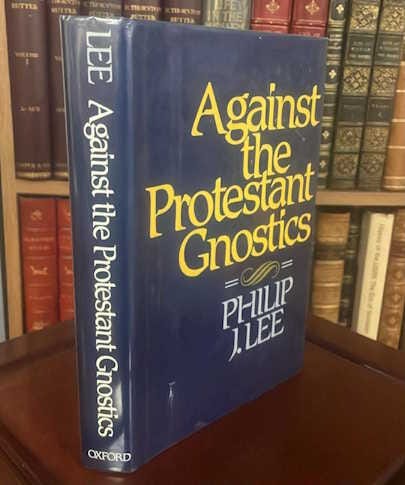
Also during the 1980’s in Canada, Presbyterian church minister Philip J. Lee noticed a Gnostic incursion into mainstream Protestant churches, and was having none of it. Rather than simply complain from the pulpit, Lee took a sabbatical to make a detailed case in writing. The result of his effort was the book ‘Against the Protestant Gnostics’, published by Oxford University Press in 1987, as recommended to me by a reader of this series.
Lee quoted Heracleon, the second century AD follower of Valentinus, as cited in Pagels’ book ‘The Gnostic Gospels’: “they mistake the images of spiritual reality for the reality itself… they worship in flesh and error”.
In response, Lee noted that Gnostics believe “that the root problem of humankind is ignorance. Judaism and Christianity in their orthodox expressions would understand the basic source of all our misery to be sin, humanity’s failure to meet God’s expectations or its own potential; gnosticism would see the human predicament as resulting from a profound blindness concerning the human situation… mea culpa having been replaced by mea ignorantia, the function of the Gospel becomes solely that of enlightening the soul concerning what previously has been hidden.”
20th century Marxist György Lukács provided a secular framing for this alleged fundamental ignorance as ‘false consciousness’, a conception later taken up by Herbert Marcuse in the creation of the New Left counterculture. Feminism also employed a similar concept at that time, leading to its activism being called ‘consciousness raising’.
Philip J. Lee noted that when “knowledge of God is thought to be pure knowledge (as in gnosticism) unencumbered by time, place, event, person or any other tangible ensnarement — that is, when knowledge has no object — then such knowledge of God requires a total escape from the world.” In this vein, Lee went on to quote the capitalisation-phobic e. e. cummings’ 1944 poem “pity this busy monster, manunkind, not”:
We doctors know
a hopeless case if — listen: there’s a hell
of a good universe next door; let’s go
As Lee explains the modern appeal of this ancient heresy, “all the promises that faith offers to the Christian are fulfilled for the gnostic here and now, though in a necessarily truncated form. For the escape the gnostic accomplishes is, in simple terms, an escape into the self… a disengagement from the world and a concentration on the self and the self’s concerns.”
Even terminology familiar to us from the transgender forums of Reddit, of eggs and cracking, was written about by Lee before the terminally online generation was born. Quoting the mystic from Zurich, Lee wrote: “Modern life, Jung maintained, owed to the ancient gnostics and the medieval alchemists what he called ‘the process of individuation’… In Jung’s gnostic image, the self is like ‘a young bird who picks its way out of an egg.’ The eggshell that the gnostics pick their way out of can be nothing else but the cosmos itself, for the cosmos is what imprisons us — it is the wall that encloses us and denies us a vision of our true being.”
If transcending the physical limits of the universe via the power of your own perfect mind sounds a tad grandiose, let’s refer back to the Gnostic text known as The Gospel of Thomas, and its promise to followers: “The heavens and the earth will be rolled up in your presence… whoever finds himself is superior to the world.” In his chapter on Gnostic elitism, Lee explains: “When the self effectively becomes the center of God’s activity in the world, then the self must be seen as holy, set apart from all common, unworthy selves.”
Or, as the second-century AD Egyptian Gnostic cult leader Basilides put it, “We are men; all the others are pigs and dogs.” We know this saying because the fourth-century AD bishop Epiphanius of Salamis wrote a compendium of heretical nonsense, the Panarion (meaning ‘bread basket’), despite, or because of, his experience being flirty-fished by female Valentinian seducers. In Hilary Clinton’s phrase, this was the original basket of deplorables. His book is an entertaining read, because like a rap battler penning his next ‘dis’ track, Epiphanius doesn’t hold back, describing this long-dead enemy like a Wilhelm Reich of the ancient desert:
“Such are the recitals of the tramp’s mythology… Basilides gives his disciples permission to perform the whole of every kind of badness and licentiousness, and gives his converts full instruction in the promiscuous intercourse of an evil kind between men and women… For many fall into the heresy for this reason of self-indulgence, since through these unnatural acts they find a way of doing their pleasure with impunity.”
Psychoanalyst Karen Horney, a contemporary of Carl Gustav Jung and Sigmund Freud who famously rejected the latter’s theory of penis envy, was cited by Philip J. Lee to illustrate the futility of the Gnostic’s narcissism. “The neurotic, in order to gratify the self as self-alone, must agree to live a kind of half-life — a life realized in terms of the self rather than in terms of others — and to forsake all hope of wholeness and healing.”
If you have ever tried to debate the facts and statistics of gender on social media, Lee warns that it may be a waste of your time: “…many cults have sprung up that claim special gnosis within their own membership. But along with this increasing anti-intellectualism on the fringes of the faith, there is within Protestantism itself a similar anti-intellectualism and at certain points a convergence of evangelicalism and liberalism in espousing a special religious knowing as opposed to a knowledge of discernable data.”
Yet anti-intellectual cultists can be employed in apparently intellectual pursuits. Philip J. Lee cited Max Weber’s observation in his 1922 book ‘The Sociology of Religion’ that “Quests for salvation which arise among classes of high social privilege are generally characterized by a disposition toward an ‘illumination’ mysticism… This brings about a strong devaluation of the natural, sensual, and physical, as constituting, according to their psychological experience, a temptation to deviate from their distinctive way of salvation.
The exaggeration and impressive refinement of sexuality, along with the simultaneous suppression of normal sexuality in favor of substitute abreactions, were determined by the life patterns of those who might be termed nothing if not intellectuals; and these exaggerations and suppressions of sexuality occasionally played a role for which modern psychopathology has not yet formulated uniformly applicable rules. These phenomena are strongly reminiscent of certain phenomena, especially in the Gnostic mysteries, which clearly appear to have been sublimated masturbatory surrogates for the orgies of the peasantry.”
Queer theorists might find Weber’s description of elite social movements like theirs hurtful, painful, and therefore enjoyable. Lee also noted that back in 1976, Tom Wolfe’s essay ‘The ‘Me’ Decade’ had highlighted the incursions of the Church into contemporary social causes as a youth recruiting tool: “Both the priests and the preachers carried placards in civil rights marches, gay rights marches, women’s rights marches, prisoners’ rights marches, bondage lovers’ rights marches, or any other marches, so long as they might appear hip to the urban young people.”

In February 2026, The Famous Artist Birdy Rose reported that her local Anglican church in Essex, England, was hosting a ‘Trans Health Event’, including a gender accessory and breast-binder swap meet. While misogynistic traditions confining and shaping the female body such as foot-binding are considered barbaric in the West, ribcage-binding in the pursuit of transmasculine identity is apparently welcome in the Church of England. After less than favourable publicity alleging the indoctrination of children, this event was hastily clarified as being for people over 18 years old.
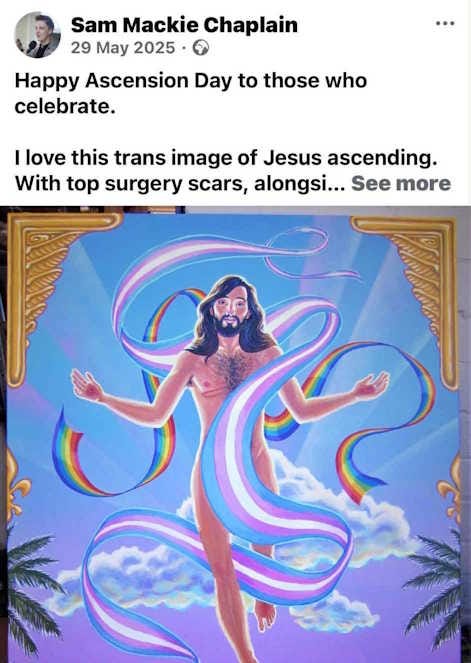
It transpired that this church’s transgender priest, the Reverend Sam Mackie, had quoted from 2003 book ‘The Queer God’ by Marcella Althaus-Reid:
“our joy is to find or simply recognise God sitting amongst us, at any time, in any gay bar…” This may be a surprise to those bar patrons who have yet to meet the Almighty while cruising. At a Rainbow Service, the Reverend Mackie cast the Son of God as the supreme queer alchemist: “Jesus was breaking down the boundaries between us. This is the transformation we are called into: water into wine. Otherness into oneness…”
In 2025, the Reverend Mackie co-founded the ‘TransFigured Mission’ with the Reverend Grey Collier, a former legal director at the UK’s Equality and Human Rights Commission and an ‘advocacy director’ at the lobby group Liberty, previously sponsors of the failed ‘Liberty Five’ legal action by sadomasochists.
The Reverend Mackie had also organised a ‘UK Christians for Trans Rights’ open letter to Members of Parliament. Both Mackie and Collier are described as active leaders in the ‘Open Table Network’ of LGBTQIA+ affirming churches.
The creation of the TransFigured Mission was in reaction to the supposedly controversial UK Supreme Court ruling that sex means biological sex in equality law. As noted earlier in this series, Britain’s Equality and Human Rights Commission came under direct attack in November 2025 after acknowledging this Supreme Court decision, with hammers being used by ‘queer’ activists to smash its windows, despite the legal impossibility of the Commission taking any other position.
The ‘Trans Health Event’ in an Essex church drew attention to the Reverend Mackie’s social media activity, which included praise for transmasculine Jesus crucifixion artwork featuring elective mastectomy scars and a testosterone beard; surgically-modified genitals hidden by Pride-coloured ribbons in place of a loincloth. For 19th century French sociologist Émile Durkheim, symbols such as our era’s ‘Progress Pride’ flags are a means of uniting people within a ‘collective conscience’ that has its own ‘social facts’ setting the boundaries, or otherwise, of acceptable behaviour.
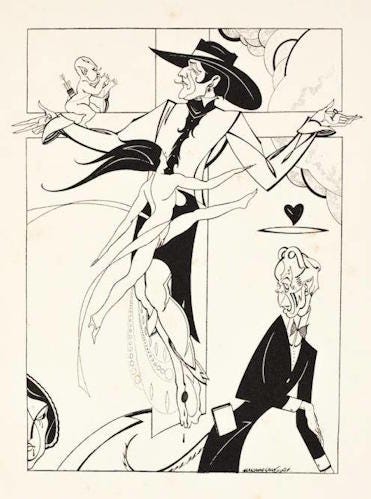
The Reverend Mackie’s ‘Call me He/Him’ Jesus image was reminiscent of the parodic depiction of Radclyffe Hall as Christ on the cross in ‘The Sink of Solitude’. Since no-one I noticed has yet claimed that Jesus was ‘assigned’ female at birth, it would appear that some heretical transgender Christians in the West are suffering from autotheophilia: being aroused by identifying as queer gods. In Iceland, a bearded Jesus of indeterminate birth sex is featured on artwork inviting children to Sunday school.
After encountering these autotheophiles and the people that worship them, it is clear we are experiencing what theologians call a ‘new religious movement’, or less charitably, a cult. Just as the invention of the European printing press by Gutenberg in the late 15th century was the catalyst for the explosion of Protestantism, I believe ‘trans’ is the first religion of the Internet, built from sacred gender identities and profane language at global scale.

As we have read about in previous instalments of this series, there is a long history of the worship of sexed, cross-dressing gods. Something has compelled men in particular to form gender cults, and women in particular to follow them, but the results do not always satisfy expectations. As e.e. cummings put it:
A world of made
is not a world of born — pity poor flesh
Genspect publishes a variety of authors with different perspectives. Any opinions expressed in this article are the author’s and do not necessarily reflect Genspect’s official position. For more on Genspect, visit our FAQs.