



Sore Loser
By Forrest Smith
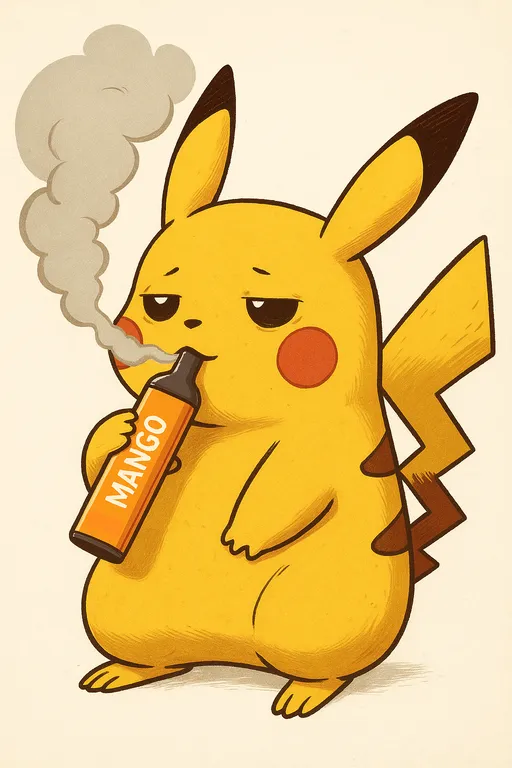
Imagine “Big Gender” as “Big Tobacco”. The following story is an allegorical response to a recent essay published in the New York Times, “The Truth About Detransitioning” by Kinnon McKinnon.
I.
Today was a big day at work for Tyler. He was already awake and lying in bed when his alarm clock went off at eight in the morning. He got up, made his bed, ate breakfast, brushed his teeth in the shower, dried off, and dressed in a T-shirt and sports coat. He combed his hair and smiled in the mirror. As he drove to the office, he vaped. One big puff of a Mango Pod was enough to get him buzzed with a blast of juicy flavor to distract him from his nagging thoughts.
Sure, he thought to himself as he waited in traffic, some people might call it an “addiction.” But what’s the difference between a Mango Pod and a cup of coffee? Besides, he tucked the pod away in his breast pocket, everything in moderation. Amirite?
His mind wandered back to his first vape, in the basement of a frat house, fifteen years ago, and his thoughts returned, rolling gently along the nostalgic track.
Funny thing about grad school, he mused, you’re supposed to be sharpening your critical thinking, but there I was, running multiple regression analyses by day and chain-vaping by night, like I’d cracked the code to surviving academia.
By the time he landed his first corporate gig, Tyler’s habit had a résumé of its own: daily use since his mid-twenties, a discerning palate for flavor profiles, and an insider’s understanding of “consumer behavior.”
Or, in his own words: “I know people who vape, and I know why they can’t stop!”
Now, as Senior Market Research Analyst for the nation’s largest tobacco company, Tyler puts that experience to good use. The senior executives love Tyler because Tyler is a Millennial. When they look at him, they see the future of tobacco. And that’s exactly what Tyler sees when he looks in the mirror every morning.
Tyler got to work, pulled into the parking spot reserved for his title, and grabbed his briefcase. It was 8:45. He rode the elevator to the tenth floor and went straight to the conference room to set up his presentation. An hour later, people trickled in. For months, he had been hyping his project, and before long, the conference room was packed with senior executives and their secretaries.
The air was full of chatter, laughter, and excitement, and the senior executives were eager to hear what Tyler had to say. At last, Tyler stepped to the front of the room and cleared his throat. The secretary nearest the door turned off the light, and the projector turned on to the first slide of Tyler’s presentation.
“We’re not just selling products — we’re selling a lifestyle.” His voice was smooth, confident. “And frankly, the Ghost of Marlboro Man has haunted this company long enough.”
The first slides flashed by: sun-creased cowboys, polished vintage ads, then the grim block-letter Surgeon General warnings that followed.
“So here’s the question. How do we make lifelong brand advocates in a marketplace where every headline paints us as the villain? How do we not only win people back but restore their trust? And not just their trust, but their loyalty?”
He paused on the next slide—four side-by-side charts, a scatter of colored dots, and intersecting lines. Chairs creaked in the breathless silence as the room leaned in.
“Call me old-fashioned,” Tyler grinned. “But how about we listen?”
Onto the next slide.
“We began by casting a broad net: smokers, vapers, chewers, any form of nicotine you can think of! All-inclusive. We advertised the survey on Meta, X, TikTok—any and every social media platform you can think of, in addition to traditional canvassing.”
The slides flashed with astounding numbers.
“Remember,” Tyler boasted, “this is the largest study on nicotine cessation ever conducted! And here’s how we did it.”
He clicked to the next slide—a crisp list of bullet points.
“We segmented quitters into four categories: those motivated by health concerns, social or workplace pressure, changes in product availability, and cost. To ensure we captured the nuances, we repeated these questions multiple times—shuffling the order—to distinguish external pressures from dissatisfaction with our brands.”
Tyler chuckled spontaneously at a thought he’d just had.
Why else would someone quit? When they could’ve switched to Mango Pods!
The room erupted with laughter, and Tyler smiled before moving on to the next slide. He talked through the results of his study, persuading the room to believe as he did—that nicotine is not nearly as dangerous as the media makes it out to be; that the number of true “quitters” are few and far between; and that the majority are merely struggling with societal stigma and the hike in cost, created by government restrictions.
Tyler reached the end of his presentation. The lights flicked on, but before he could speak, a sudden wave of exhaustion crashed over him. His head grew heavy, his stomach twisted, and almost without thinking, he pulled the pod from his breast pocket and took a long drag of Mango Dream. For a moment, the room tilted; the rush of nicotine barely touched the yawning void inside. My upcoming birthday—it will be his 43rd—his wife, his son, the crushing loneliness of every night; it all presses in relentlessly, he thought.
Don’t think like that, he told himself, steadying his breath, forcing his gaze back to the expectant room.
“Ladies and gentlemen,” he said, with a weak smile. “The takeaway here is clear: nicotine users don’t want to quit—they want products and experiences that fit their lives. Our role? To meet them where they are, not push them away.”
A small round of applause broke the tension. Secretaries scribbled on notepads without looking up. Someone raised their hand.
Tyler nodded in her direction. “It’s McKenzie, isn’t it?”
“Yes, thank you, Tyler. Were you surprised by your findings? What was the most unexpected result?”
Tyler brightened. This was exactly the kind of question he’d been waiting for. The weakness that had flickered through him moments ago vanished, buried under the clean, sharp metrics of his work.
II.
Tyler came home from work, shut the door behind him, and caught sight of his wife, holding her phone up to her face.
“You can see how this UltaCloud couch cradles you like a cloud—perfect for a night of binge-watching your favorite show, you know, just trying to forget about the world for a while…”
She glanced at Tyler with a fierce look, signaling for him to get out of her way. He scowled, skirted around the edge of the room, and up the stairs.
Does she ever get tired of being so fake? he thought bitterly.
He found his son upstairs, watching TV. His small head and soft brown hair barely reached the top of the sofa.
“Hey, hey!” laughed Tyler. “What’s this?”
“Hi, Dad.” His son hardly looked up from the TV.
“Aren’t you a little young for the Tonight Show?” Tyler asked incredulously.
“I like him,” said the boy. “He’s funny.”
Tyler turned his attention to the show. The guest was a young celebrity who had taken a turn for the worse and disappeared from the public eye many years ago. How could I ever forget? Tyler thought, with a note of alarm. His ads were great! He leaned in. Both he and his son watched in silence.
The host chuckled congenially. “You’ve got some wild tattoos, man. What am I looking at? A Pokémon?”
The young man looked up, eyes watering. “Yeah,” he laughed sadly. “A lot of bad nights. Vegas, blackouts… Pikachu… You know, stuff that sticks with you—literally. Actually, I’m having them removed.”
The host laughed politely, nodding along. “Sounds rough,” he said. “I heard you quit smoking not too long ago. What pushed you to that?”
The young man fell quiet, a far-off look came into his eyes, and he spoke softly. “My dad smoked every night on the porch. He called it his ‘post-prandial’ cigarette. He left when I was eight years old. I guess… smoking was my way of filling that hole. But no matter how much I smoked, it never really went away.”
The host interjected abruptly. “Man, I remember your commercials! What happened to Mango Dream?”
Tyler stared without blinking, his eyes watching carefully, studying the young actor as he spoke.
He scoffed. “Yeah, Mango Dream… It was everywhere, and I was the face of it. But that’s all it was—a dream—and there’s no getting back lost time.”
Tyler scoffed derisively. “What a thing to say!” he said to no one in particular.
But his son said nothing, watching the show intently.
For a moment, even the host was stunned into silence, blinking in surprise at his mild-mannered guest, who smiled pleasantly back at him.
At last, he cried. “Man, what are you on now? I’d like to try some of that stuff!”
The young man threw his head back and laughed as though he had fully recovered from his moment of weakness.
“Once you get a taste of freedom,” he said sincerely. “You can never go back.”
The host leaned in, raised an eyebrow playfully. “Think you could sell that in a commercial?”
Tyler was breathless, hanging on every word of the young man as he paused, his eyes downcast, and thought about the question.
What does he know? What can he possibly know that I don’t? Tyler wondered.
The young man laughed awkwardly. “No way,” he said at last. “That kind of freedom? It’s not for sale.”
The camera pulled back as applause filled the studio. Tyler held the remote in his hand. There was nothing in the world more vexing to him than someone who refused to be put in his boxes. He turned the TV off reflexively.
“That’s nuts!” he muttered viciously.
The child shouted angrily. “Hey! I was watching that!”
Tyler scooped him up and carried him to his room, ignoring the boy as he kicked and screamed.
“Enough’s enough,” he told him sternly. “You need to brush your teeth and get ready for bed.”
III.
Tyler joined his wife in bed at the end of the night. He lay awake beside her as she scrolled on her phone, and the bright screen flashed across the pillow. Tyler did not care what she was doing. He was too busy thinking about the young actor.
I know his type, thought Tyler, pulling out his vape from the bedside table. He’s just a sore loser.
He took a hit, felt his head spin, rolled over, and grabbed his wife. She put her phone down and snuggled up against him.
If he can’t enjoy it, then no one else can.
He closed his eyes and went to sleep.
Tomorrow Tyler will awake to a bright new day.
Forrest Smith, born in 1995, lived openly as a trans woman for five years before detransitioning in the fall of 2020. His decision was met with resistance from state, medical, and legal institutions in Portland, Oregon.
With the support of family, faith, and resilience of body, he has pursued recovery and reflection. Over the past year, he has completed a memoir manuscript, chronicling that journey. Follow him on Substack to stay connected and support his work.
Genspect publishes a variety of authors with different perspectives. Any opinions expressed in this article are the author’s and do not necessarily reflect Genspect’s official position. For more on Genspect, visit our FAQs.
Inspecting Gender is delighted to feature work by detransitioners like Forrest. We hope you’ll join Genspect at the Bigger Picture Conference in Albuquerque, September 27-28 where you’ll hear more from the growing number of people moving beyond trans. Register at genspect.org
Tickets are selling fast – secure your seat now.