



Overlooking Lies to Prove Their Point
By Hermes Postma
A Dutch article on informed consent accidentally exposes how young people learn to lie to obtain the diagnosis they seek
In August 2026, Medical Law International published the article The Fiction of Prior Knowledge: Rethinking Informed Consent in Adolescent Gender-Affirming Medical Care by Ezra Oosthoek and colleagues, with Annelou de Vries as co-author. It is yet another academic attempt to move the goalposts now that gender medicine is under international pressure. On close reading, it is an extremely absurd publication in which the authors, without realising it, further undermine their own practice.
What the Article Claims
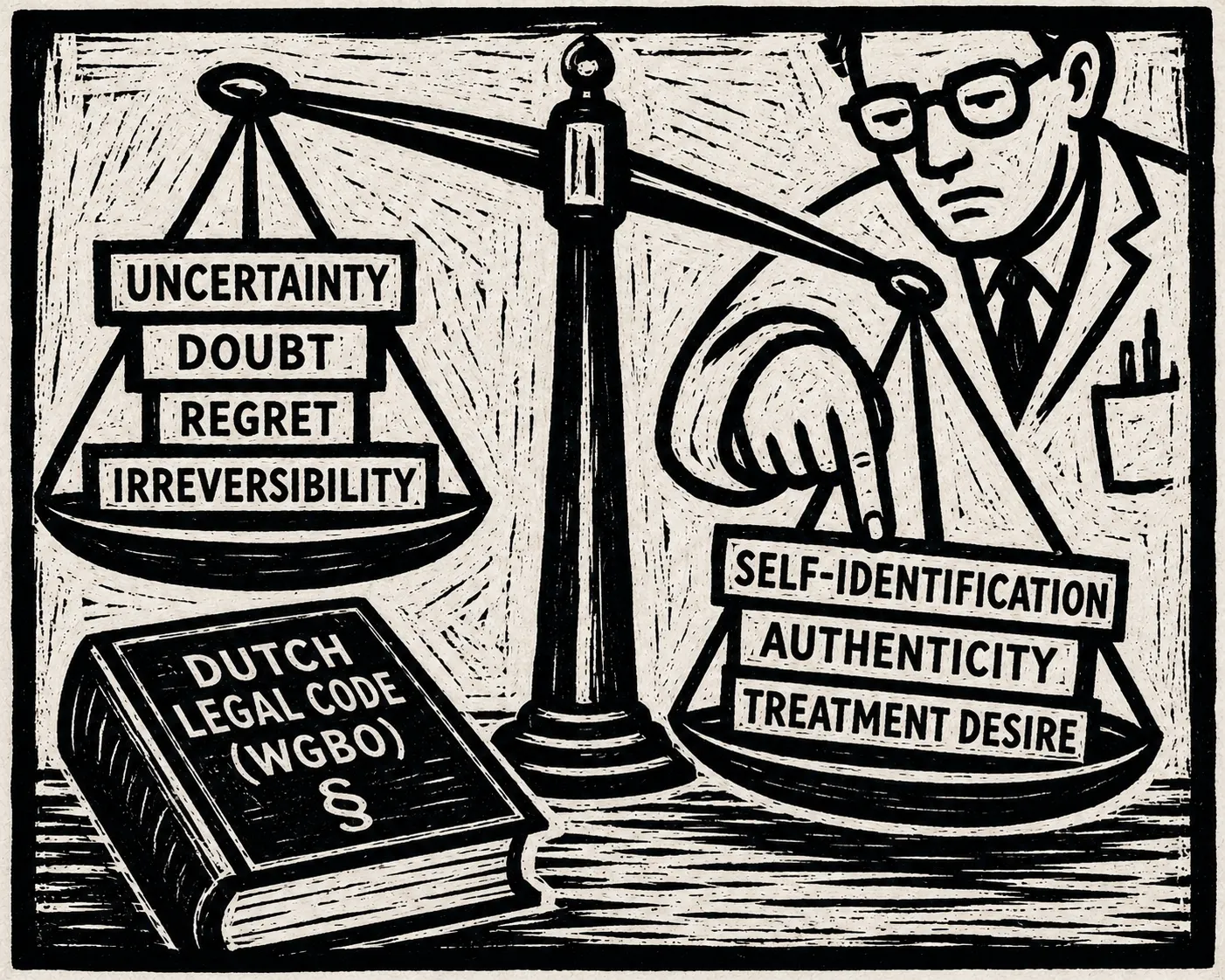
The authors set aside the usual question of whether adolescents can or cannot give informed consent. Instead, they criticise the medico-legal model of informed consent. That model, anchored in the Dutch Medical Treatment Contracts Act (WGBO)1, assumes a reasonably stable patient, prior knowledge, and a decision that precedes treatment. In the gender clinic, they argue, this does not work. Gender is a process of becoming. Identity, understanding, and meaning partly arise during and through treatment. As a result, informed consent becomes “overburdened”: it is required to deliver diagnosis, readiness assessment, and future certainty that it cannot provide.
They identify three mismatches with the legal assumptions:
- Ontological: the “object” (gender dysphoria) and the patient as a stable subject emerge in the consulting room, rather than already existing.
- Epistemic: understanding must be demonstrated in a credible way.
- Temporal: sufficient understanding often arrives only during or after treatment.
Instead of concluding that the care must conform to the legal requirements of informed consent, they reverse the reasoning. The mismatch arises, according to the authors, because gender is a circular process of diagnosis, “gender becoming,” and consent. Therefore, informed consent itself must be allowed to be process-oriented and uncertain. Care does not adapt to the law; the interpretation of ethics and the law must yield to the practice of care.
For years the central justification for somatic treatment of minors was that gender identity is fixed. Persistent, early-onset, not easily changeable. Precisely that presumed stability made it legitimate to take irreversible or hard-to-reverse steps.
Now that this assumption is under pressure from desistance rates, detransition, accounts of regret, comorbidity, and the clinical reality itself, this foundation is suddenly abandoned. Gender is now becoming: open, in the process of formation, only gradually knowable. The old argument (“it is fixed, therefore there is no alternative to somatic treatment and it therefore deserves the status of necessary care”) is silently exchanged for its opposite (“it is not fixed, therefore informed consent may be uncertain”). This is not scientific progress. It is moving the goalposts once the facts prove inconvenient.
Iatrogenic Identity Formation
The paper states that identity, understanding, and meaning partly arise during and through treatment. This sounds philosophically elegant, but medically it is a serious problem. When the somatic intervention itself helps construct the patient’s gender identity and self-understanding, the effects are iatrogenic: the treatment produces or reinforces what it claims to affirm.
Somatic gender care is justified as the affirmation of an already existing, fixed incongruence. If that incongruence and the associated self-understanding are partly brought about by hormones or other interventions, it is no longer neutral affirming care. The care then becomes co-responsible for forming the outcome on which it relies. In the case of minors and hard-to-reverse steps, this is an additional reason for great caution, not for relaxing informed consent.
The Authors’ Own Data Indict Them
The interviews the authors themselves present reveal something far more serious than a mere philosophical mismatch in their starting position.
One young person describes openly how the system works:
“I realized quite early what was expected of me. I knew: if I give this answer, it will be seen as more ‘male’ and that would help with getting a diagnosis . . . But looking back now, I think [my gender] is much more complex than that.”
This patient, too, distorts the self-report and admits it openly. Worse still, the patient cannot even formulate what gender they are. How that complexity manifests itself is not stated in this short quotation, but it is plausible that it is no clearer than “something between a man and a woman.” How can a wish be taken into treatment if the wish itself is not known and clearly definable? What are the characteristics of that complex gender, and why does a complex gender require somatic care? If it does, how does the chosen form specifically meet the need, and why is a less invasive form not the better solution? Every somatic gender treatment damages the body to a greater or lesser extent, whether hormones or surgery. The longer one keeps asking questions, the less clear it becomes.
Another:
“They would ask why I feel like a boy, and I was like, I don’t know, I just feel that way . . . I couldn’t really explain it, because what even is a boy?”
A repetition of what has already been described above. The patient cannot even give an answer. The patient does not even know what a boy is. How, then, can the clinician understand what the patient themselves neither understands nor can articulate?
And on possible later regret:
“Say I ever wanted to go back – which I don’t expect – then I wouldn’t really call it regret, because this is something I genuinely really want right now . . . something that really fits me at this moment. So if later, when I’m 40, I’m like, ‘shit, I’m a woman,’ then at least I would have been able to live for about 25 years as how I felt at the time . . . I wouldn’t want to not do this now just because it might not fit me anymore someday.”
This, too, is a remarkable quotation. The patient openly admits that they will never acknowledge regret to themselves. How, then, can they give honest answers in follow-up research?
The young people state in black and white that they strategically adjust their answers, suppress doubt, and exaggerate or feign certainty in order to avoid delay and reach treatment more quickly. This is not neutral “self-presentation.” This is deliberate deception aimed at circumventing the necessarily careful medical system. The pattern is not new: in the podcast The Protocol, patient zero already admitted to having exaggerated suicidal thoughts in order to apply extra pressure.
And most shocking of all: the clinicians know this. Nevertheless, they look for coherence, “feeling” and authenticity, and proceed with somatic care. The authors document this mechanism and then use it to argue that informed consent must be revised. They see the strategically manipulative answers, acknowledge that the diagnostics are shaped by them, and do not conclude that the assessment has become unreliable, but that the ethics must yield.
This is the point at which a moratorium becomes inevitable. When the authors’ own data show that patients systematically learn which answers lead to faster treatment, and clinicians rely on those answers when deciding on irreversible or hard-to-reverse interventions, the diagnostic foundation is compromised. Continuing with somatic care is then no longer defensible.
Selective Logic and Blind Spots
The authors completely ignore the role of the internet, online scripts, and social contagion. They explain strategic answers mainly as responses to clinical demands, as if TikTok, Reddit, and peer groups do not exist.
“Becoming” is applied asymmetrically. If gender is an open process, then unbecoming — detransition, changed wishes, later insights — is equally logical. Irreversibility is mentioned (including via Liam’s quotation about “if later I think differently”), yet they use the becoming framework to relax the requirements for informed consent, not to place stricter limits on somatic care.
Some authors have themselves received or provided gender-affirming care and state explicitly that they do not wish to abolish it. This shows that they do not occupy a neutral position. The article appears amid the international backlash after the Cass Review, restrictions in several countries, and growing criticism in the Netherlands. The timing and direction are no coincidence.
The paper refers to the Dutch Health Council’s advice on transgender care for young people (June 2026). That Council stated that informed consent can be a process under conditions of uncertainty. The Health Council thereby left some room, but it did not advise maintaining a practice in which strategic deception is rewarded, or advise that clinicians should base irreversible steps on it. The paper uses that room to normalise the tension with the WGBO rather than to resolve it.
One of the authors, Martine de Vries, sat on the Health Council committee. There is therefore an element of self-reference in the citation of that June 2026 report. The text omits that a group of parents submitted their own report to the Health Council before the Council published its advice, that the Council acknowledged receipt of the report, and that it claimed the committee would take it into account in its evaluation2.
Chapter 2.3 of the parents’ report refers to De Cuypere’s book (Transseksualiteit, 1995), which explicitly warns against distortion of self-report by patients. Clinicians must remain alert to this throughout the treatment trajectory. This conflicts with what the authors of the present paper now describe.
Too Little, Too Late
Oosthoek et al.’s publication is academic damage control that falls into its own trap.
At first, the gender “care” was rolled out on the story that gender identity is fixed — persistent, early-onset, stable enough to justify somatic interventions. Now that foundation is collapsing, they are trying to reformulate the ethical and legal framework around informed consent so that gender may be becoming, and informed consent may be uncertain and process-oriented. The law, however, requires prior certainty and honest information. The practice does not deliver this. Instead of adapting the practice, this raises questions about the usefulness of informed consent and suggests the need for revision.
When this becomes clear, the only responsible response is an immediate moratorium on somatic gender care for minors and young adults at the very least — and why not for adults as well? More fundamentally, what remains of any rigorous truth-testing of self-reports? Such a pause must remain in place until diagnostic standards have been demonstrably restored and patient safety is no longer subordinated to the drive to keep treating.
1 The WGBO is the Dutch Medical Treatment Agreement Act that sets the legal and ethical rules for the relationship between patients and healthcare providers, including informed consent, the right to clear information, and medical records.
2 This parents’ report is not publicly available due to privacy considerations. However, Genspect has received a copy and can confirm that the source exists and has been correctly applied in this article. Genspect aims to make this source or its content publicly available in the future.
Genspect publishes a variety of authors with different perspectives. Any opinions expressed in this article are the author’s and do not necessarily reflect Genspect’s official position. For more on Genspect, visit our FAQs.