




Gender Recognition in Ireland: Charting a path back to reality-based legislation
By Catherine Monaghan

Let’s reclaim the truth
Many people in Ireland are unaware of quite how easy it is to legally change one’s sex for all intents and purposes, and of the implications of allowing a highly contested belief (that one can change sex) to be reified in law. Enacting legislation that allows men to legally identify as women has undermined all of the sex-based rights of all women and essentially made a mockery of our Equal Status Act. How was this allowed to happen? And is there anything we can do about it?
Irish women were largely kept out of the loop when gender recognition legislation was being developed; they were neither consulted nor considered. As time goes on though, and Irish people begin to see the effects of this legislation – men in women’s prisons and refuges, men playing in women’s sport, and the imposition of gender ideology in schools and other institutions – a growing number of citizens are asking questions and looking for a way to challenge it.
This coming March 7th a one-day conference in Dublin will provide an opportunity to listen, learn and engage with this issue. For more information, read on. Follow the links below for details and tickets.
What is The Gender Recognition Act?
Just over ten years ago, the introduction of the Gender Recognition Act (GRA) quietly altered the legal landscape around sex and gender in Ireland. The Act, passed by the Oireachtas in 2015, enables anyone aged 18 and over to legally change their sex through a simple administrative process known as self-ID.
This process requires no clinical assessment, diagnosis, or treatment. Applicants simply fill out an online form and submit a statutory declaration. They are then issued a Gender Recognition Certificate (GRC). Once issued, that certificate legally changes the person’s sex for all purposes from that date forward. For people aged 16–17, the process requires parental consent, written approval from medical professionals, and a court order exempting them from the adult age threshold. Activists and some politicians in Ireland continue to campaign for lowering or even abolition of the age limit and for legal recognition of other “gender identities”.
The Gender Recognition Act is the legal application of gender ideology – the idea that boy, girl, man, woman, both, or neither is determined by how you feel rather than by your actual, physical body, and that it is possible to change one’s sex. Gender ideology has no basis in fact or science. In fact, sex is binary and immutable. One is either male or female, and it is not possible to change.
Sneaky Strategy
The GRA came into effect the same year as the Marriage Act 2015 which amended the Constitution to legalise same-sex marriage. Amendment of the Constitution requires a referendum, so the introduction of same-sex marriage involved extensive public consultation, media coverage and grassroots activism. There were national campaigns and a high level of engagement by politicians and political parties. The public were informed and engaged, and overwhelmingly voted yes to legalise same-sex marriage.
The Gender Recognition Act did not change the Constitution and therefore moved through the Oireachtas like ordinary legislation with no referendum necessary. The public were focused on same-sex marriage, while behind the scenes activists were working on the GRA.
Gender recognition legislation impacts all sex-based rights and public policy and yet, there was negligible media coverage and no public scrutiny or debate.
It turns out that this under the radar approach to the introduction of gender recognition legislation is a deliberate strategy employed by transgender rights activists in order to avoid public scrutiny and uncomfortable questions. We know this because it’s documented in a report by Dentons, a multinational law firm which advises activists on how to advance legislation to allow children and young people under 18 to legally change their gender. Among other suggestions, the report advises activists to piggyback onto campaigns for more popular reforms (for example same sex marriage), and to avoid excessive press coverage and exposure. Ireland is specifically cited in the report as an exemplar of this under the radar strategy and is lauded by campaigners for gender recognition worldwide.
What About Women?
The development of the Gender Recognition Act involved consultation with certain specialist stakeholders – legal experts, medical professionals, government officials, and representatives of advocacy groups such as Transgender Equality Network Ireland (TENI) but did not include broader consultation with women’s rights organisations, child welfare organisations, or groups focused on single-sex services or sex-based legal protections.
The advisory body established by Government to support drafting of the GRA leaned heavily toward advocates of broad self-ID and, again, did not include voices that might have raised concerns about women’s rights, data integrity in public policy, or other sex-based rights.
Issues that should have been considered include:
- Single-sex spaces: If access to women’s services and spaces – such as prisons, refuges, changing rooms, and toilets – is based on legal gender or gender identity rather than biological sex, these are no longer guaranteed to be female spaces. The need for women’s spaces is based on biological sex, and so provision must also be based on biological sex. Women need guaranteed safety, dignity, and privacy when they are vulnerable, such as when changing clothes, using bathrooms, sleeping, seeking refuge, or especially if they are sick, incapacitated, or imprisoned.
- Women’s sport: Admitting males who identify as girls or women into female sports is neither safe nor fair. Even with hormonal treatment and decreased testosterone levels, males retain the advantages of male puberty. They are generally bigger, faster, and stronger from a young age. Women and girls deserve safety and fairness in sport, as well as privacy and dignity when it comes to changing facilities, whether playing sport for recreation or at elite level.
- Equality law and protections: The introduction of Gender Recognition Certificates has created a conflict of rights. The Equal Status Act states that it is reasonable and legal to have women-only spaces, but the Gender Recognition Act says that a man who identifies as a woman and obtains a GRC is legally female and entitled to enter those spaces. This has resulted in violent men being placed in women’s prisons and shelters.
- Data collection and statistics: Official statistics on health, employment, crime, and other issues often rely on sex-disaggregated data. Legislation that allows individuals to choose their sex falsifies public health research, equal pay audits, and crime statistics. Future policies on health, education, employment, and social issues depend on accurate data.
- Medical care and research: Sex differences are critical in medical research, assessment, diagnosis, and treatment. Males and females have different requirements and responses when it comes to to medical conditions, medications, and treatments. Biological sex is the only safe basis for planning healthcare in both personal and public spheres.
Captured
Gender ideology was enshrined in law under our noses in a move that justified the promotion of dangerous and nonsensical ideas to Irish people in all aspects of their lives. Now, a decade on, gender ideology is everywhere. Irish institutions and the national media are in thrall to the same lobby groups, including TENI, who pushed through the Gender Recognition Act in 2015.
Schools, both primary and secondary, have gender ideology embedded in curriculum and policy, and many advertise their allegiance to it by flying the progress pride flag during Pride month and beyond. Activist organisations – TENI, Shout Out and Belong To – are providing training and workshops to staff and students at schools around the country.

Irish Universities, in order to receive funding for research, are obliged to sign up to the Athena Swan Ireland Charter which requires them to foster “an environment that creates collective understanding that individuals can determine and affirm their gender” and requires active promotion of gender self-ID.
Across sectors, employers and institutions have introduced policies that embed gender ideology in workplaces. Adults working in offices, hospitals, schools, and in government are expected to attend workshops and training provided by TENI, to advertise pronouns in signatures and on badges, and to proactively express support for ideas that many don’t believe in.
Irish media have consistently promoted gender ideology and remained almost silent on developments at home and abroad that challenge the logic, wisdom, and safety of pretending that biological sex doesn’t matter.
Moving Forward
The law should reflect the reality of the world we live in. The Gender Recognition Act doesn’t do that.
What can we do about it?
Wicklow Women 4 Women – a grassroots collective of women based in Co. Wicklow, Ireland, and committed to upholding the sex-based rights of women and children – will host a one day conference in Dublin on Saturday 7th March to address the impact of Ireland’s Gender Recognition Act.
Please join us, and a brilliant line-up of guests who are informed, experienced, and active in fighting for reality-based legislation, women’s rights, and child-safeguarding. It promises to be a day of lively and informative discussion, debate, and strategising.
The focus will be on the Irish Gender Recognition Act – what it means for society in general and women and children in particular – and how we can move forward in campaigning for change.
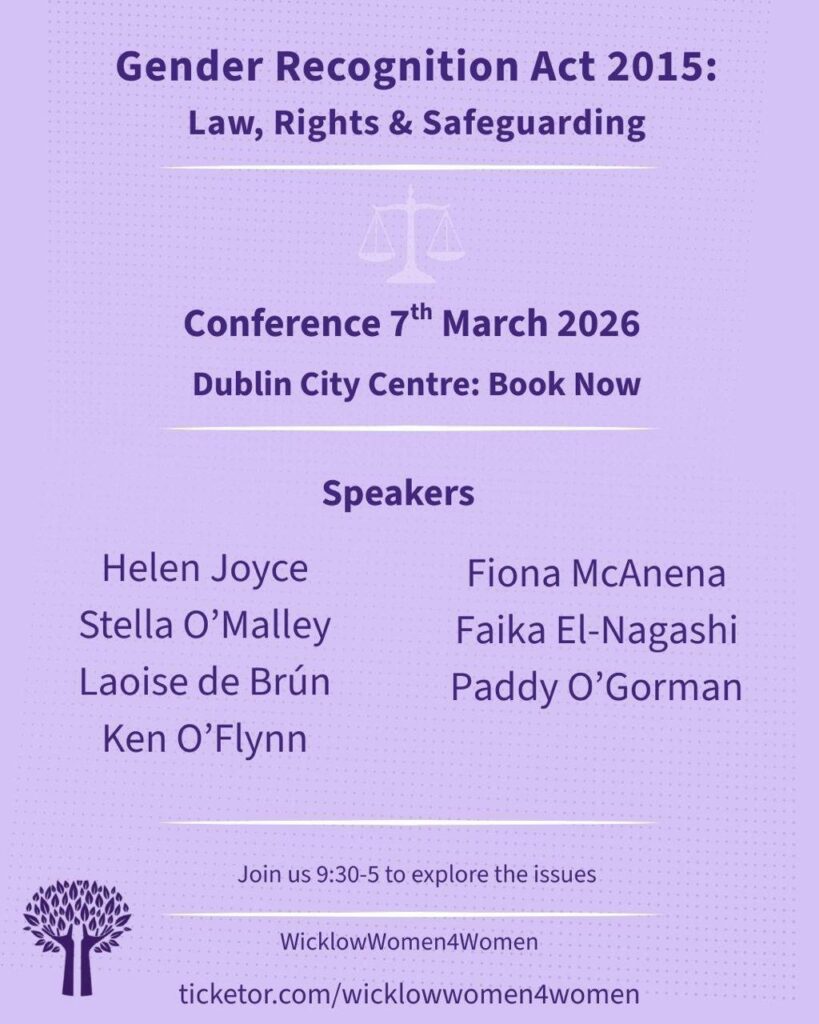
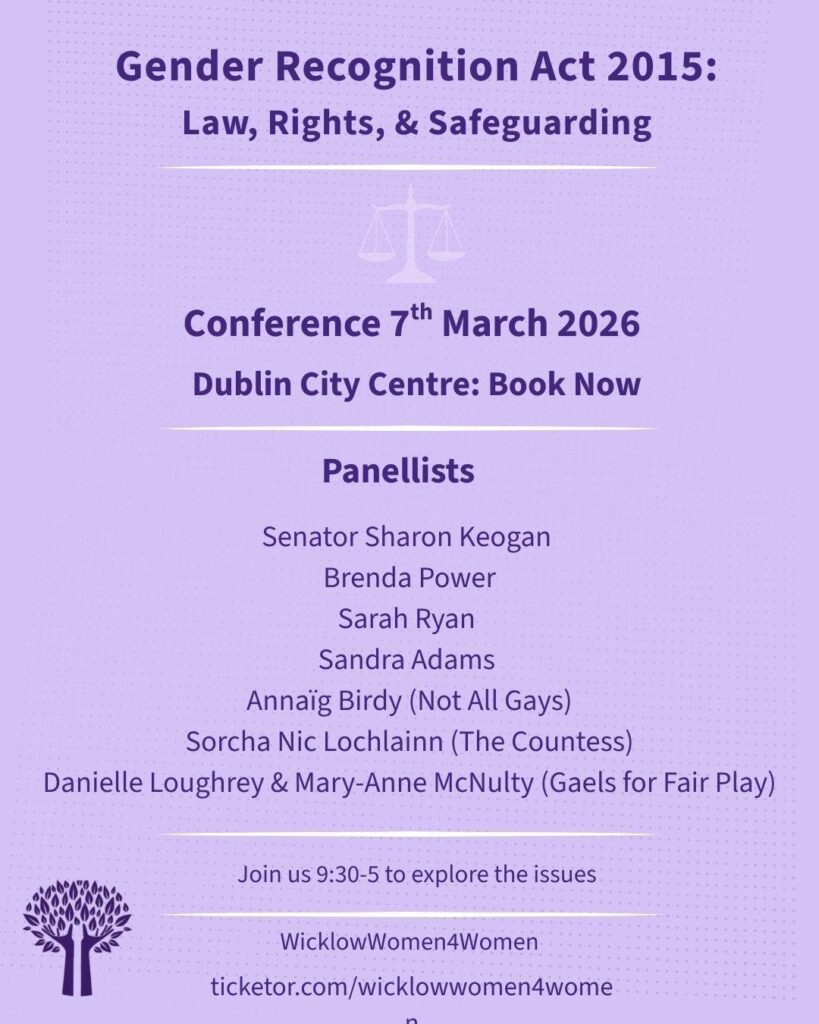
Tickets are on sale here. The exact location will be announced via email to ticket holders in due course. Tea/coffee and refreshments will be provided morning and afternoon, lunch will be available to purchase at the venue and nearby.
We hope to see you there!
Contact Wicklow Women 4 Women: wicklowwomen4women@gmail.com or find us on X: @wicklowwomen4w1.
Catherine Monaghan is an Irish women’s rights activist and a founding member of Wicklow Women 4 Women.
Genspect publishes a variety of authors with different perspectives. Any opinions expressed in this article are the author’s and do not necessarily reflect Genspect’s official position. For more on Genspect, visit our FAQs.