




Bí Cineálta – Be Kind Part 1
By Catherine Monaghan
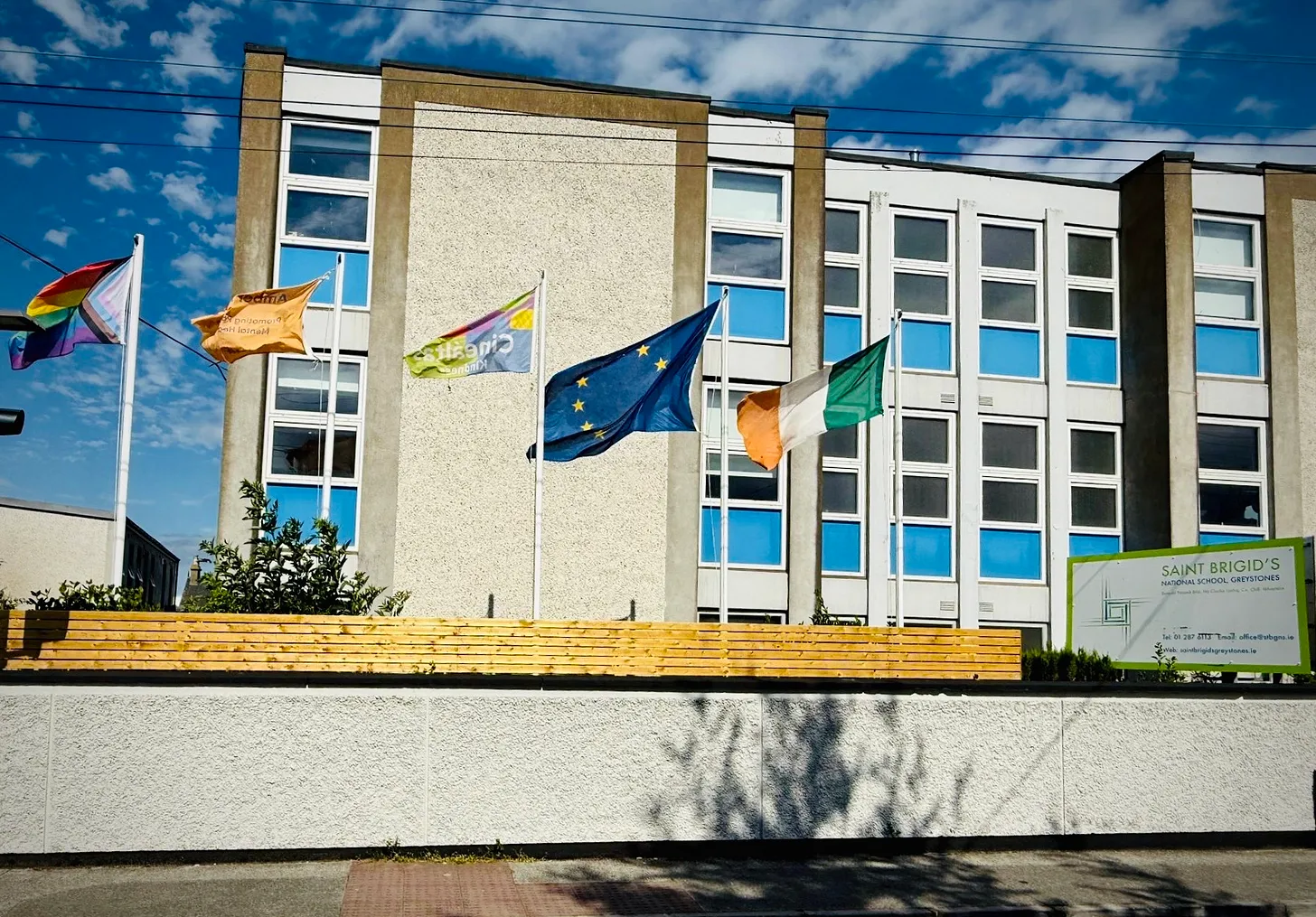
Recently, I drove past my old primary school and noticed the progress pride flag flying, presumably for the month of June – Pride month. It’s quite some time since I was in primary school. I don’t remember if we flew flags for anything back then, but we definitely didn’t fly a pride flag. It was the 80s and the fight for gay rights in Ireland was in its infancy. Also, the school was, and remains, a Catholic school. The Catholic church, while supporting the dignity and rights of LGBT people in society in general, is not ok with same-sex sexual activity or same-sex marriage. But, aside from that, what would it have to do with children anyway? Until recently it would have been considered inappropriate and unnecessary to bring children or schools into a cause that revolved around adult sexuality. Sex and sexuality were not considered relevant or important in primary school. Our very basic sex education in 5th class covered the mechanics of how babies were made, with an emphasis on marriage being a prerequisite.
A lot has changed in Ireland since then. The first Pride march in Dublin took place in 1983. Homosexuality was decriminalised in 1993. In 2010, civil partnerships were introduced, granting same-sex couples legal recognition and some of the rights of marriage. In 2015 Ireland became the first country in the world to legalise same-sex marriage by popular vote. For a decade now, lesbian, gay, straight – we all have the same rights and recognitions. Ireland is by any standards a progressive and tolerant country.
What’s In a Flag?
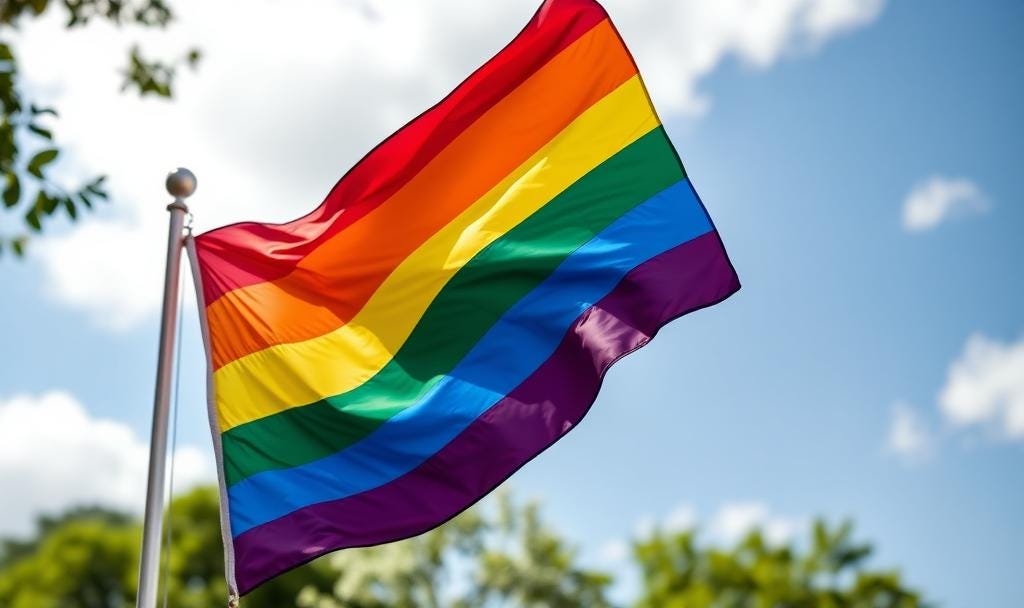
The original pride or rainbow flag (below) that most of us are familiar with was designed in 1978 as a symbol of pride for the gay community in San Francisco. Over the next few decades it came to represent the lesbian, gay and bisexual community worldwide.
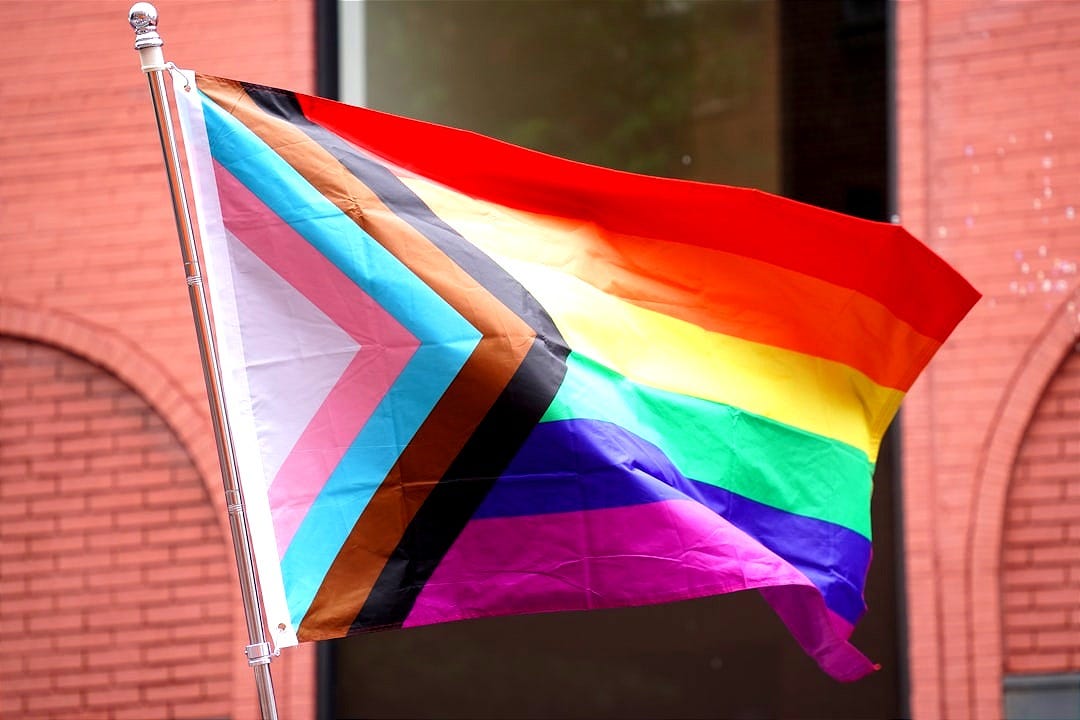
The progress pride flag (below), which is flying outside my old school and many other schools around Ireland, has only been around since 2018. In addition to the original rainbow, it represents those who identify as transgender and nonbinary with baby blue, baby pink, and white stripes. It also has brown stripes to represent people of colour (although, the original flag was designed to represent all LGB people which of course includes people of colour) and black to represent those lost to HIV/AIDS, and those living with HIV.
By flying this flag the school is sending a message to pupils, parents, teachers and the wider community that it believes in and supports gender identity ideology, aka trans ideology.
Trans ideology is the idea that boy/girl, man/woman – or something else entirely – is determined by how you feel rather than by your actual biology. It’s the belief that it’s possible to be born in the wrong body and when that happens it’s possible to transition to the opposite sex. It is a belief, just like a religious belief, with no basis in science, evidence or fact.
In schools, this belief system is often translated into practices like using chosen names and pronouns, affirming transitions, and teaching that gender exists on a spectrum. While some adults might choose to adopt this worldview and go along with such practices, expecting children to understand or participate is unrealistic and potentially harmful.
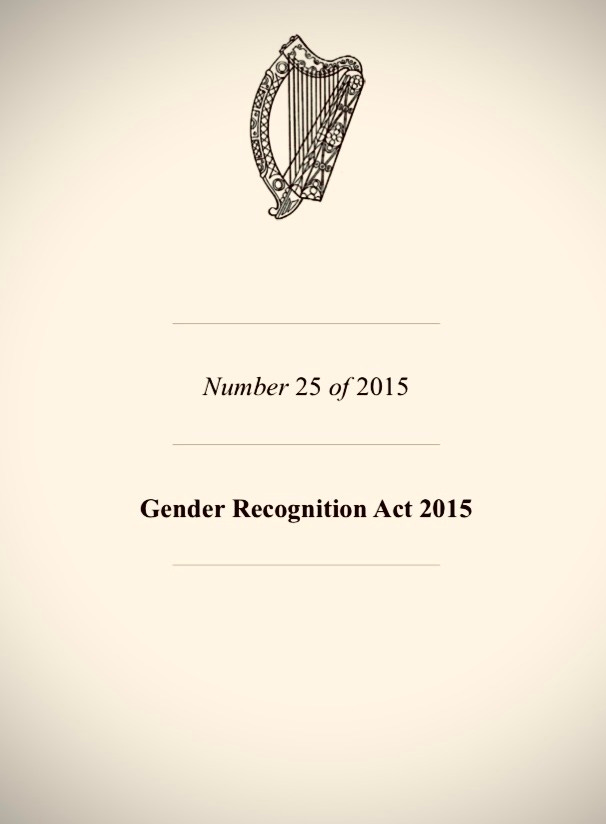
In terms of legislation, Ireland is on board with trans ideology with some of the most advanced legislation in the world designed to accommodate the belief. Introduced alongside same-sex marriage in 2015, but very much on the down-low, was our Gender Recognition Act (GRA). This legislation allows individuals to legally change their sex and have it fully recognized for all legal purposes, including on birth certificates and official documents. Anyone aged 18 and over can declare a change of sex without the need for medical assessment, diagnosis, or intervention of any kind (activists continue to campaign to lower the age requirement). This is known as “self ID”. Applicants simply fill out a form online and submit a statutory declaration. They are then issued a Gender Recognition Certificate (GRC) and their new gender is legally recognised as their preferred gender for all purposes. Ireland was one of the first countries to adopt this approach of self declaration and it is seen as highly progressive, but the GRA is in direct conflict with the legislation that protects women from discrimination on the basis of their sex (the Equal Status Act, 2000).
You Don’t Know What You Don’t Know
Anecdotally, many if not most people I ask have no idea about the GRA and self ID. In fact, just last year in the run-up to our general election I asked every politician who canvassed at my door for their thoughts on the GRA and self ID. Not one politician admitted to any knowledge, and all appeared shocked to learn that the legislation meant that sexually violent men who claim to be women are housed with women in our prison system. If our politicians are oblivious about the societal impacts of trans ideology, we can hardly expect the general public to be informed.
Likewise, most people by now are familiar with the rainbow pride flag but many don’t know the meaning of the progress pride flag, and have only a superficial knowledge of trans ideology. Some believe it’s just a fad that the kids are into. Surveys in the UKhave shown that there are high levels of misunderstanding and confusion around the terms used in discussion about gender and trans issues.
But we must assume that the school does understand it all, as it’s flying the flag. The school is signalling that it believes in, supports, and will affirm trans identities – girls who think they are boys or vice versa – despite all evidence to suggest that this is a dangerous approach. And there is no shortage of evidence:
- The Cass Review is a comprehensive, independent review of gender identity services for children in the UK, commissioned by the NHS and carried out by paediatrician Dr Hilary Cass. The findings raised serious concerns about the lack of evidence for medical and social interventions, and highlighted the need for caution and an evidence-based approach to supporting children who are confused or distressed about gender. It concluded that there is no reliable evidence that puberty blockers are safe or reversible, that an affirmation only approach is unsafe, that gender care for children has been ideologically captured, and that medical transition for minors should be paused. Many countries such as the UK, Sweden, Finland, Norway, Denmark, France, and Italy have now restricted the use of puberty blockers and retreated from the gender-affirmative approach.One of the most important findings of the review concerned social transition (e.g. changing name, pronouns, clothing) in children with gender-related distress. The Cass Review concluded that social transition, especially in younger children, is not a neutral or benign intervention, but has “significant psychological effects and may influence the likelihood of persistence of gender dysphoria” (Cass Review, Final Report, 2024).
- Our own Irish experts in this field have expressed support for the Cass Review. In fact, Professor Donal O’Shea (consultant endocrinologist) and Dr Paul Moran (consultant psychiatrist) of the National Gender Service (NGS), sought and have been granted a judicial review of the treatment of children in Ireland with gender identity issues because children were referred to clinics abroad which took an affirmative approach, much to the detriment of their young patients. Dr Moran and Professor O’Shea have also expressed concern over what they see as inappropriate influence of trans activist groups, such as TENI and Belongto, on gender services in Ireland. These same activist organisations have involvement with many schools around Ireland providing training and workshops for staff and students and contributing to the development of curriculum resources and school policies.
- The current 2025 Programme for Government explicitly supports implementing the recommendations of the Cass Review and emphasises the importance of clinical evidence in treatment of children with gender-related distress.
The importance of the Cass Review cannot be overstated. It is the most up-to-date and comprehensive report available on the provision of care for children and young people dealing with distress related to gender. For the Department of Education or any individual school to ignore or be ignorant of its findings is inexcusable.
Theory Into Practice
The flag is one highly visible way of demonstrating support for trans ideology. School policies and curriculum are another, less obvious way. The flag in the middle of the photo of my old school, above, is for ‘Bí Cineálta’, a new anti-bullying policy about to be rolled out in all Irish primary and post primary schools. Implementation is set for the next school year, beginning September 2025. Bí Cineálta is Irish for ‘be kind’.
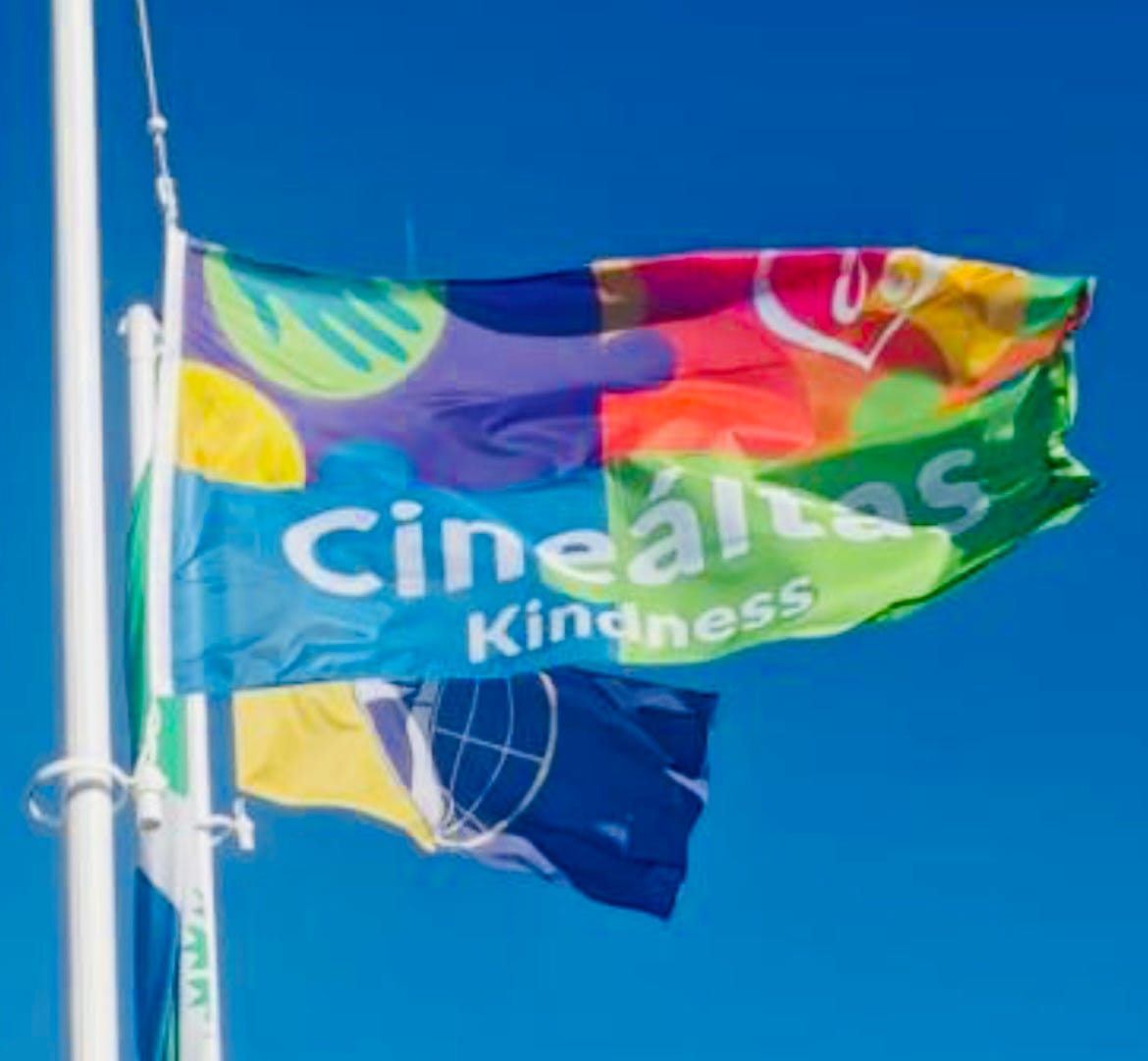
In June 2024 the Irish Department of Education published Bí Cineálta: Procedures to Prevent and Address Bullying Behaviour for Primary and Post-Primary Schools, replacing the 2013 Anti‑Bullying Procedures. As part of its broader Cineáltas: Action Plan on Bullying, the Department of Education claims the initiative promotes a culture of respect and inclusiveness across primary and secondary schools. Each school drafts their own Bí Cineálta policy, based on training provided by Oide, but the policy must include reference to particular types of bullying, including identity-based bullying such as transphobic, homophobic, racist, and sexist bullying.
Parents have expressed concern about Bí Cineálta’s emphasis on identity-based bullying and are questioning why it is necessary. They are also concerned about its uncritical adoption of trans ideology, introducing a belief system into school policy that is not grounded in fact, but in controversial ideas about gender. While all children should be protected from bullying, that protection must not be based on the promotion of one worldview as truth in a diverse and pluralistic society. The notion of having a gender identity is a belief held by some people, not an objective reality accepted by all, and schools must not compel students or families to affirm beliefs they do not share.
In Bi Cinealta-Part 2, we’ll look at how this new anti-bullying policy is being used as a tool to embed contested ideas about gender into children’s lives, despite all current research pointing to the dangers of this approach.
Catherine Monaghan is an Irish women’s rights activist and founding member of Wicklow Women 4 Women.
Genspect publishes a variety of authors with different perspectives. Any opinions expressed in this article are the author’s and do not necessarily reflect Genspect’s official position. For more on Genspect, visit our FAQs.this article are the author’s and do not necessarily reflect Genspect’s official position. For more on Genspect, visit our FAQs.