




Facing Consequences – Gender Recognition in the Irish High Court
By Catherine Monaghan
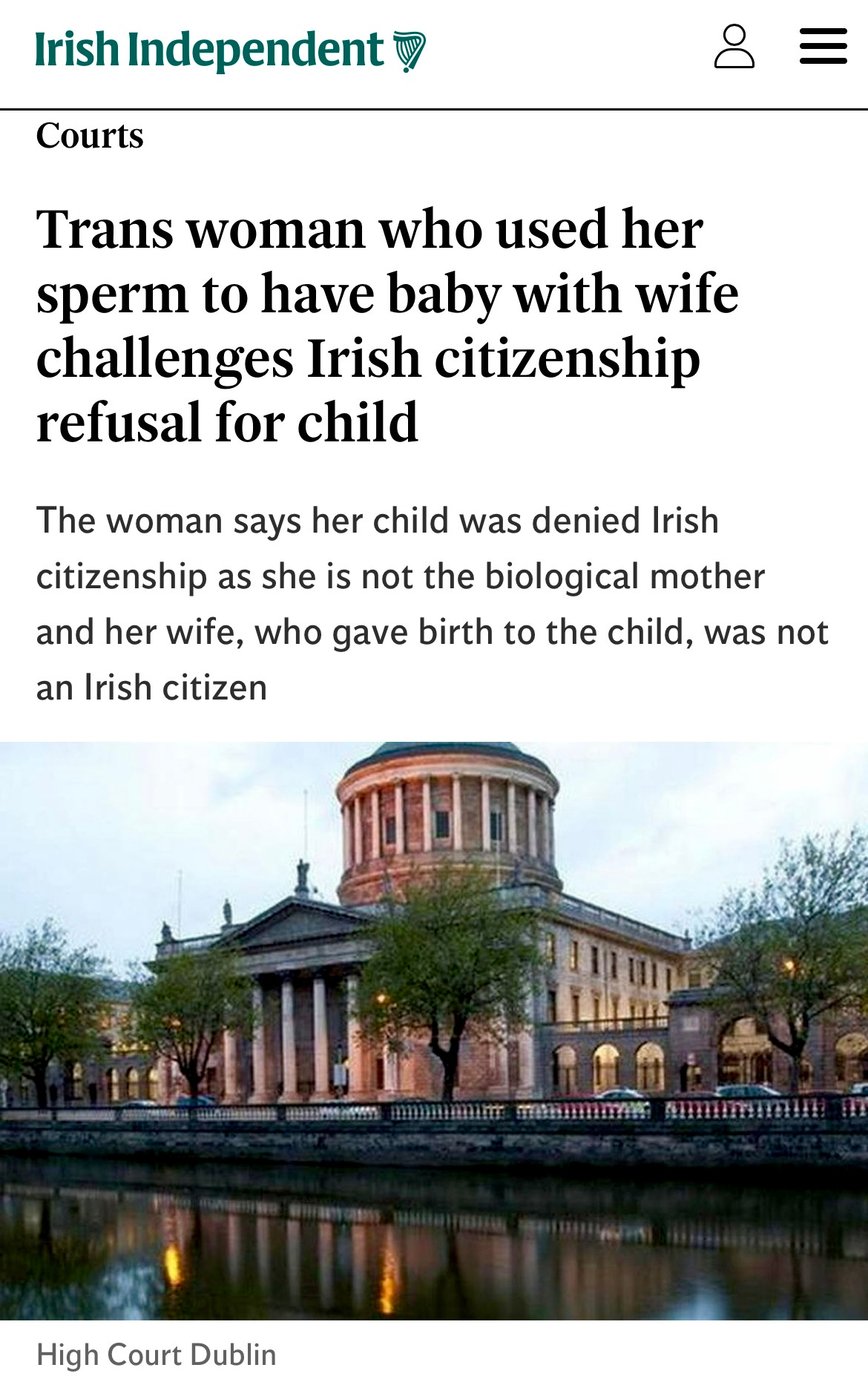
Recently Irish media reported a story about a man who is encountering difficulties as a result of legal gender recognition. The phrase “a lie begets a lie” came to mind. What starts off as one person “affirming their gender identity” with personal official documents inevitably creates a chain reaction of dishonesty and deception, an example of which we will see play out in the Irish High Court in January.
How Did We Get Here?
Gender recognition is a legal process that allows a person to change the sex marker on their official documents to align with their “gender identity” – their feeling of being male or female. This usually involves applying for a Gender Recognition Certificate (GRC). Not all countries allow for gender recognition, and amongst those that do, the specific requirements and the process varies.
Ireland takes a strong stance on gender recognition. Since 2015 our Gender Recognition Act (GRA) has allowed anyone aged 18 and over to declare a change of sex without the need for medical assessment, diagnosis, or intervention of any kind. This is known as “self ID”. Applicants simply fill out a form online and submit a statutory declaration. They are then issued a Gender Recognition Certificate and their chosen sex is legally recognised as their actual sex for all purposes. They can apply for a revised birth certificate, essentially rewriting history, and a new passport.
Young adults, aged 16-17, can apply for a GRC with court approval, the consent of parents or guardian/s, and written approval from both their primary medical practitioner and either a psychiatrist or an endocrinologist not involved in the child’s medical care.
Ireland was an early adopter of self declaration. We went from having no means of legally changing gender prior to 2015, to full self ID once the Gender Recognition Act was introduced. Our nearest neighbour, the UK, requires a medical diagnosis of gender dysphoria and evidence of two years living in the desired gender before granting a GRC. Some European countries have caught up and even surpassed us, for example in Germany as of last year there is no lower age limit on gender recognition and no medical or psychological assessment required.
The Irish legislation was developed with minimal public consultation or education – a deliberate and documented strategy employed by transgender rights activists worldwide in order to avoid scrutiny. In 2015, Irish people were focused on the campaign for same-sex marriage legislation. Everywhere we looked and listened we found discussion and debate on that issue and when the time came to vote, we voted an overwhelming “yes” for marriage equality. Irish people are generally tolerant and liberal.
Gender recognition legislation deserved at least the same level of discussion and debate. A law that allows anybody to self-declare their sex is in direct conflict with equality legislation which is in place to protect the interests of men and women in situations where sex is relevant, for example in single-sex spaces, in sport, and in ensuring equal opportunities in workplaces and education.
The Story So Far
According to Court News Ireland:
“A UK trans woman, who used her frozen sperm to have a baby with her wife, has been granted permission to bring a High Court challenge against a refusal by the State to grant Irish citizenship to the child on the basis that she is not the biological mother.
The woman – who has Irish citizenship while her wife does not – submits that if she has to claim to be the “father” of the child as part of the application, it would be an “offensive, discriminatory and unjust attack” on her person, gender identity and legal status.”
RTE, The Journal, the Irish Times, and the Irish Independent all reported on a trans woman who used “her sperm” to have a baby with her wife. Only men produce sperm, enabling them to father children. This is a basic fact of life. The fact that this person produced sperm means he is not woman. The job of the media, especially our national broadcaster, is to report the facts.
So, a man who now identifies as a woman used his frozen sperm to conceive a child with his wife in the UK. The man – the father – is an Irish citizen. Usually, a child born abroad to an Irish citizen is automatically entitled to Irish citizenship, provided that citizen is recognized as a parent under the Irish Nationality and Citizenship Act 1956.
The Irish State has refused to grant citizenship in this case. Why?
Because the Department of Foreign Affairs argues that he is not recognised as a “parent” for this purpose. Irish law only allows for a mother and a father, and the mother is always and absolutely the person who gave birth to the baby, regardless of genetics (if the baby was conceived with a donor egg) or intention (if the baby is intended to be adopted). This man’s wife is the mother, obviously. He is not a mother, and although he technically is the father of the child, his GRC means that he can’t be recognised as such on a birth certificate in the UK where he is based, or in Ireland, because he is legally a woman.

The man, who identifies as a woman, has been granted permission by the High Court to challenge this refusal, meaning the case will proceed to a full hearing.
According to the media, the man submitted that he could have claimed to be the father of the child and obtained citizenship by descent that way, but he felt that would “invalidate” him as a trans woman and invalidate his “same-sex” marriage. Being made to claim fatherhood of the child would be an “offensive, discriminatory and unjust attack” on his person, gender identity, legal status and same-sex marriage.
But the truth of the matter is that this man is the father of the child. No matter how much he wishes it to be otherwise, he provided the sperm, thus fathering the child, something only a man can do.
By choosing to legally change his sex to female, the man himself ruled out the possibility of being on his child’s birth certificate, and of his child claiming Irish citizenship through him. Gender recognition legislation allowed this situation to arise.
Truth Matters
The Gender Recognition Act compels us to lie about something really fundamental – the binary and immutable nature of sex. This lie about one of the most basic facts of life has far-reaching consequences.
Societies work because members operate on a common understanding of basic facts such as: what a human being is, how the world works, what’s physically possible or impossible, what rights and responsibilities apply to each person. This shared understanding is what allows us to coordinate government, laws, development of infrastructure, education, healthcare, and everyday life.
If we abandon objective truth in favour of beliefs that contradict physical reality, coordination breaks down. If institutions promote or endorse ideas that people know to be untrue, public trust declines. The legal system depends on definitions so when these depart from physical reality, legal consistency isn’t possible. Most professions rely on objective standards – doctors make decisions based on anatomy and physiology; educators who teach science, maths, history, geography, and many other subjects do so within a framework of objective, evidence-based facts; scientists, engineers, social workers, builders, plumbers, nannies, chefs, and almost anyone who doesn’t work in the arts relies on our common understanding of reality in order to do their jobs.
If legal categories can be redefined arbitrarily or unrealistically the rule of law is undermined. If educators depart from the truth, there is no knowledge passed on. If professionals are expected to affirm falsehoods, competence and safety degrade. A shared sense of reality is critical to social cohesion and without it, cooperation becomes difficult.
A Sticky Web
Legal gender recognition has many unintended consequences for the individual, for the family, and for society as a whole. In this case it has deprived a man of the legal acknowledgement of his fatherhood on his child’s birth certificate, and it has deprived the child of the legal recognition of his or her father and, thus far, of Irish citizenship. The man made a choice, of course, but given the ease with which one can obtain a GRC – with no legal or medical consultation – it’s impossible to know if any applicant is fully informed about the downstream ramifications of legal sex change.
It will be up to the High Court to resolve this particular issue and in the process hopefully shine a light on the Gender Recognition Act and some of it’s unforeseen consequences. Perhaps there is a lesson to be learned about suppression of public discussion and debate about legislation that is at odds with our basic common sense.
“Facts do not cease to exist because they are ignored” – Aldous Huxley
Catherine Monaghan is an Irish women’s rights activist and founding member of Wicklow Women 4 Women.
Genspect publishes a variety of authors with different perspectives. Any opinions expressed in this article are the author’s and do not necessarily reflect Genspect’s official position. For more on Genspect, visit our FAQs.