


Detransitioners Tell Their Stories of Life Beyond Transition
By Stella O'Malley
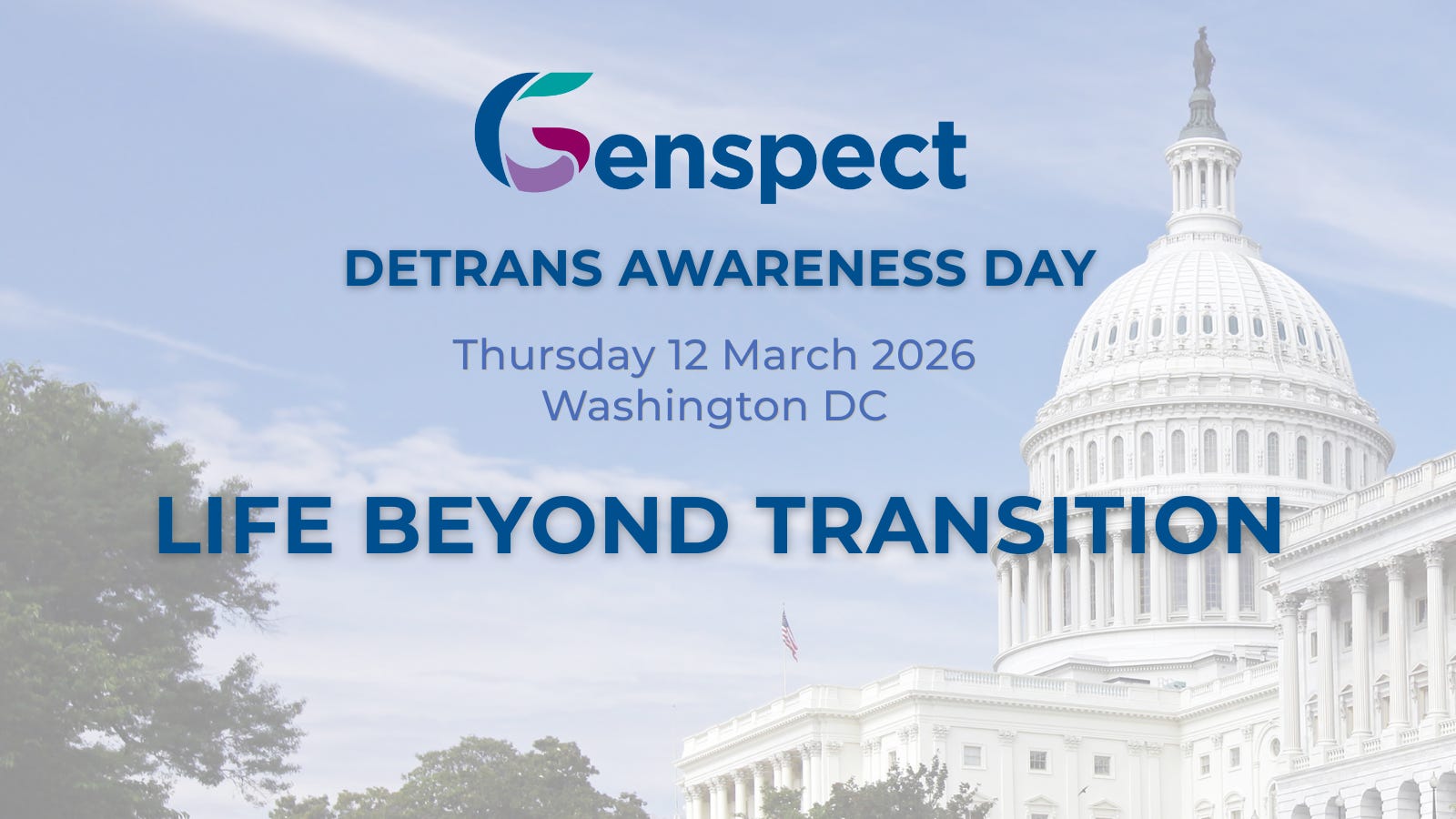
The Detrans Awareness Day 2026 will be the largest gathering of detransitioners ever.
History will be made in Washington, D.C. on Thursday, March 12th, when Detrans Awareness Day brings together more detransitioners than ever before.
For a group that has largely lived out of public view, this gathering marks a turning point, allowing detransitioners to claim their place as a vital chapter in the history of the trans phenomenon.
Until now, many people who regretted their medical transition have lived in a solitary hell. Genspect’s Beyond Trans program runs online therapeutic support meetings for people who regret their medical transition. In these meetings, participants describe countless nights spent alone. We’ve heard too many accounts of people waking up in the middle of the night crying, veering from murderous rage to debilitating shame, and never knowing where to turn for help. The vast majority feel profoundly isolated. Most have never met another detransitioner in person. Many feel scared to speak publicly because they know their stories will be weaponized and reduced to talking points in a vicious debate.
Now it’s time to move forward and bring solutions to the table. We know there is significant demand for this gathering, and we also know it will be difficult to host. Over 70 detransitioners have already applied to attend. Sadly, we have now reached the limit of our budget and must rely on others to step forward. If you would like to help make this possible, you can donate here so that we can continue to welcome more detransitioners.
This summit will be more than a conference. It will be a working meeting designed to identify real needs and practical solutions. At the heart of the event will be structured roundtable discussions bringing together detransitioners, clinicians, lawyers, policymakers, and leading researchers. These sessions will focus directly on the lived realities of detransitioners and on practical pathways forward, including clinical care, legal protections, and social support. Rather than relying only on speeches from a podium, although we will have some outstanding speakers, the emphasis will be on honest dialogue and problem-solving.
Alongside these core discussions, we will convene a dedicated session with detransitioners and legal experts to examine possible legal avenues and protections. The LGB Alliance will also host a specialized roundtable focused on the social needs of lesbians, gays, and bisexuals affected by current policies, with particular attention to friendship, connection, and social networks.
Well-known detransitioners such as Keira Bell, Ritchie Herron, and Michelle Alleva have already confirmed they plan to attend, alongside newer voices including Jonni Skinner, Jessi Harris, and Aireal D. Salvatore. More than 600 detransitioners are signed up for our Beyond Trans group sessions, and we have seen the powerful impact of bringing them together. Those further along can share hard-earned lessons, while those newly detransitioned remind more experienced voices how far they have already come.
Meeting in person has a unique power that a screen cannot match. Online support has been invaluable, but a face-to-face connection creates a deeper sense of understanding and solidarity. We have seen this transformation among parents of trans-identified children. When we began online support in 2020, most parents were isolated and had never met another parent in the same position. Today, more than 5,000 parents are part of our network. Friendships have formed, confidence has grown, and parents have become an informed and influential voice. For that reason, parents will have dedicated content at the Washington, D.C. event. Life beyond transition affects the entire family, and a panel led by Dr Stephen Levine will explore how medical transition reshapes family life.
We called the event Life Beyond Transition because tens of thousands of people are trying to navigate exactly that, and it is often incredibly difficult. Many regret the entire process and try to reverse it. Some stop medical transition but remain socially transitioned. Others reject the trans framework altogether and see themselves as ideologically detransitioned, yet remain medically transitioned because they believe they have passed the point of no return. For some, attempting a reversal feels too risky or experimental.
These are deeply complicated clinical situations that demand thoughtful, ethical, and evidence-based responses. For example, female detransitioners describe being placed on puberty blockers before they had their first period. After spending years on testosterone and undergoing a mastectomy, oophorectomy, and hysterectomy, they are scared to reintroduce estrogen into their bodies, which they are no longer able to process normally.
For this reason, we have invited leading doctors, clinicians, lawyers, policymakers, and researchers to participate. Recent legal developments suggest that many more people may begin to seek accountability and redress, and the situation in the US may spark a “Me Too” moment among those who were medically transitioned. The roundtable format will enable experts, leading researchers, and detransitioners to work side by side to address emerging legal options and the urgent need for better research and understanding.
When we consider the recent systematic review and meta-analysis by Miroshnychenko, the formal statement from the American Society of Plastic Surgeons questioning the evidence base for pediatric transition surgeries, and the $2 million Fox Varian verdict, the picture becomes impossible to ignore. The only reasonable conclusion is that any health system allowing doctors to perform mastectomies on minors has lost its moral and scientific compass. The same is true of any insurance company willing to underwrite malpractice coverage for such procedures.
Detransitioners are a minority within a minority, and isolation has been their defining experience. Yet their stories point to something far larger than personal regret. They raise serious questions about medical fraud, consumer fraud, and institutional failure. Whistleblowers are already coming forward, and legal actions under qui tam provisions may soon follow. What was once hidden is now, finally, coming to the surface. The era of inappropriate medical transition is ending, and the public is waking up.
You can support this historic day in three ways. Buy an in-person ticket, purchase an online ticket, or donate to help make the event possible.