



“Weird and Delicious”
By Elizabeth Edens
On persisting through grief, and growing tomatoes
“Look, Mama, ” my three-year-old holds out a mangled strawberry. At least this one was ripe when she picked it. In her third summer, she noticed her favorite snack growing in our lawn. Her eyes grew wide the first time I told her she could pick them to eat. Soon we had an entire Bluey pail full of the red fruit. “Look, Mama, stwa-bitty”. “Should we go pick some more?” I ask her. She nods and walks over to the container garden lining our pool deck. She picks a pepper. “Red. Ready to pick”. My little gardener plucks all the freshly red peppers off the vine. We will bring some to Grandma.
Next we move on to the tomatoes.
My grand experiment this year is growing tomatoes inside. The six-inch-tall plants fit in my pantry, under grow lights. The goal is to have tomatoes in the dead of winter.
The bees aren’t invited inside to pollinate the flowers, so these little tomato plants have been carefully pollinated by a retired toddler toothbrush.
I decided to test this concept in July in Virginia, so, unfortunately for everyone, tomatoes are the heart of every recipe for the foreseeable future.
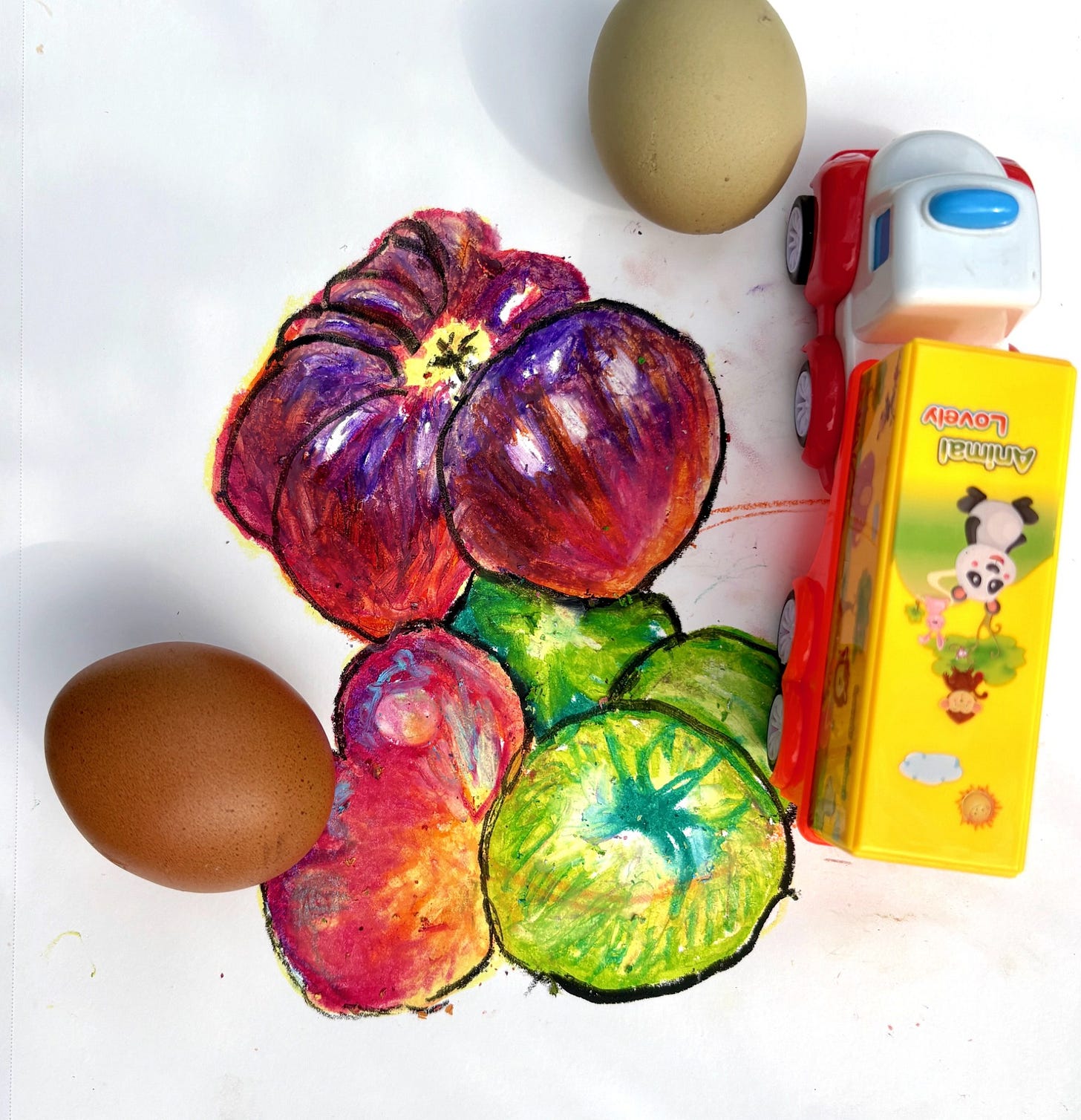
In addition to my indoor experiments, I am also growing “Zebra”, a beautiful green striped tomato that grows to the size of a tennis ball and stays round. We have a row of heirloom Cherokee purples, lining the sunniest fence. I have “Pink Fang”, which grows long and tubular, with a bulbous body. We have “Black Beauty”, which grows darker in the sun. There is a motley assortment of cherry tomatoes as well: ones that stay yellow, ones that are no bigger than a pom-pom and fruit prolifically. The heirlooms grow weird and delicious.
I come in after each trip to the garden, pockets bursting with fruit at first blush.
During the last trip inside, I noticed some tomatoes with blossom-end rot. This means a calcium deficiency. A few Tums in the ground at the base of the plants should get them sorted out.
I grab the less desirable tomatoes and bring them outside to my chickens. The tiny green tomato bounces as it lands on the floor of the run and then rolls. Fifteen chickens take off in pursuit of the fruit.
Penny, my mama hen, gets the fruit and runs it, like a football, down the perimeter of the coop. “Big Bird” makes a play and tackles her for it. I watch as my tiniest chicken, a silkie, makes off with the tomato after it rolls away from Hennifer.
Penny has a soft place in my heart after I watched her care for a ceramic egg for months, waiting for it to hatch. Miraculously, that egg turned into three peeping, baby silkies, after my last trip to the farm swap.
The proud mama kept them warm all spring, until they were too big to fit under her wings.
But wait. This is a periodical on detransition. Why are you telling me how to cure blossom-end rot?
Because, dear readers, it gets better.
Much like the cheesy advertisements from the mid-2000’s told us it would.
Grief is human. It is unifying, so we can turn to centuries old wisdom on how to move through it. My grandmother used to say that to live a good life is to learn to suffer well.
When I first realized I had to detransition to keep living, I had no clear picture of what that life could look like.
I could never have imagined that I would meet a man, a stranger to me then, get married and start a family. Never could I have dreamed of the little girl, squishing strawberries from the garden and calling me Mama. Six years ago, I knew nothing about gardening.
Today, my career is in a field I knew nothing about six years ago. I have made dear friends out of strangers.
So often, young people can fall into the trap of not seeing a future. One day at a time, one choice at a time, one interest at a time, in six years my life looks nothing like it did on that first day I decided to keep living.
We survive something profound, and the days keep going, putting more space between us and “the bad thing that happened.”
Seeds contain potential and life. They are miraculous little containers, holding hope and genetic code. When I put these seeds in the soil and nurture them, one day at a time, they grow and bear fruit.
Putting myself back together after surviving was a similar process. I collected all the seeds, all the potential life left in myself, and carefully put them in soil. I let my creator water them, and participated in caring for the baby plants as they emerged.
Nurturing something outside of myself helped me to put one foot in front of the other until I was able to look back one day and say, “ Wow, look how far we’ve come”.
What new interests have you gained in the time since desisting or detransitioning? What new people do you know now that you didn’t then? What new skills have you developed? What new job do you have?
Genspect publishes a variety of authors with different perspectives. Any opinions expressed in this article are the author’s and do not necessarily reflect Genspect’s official position. For more on Genspect, visit our FAQs.