




Yes, You Can Prevent a Hasty Diagnosis of Gender Dysphoria
By Genspect

The Genspect Gender Dysphoria Support Tool is a powerful counter to automatic affirmation
Sarah was shocked when her 19-year-old daughter announced she wanted to start testosterone. She had shown no gender distress throughout childhood. She had been a typical, happy girl who loved music and was creative from a young age. The feelings only appeared around puberty, coinciding with increased social media use during lockdown and a close friend who had also started identifying as ‘non-binary poly, but asexual’. Still reeling, Sarah agreed to go with her daughter to a gender clinic for an assessment.
Disrupting the Machine
It’s an all-too-familiar story: Isolated during the pandemic, a young person begins spending most of their time online. A real-life friend, or even just online peers, may begin identifying as trans or non-binary. The young person could be gender-nonconforming in some way, or may be autistic. Then comes a scripted announcement: They’ve always known they were really a boy/girl. There’s a new name, a demand for ‘life-saving gender-affirming care’, and an appointment at the gender clinic. To parents, it is as if their child has become caught in the wheels of some enormous machine—and it’s true. Everything about the affirmative approach works like a winch, ratcheting young people ever forward into its maw, until going back seems impossible. But there is something parents can do to help their child break free.
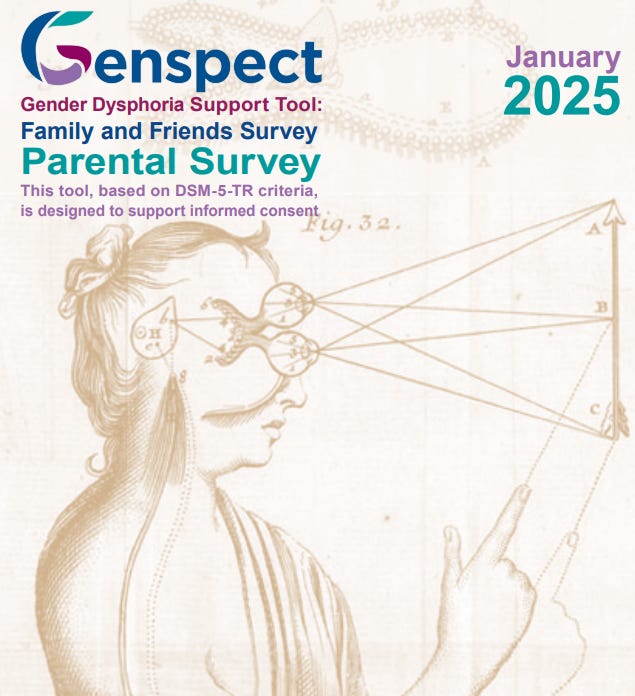
The Genspect Gender Dysphoria Support Tool is designed to prevent hasty diagnoses. It does this by applying the standard diagnostic criteria for gender dysphoria. These are sometimes referred to in short as “consistent, persistent, and insistent,” or, more formally, as being “clinically significant distress or impairment arising from a marked incongruence between one’s experienced/expressed gender and assigned gender (typically based on sex at birth), rather than gender nonconformity or identity variation alone” (from an article by the American Psychiatric Association). Such diagnoses rely almost exclusively on the patient’s self-reports, especially accounts of childhood, while discounting parents’ reports—after all, what parents observe and what a child feels at any given time might differ.
The problem lies in cognitive bias and selective memory—our tendency to project our current preoccupations onto the past. What we remember, as we learned in the so-called memory wars of the 1980s–1990s, is highly unreliable. Rather than depending on the memories of interested parties, listening to multiple recollections from more neutral parties gives a much clearer picture of what is actually going on. The Gender Dysphoria Support Tool is a powerful way to gain a more accurate assessment.
Comprised of two surveys, one for family and friends, and one for parents, it helps gather structured, multi-perspective information about a young person’s gender-related distress. It aims to ensure parental and family observations are documented (which makes them harder to dismiss) and to help identify potential underlying factors (such as comorbidities, trauma, autism, etc.) that ought to be explored before rendering a diagnosis of gender dysphoria. Sarah’s story, continued below, shows exactly how it works.
The Tool in Action
Sarah thoroughly prepared for the appointment at the gender clinic. She, several close family members, and long-time friends completed the detailed Genspect Dysphoria Support Tool questionnaire. These accounts clearly documented that her daughter’s childhood was without any signs of dysphoria. At the appointment, she stayed calm and presented the completed surveys and statements. What happened then shows the tool’s potential.
The clinician reviewed the material carefully. He decided against starting hormones straight away, recommended a six-month pause with counselling, and even refunded the consultation fee. Once it was clear that medicalization was off the table, the pressure on the family eased considerably. Her daughter even used the refunded fee to go to a music festival with friends.
The situation is not fully resolved. Her daughter still identifies as male or as “non-binary”—but what does that even mean, and why would it require taking testosterone? In some settings, like at college, she remains strongly influenced by her trans, non-binary, asexual friend. However, the tool has taken medicalisation off the table for the moment and has given her daughter valuable time to grow into adulthood.
Sarah says: “We were polite, non-confrontational, and simply presented the facts about her actual history. It clearly made a difference.”
This case closely mirrors the first Scottish success story shared on PITT last year, in which another family used the Genspect Dysphoria Support tool. As a result of the evidence they gathered, the clinic decided to drop their daughter’s hormone pathway. In both instances, providing a fuller picture of the young person’s development, autism-related challenges, and social influences led the clinic to step back.
These outcomes show that prepared, evidence-based parental involvement can still protect young adults from hasty medical decisions. The Genspect Gender Dysphoria Support Tool is free and available in English, Dutch, German, and French.
Genspect publishes a variety of authors with different perspectives. Any opinions expressed in this article are the author’s and do not necessarily reflect Genspect’s official position. For more on Genspect, visit our FAQs.