



Words of War, Words of Peace
By Sara Morrison
I grew up in Belfast when the air was thick with tension, spoken and unspoken. Language wasn’t just communication, it was survival. Painted kerbs, murals, flags, even how you pronounced the letter ‘h’: each one a coded message about who belonged and who didn’t. You learned early on how to read the room because sometimes, misreading it had consequences. And not the kind that played out online – I’m talking about real-world, physical danger: a wrong word in the wrong place could get you beaten, kneecapped, or worse.
So perhaps it’s no surprise that I see something chillingly familiar in today’s gender debate. Not in the threat of violence though online, the aggression is real but in the language: euphemistic, moralising, and loaded with emotional coercion. Back then, it was “interface,” “peacekeeping,” and “legitimate target.” Now it’s “affirmation,” “erasure,” “lived experience.” All soft-sounding words, used hard.
When the Good Friday Agreement was signed in 1998, I was living in London, but like many from across the island of Ireland, I felt the weight of it. The document didn’t solve everything, but it showed how political language could be used to de-escalate rather than inflame. It was careful, negotiated, and – most importantly – measured. Every word mattered because every word could be a landmine.
Mo Mowlam, who practically dragged the process over the line with sheer willpower and charm, once said: “We don’t need to fall in love with each other. We just need to find a way to live together.” That line has stuck with me. It’s a grown-up way of thinking, one that has no room for ultimatums, purity tests, or ideological litmus.
Today, we seem to have forgotten the value of that restraint. In debates over gender identity, we’ve embraced hyperbole as a moral imperative. To question a teenager’s access to puberty blockers is framed as denying their right to exist. To believe in biological sex is “literal violence.” And in an opinion piece last week’s in the Belfast Telegraph, Caitlin Wickham went so far as to compare gender-critical viewpoints to the early stages of the Holocaust.
That is not only historically illiterate, it is profoundly offensive to many. The Nazis targeted Jewish people, Roma, political dissidents, and gay men with a systematic campaign of extermination. To compare legitimate public policy debates to this is to trivialise actual genocide and shut down dialogue. It’s rhetorical arson masquerading as compassion. Trans people in the UK and Ireland are protected under multiple pieces of legislation. Between 2008 and 2020, 11 trans individuals were murdered in the UK, tragic, yes, but not evidence of a coordinated campaign. Compare that to the Femicide Census, which shows a woman in the UK is killed by a man every three days. Since 2020, 24 women in Northern Ireland have lost their lives to violent attacks – nearly all at the hands of men. Since 2017, there have been 41 confirmed femicides, giving Northern Ireland the highest per capita rate on the island of Ireland and in the UK, and the third highest across Europe.
The suicide narrative is another example. While activists often claim that failing to affirm a trans identity leads to suicide, the data simply doesn’t support this. Mental health challenges in gender-distressed youth are real – but complex. Suicidality in this group often correlates with autism, trauma, and family breakdown. To suggest that affirmation is a life-saving intervention is irresponsible and harmful. Perhaps more importantly, high-quality data indicate that people who undergo medical transition are more than 19 times more likely to die by suicide compared to the general population. In contrast, the suicide rate among gender-distressed young people is comparable to that of other youth with mental health challenges. Taken together, these data points suggest that medical transition may be a risk factor for suicide, rather than a protective one.
Nor can we ignore the distinction between LGB rights and the current gender debate. The fight for same-sex attraction was about removing legal barriers to same-sex relationships. Gender ideology, by contrast, raises entirely different concerns: the harmful and irreversible medical interventions that lead to infertility, sexual impairment and multiple physical challenges, fairness in sports, safeguarding in women’s spaces, and the right to define biological reality. Lumping all of this under a single rainbow banner flattens necessary complexity.
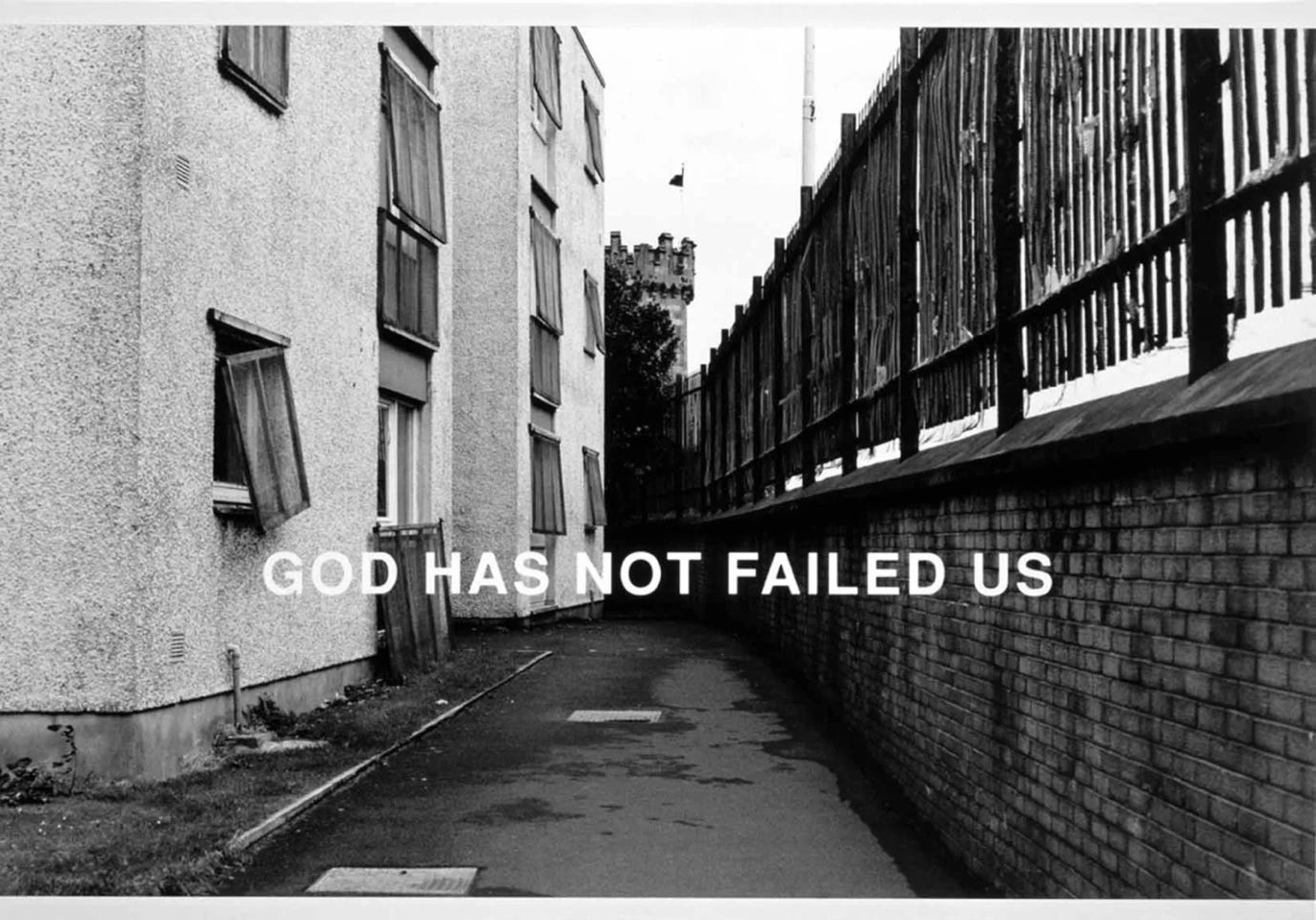
This is where artists like Willie Doherty offer something vital – not solutions, but insight. Born and raised in Derry, Doherty lived through the worst of the Troubles. His work, often text superimposed on stark images, captured the unnerving ambiguity of conflict. Words like “PROTECTING” and “INVADING” float over desolate landscapes, forcing viewers to confront their own assumptions about who is being protected, and from what.
In God Has Not Failed Us (1990), a line of text overlays an alleyway, evoking religious defiance, despair, or both. The slogan “God has not failed us” reflects a Protestant minister’s endorsement of the authorities’ refusal to approve a civil rights march, while permitting the Apprentice Boys parade. This denial of protest approval intensified tensions between the police and the Catholic community, exacerbating existing frustrations with discriminatory policing. The refusal to allow peaceful demonstration further inflamed the situation, contributing directly to the outbreak of the Battle of the Bogside in 1969. Doherty understands that language, especially in divided societies, is never neutral. His work feels disturbingly relevant again – because our current discourse is once again full of signals, boundaries, and sides.
We can also see this in the renewed tensions surrounding Belfast’s bilingual street signage. What should be a simple civic gesture acknowledging the Irish language, becomes a flashpoint. Why? Because in a contested place like Northern Ireland, language is identity, and identity is territory. The fight over whether a street sign reads “An Bóthar Mór” as well as “Ravenhill Road” is about more than translation, it’s about belonging and identity. Just like the slogans on gender, these symbols tell you who is welcome and who isn’t. They don’t open up dialogue – they close it down.
In the post-conflict North, we developed a cultural reflex: be kind, keep the peace. It was necessary, for a time. But kindness without scrutiny becomes dangerous. Last year, a Mermaids Centre opened here in 2024, an extraordinary development given that Mermaids, the UK charity that claims to support transgender youth, has been at the centre of escalating controversy and was formally investigated by the Charity Commission. The inquiry, launched in 2022 after serious public complaints and media exposés, revealed alarming governance failures. Mermaids had sent chest binders to children without informing their parents, offered reckless advice in online forums, and maintained ties with the discredited Tavistock gender clinic even after serious concerns about its practices had become public. The leadership, particularly under former CEO Susie Green – who resigned under a cloud of criticism in late 2022 – failed to show accountability or transparency. While the Charity Commission stopped short of finding deliberate misconduct, it issued a damning assessment: the charity’s governance, culture, and safeguarding were wholly inadequate and had failed to evolve in line with its growing influence. The findings confirm long-standing concerns that Mermaids prioritised ideology over child welfare. This should have prompted public alarm. Instead, in Northern Ireland, it barely raised a whisper. Why? Because questioning it would be seen as unkind.
But uncritical kindness is not a virtue. It is complicity.
We need to return to grown-up conversation, of the kind Mo Mowlam excelled at. Where disagreement doesn’t mean annihilation. Where words are chosen with care, not flung like grenades. Where the desire to “be kind” is matched by the courage to tell the truth.
Because when language becomes a weapon, it doesn’t just silence – it can incite. And when words are used as weapons, violence often follows. Silence isn’t peace. It’s fear.
Sara Morrison is the director of Genspect Ireland.
Update: Today, the 16th April 2025, the UK Supreme Court ruled in favour of For Women Scotland in a landmark case affirming that the legal definition of “woman” under the Equality Act refers to biological sex, not gender identity. This ruling is not just a legal technicality – it’s a profound moment of clarity in a landscape clouded by euphemism and ideological obfuscation. It confirms what many women have been trying to say for years: that language matters, especially in law. Just as the Good Friday Agreement showed us the power of precise, negotiated terms to prevent conflict, today’s judgment reinforces the need for language that reflects material reality – not feelings, not identities, but facts. This decision reclaims ground for those who have been vilified for saying what was, until recently, self-evident. It is a turning point – and a reminder that peace is not built on silence, but on truth.

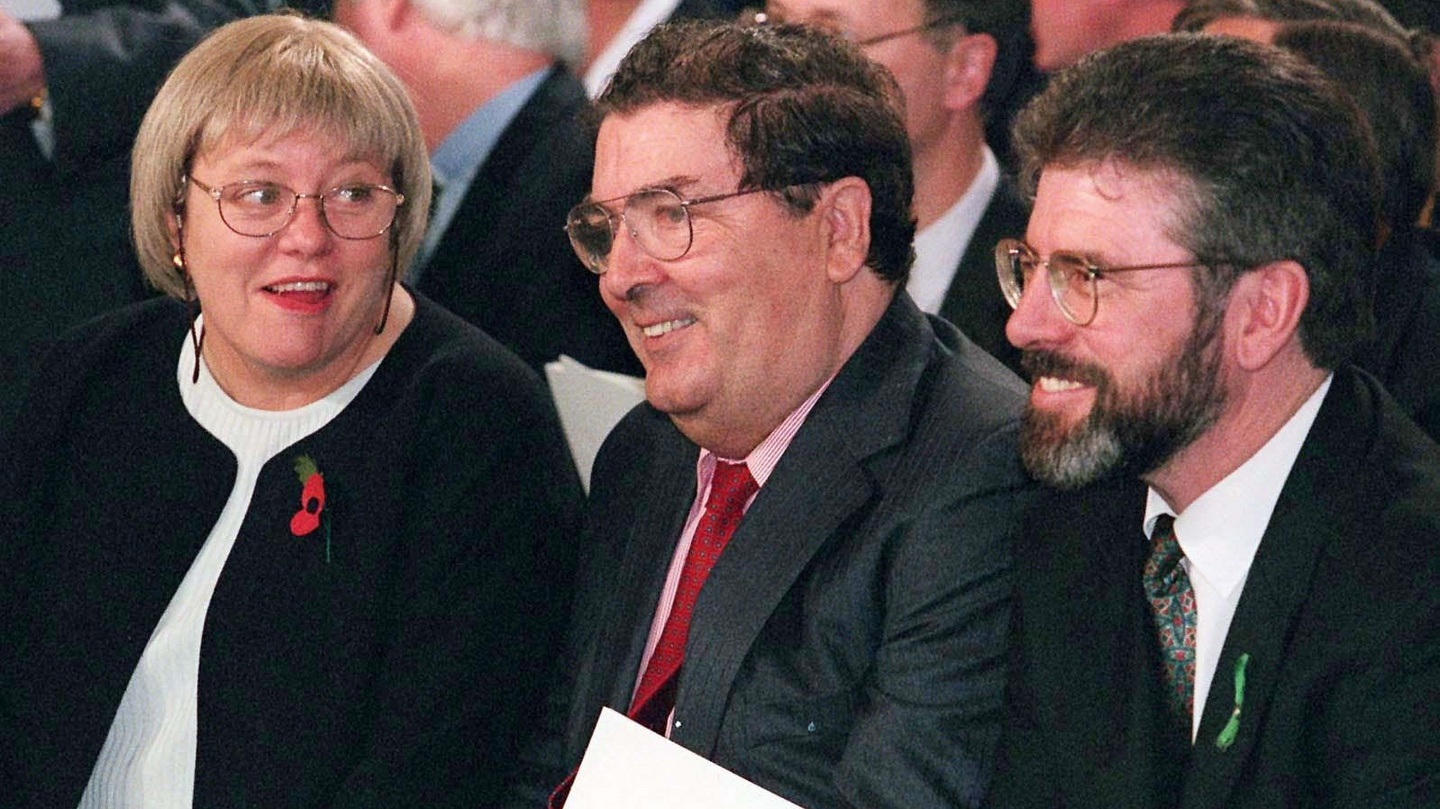
Photo credit: The then secretary of state for Northern Ireland Mo Mowlam with SDLP leader John Hume and Sinn Féin president Gerry Adams. Photograph: Brian Little / PA