




Who Comes to a Genspect Conference?
(The Results Might Surprise You)
By Stella O'Malley
In Genderworld, everyone’s fighting a different fight on the same battlefield. The feminists are smashing the patriarchy, the academics are saving academia, the left are rescuing humanity from far-right fascists, and the right are gallantly saving it from left-wing loons. Meanwhile, influencers are selling merch, commentators are chasing clicks, professionals are marking their territory, and activists are stretching for their next moral victory on Twitter.
Perhaps that’s why, since Genspect’s launch in June 2021, people have been suspicious. Whose side are you on? they ask, narrowing their eyes as if we’re hiding a manifesto up our sleeve.
But Genspect has no hidden agenda. Our only interest is uncovering the truth about the trans phenomenon, not advancing a cause. Full disclosure: if Genspect fits anywhere politically, it’s within the classical liberal tradition — one that values open dialogue, individual freedom, and resistance to dogma. And just to be clear, that’s not “liberal” in the American sense.[1]
That’s why we welcome a range of voices – as long as they’re civil, well-informed, and willing to engage in honest debate, we’re happy to offer a platform. We’ve said the same thing since day one: the trans issue demands objectivity, evidence, and open dialogue. From our very first article, published on launch day, Genspect set out its mission clearly. We take an explicitly cross-partisan, evidence-based approach to one of the most divisive issues of our time.
Still, assumptions persist. So this year, we decided to test them.
We conducted a conference survey of roughly 300 participants in Albuquerque, New Mexico to finally figure out who supports Genspect. Not everyone filled the online survey out, yet enough did for it to be representative.
So what does the survey tell us about the Genspect community? You can follow this link for the detailed results, but here are some highlights.
To start with, the sex breakdown was roughly 76% women and 23% men. Around 39% of delegates were parents of trans-identified children, and 95.5% of those parents believed the term “ROGD” accurately described their child’s experience.
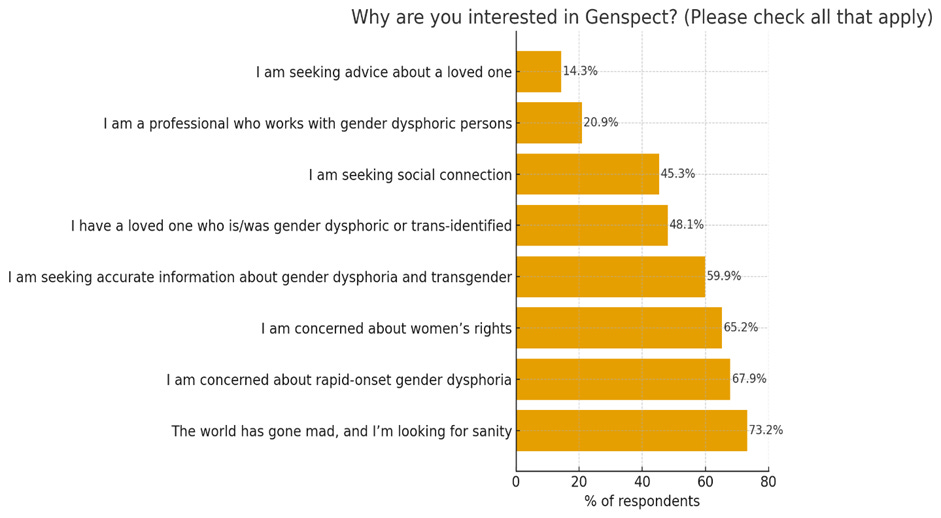
For 60% of participants, it was their first Genspect conference. Overall, the results reflected a group of people looking for sanity, clarity, and accurate information. When asked why they were interested in Genspect, 74% said they were concerned about youth transition, and 73% said they believed the world had gone mad and were looking for sanity. (Participants could tick more than one box.) Sixty-five percent were worried about women’s rights, 48% had a loved one who was gender dysphoric, and 21% were professionals working with gender-distressed individuals.
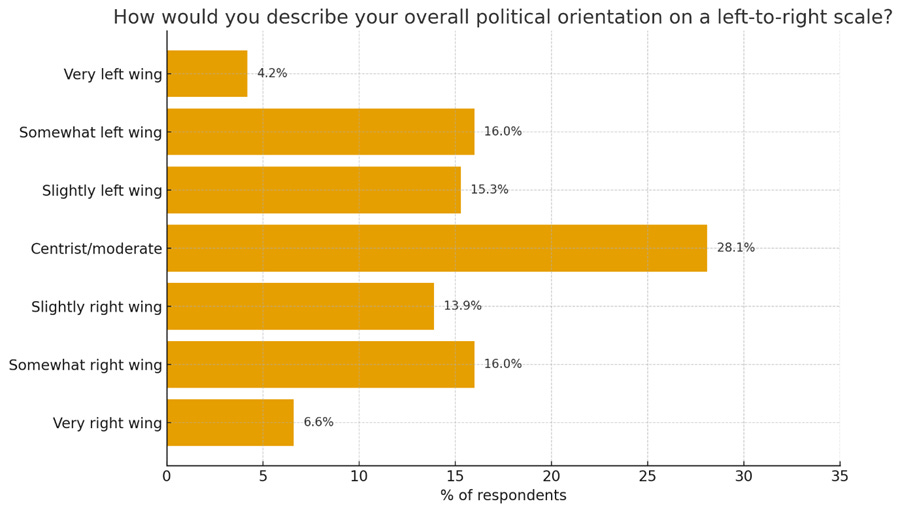
Now for the big one – politics. Apparently, we’re either a right-wing conspiracy or a left-wing plot, depending on who you ask. Everyone was convinced they were surrounded by the opposition. Republicans told me the place was crawling with Democrats, while Democrats wondered whether they’d wandered into a MAGA rally by mistake. It turns out – quelle surprise – they were both wrong, and both right. In reality, 35.5% described themselves as left of center, 28% as center, and 36.5% as right of center.
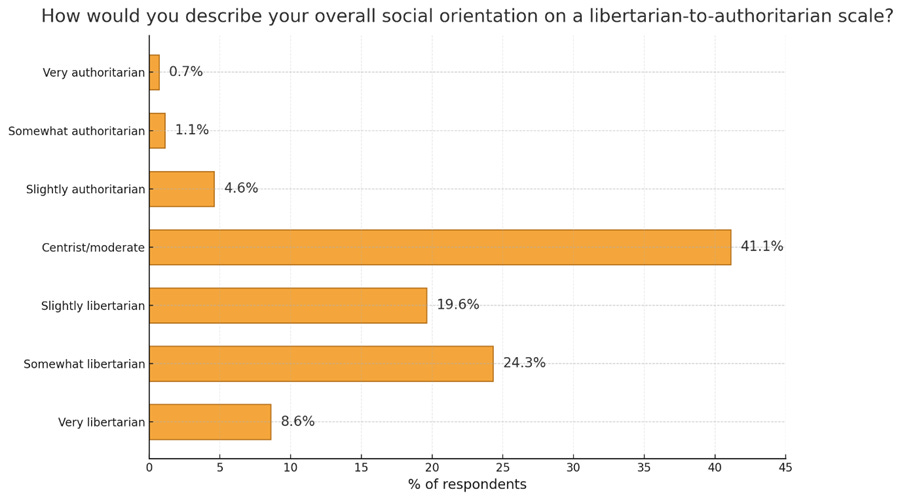
As the left-right divide is arguably an anachronism that no longer captures the realities of modern politics, we also asked delegates where they placed themselves on the libertarian-authoritarian scale. This proved especially revealing: 52.5% leaned libertarian, 41% were centrist, and only 6.4% identified as authoritarian.
Thus, the data suggests that most attendees lean toward a “live and let live” philosophy, whatever their place on the political spectrum. This was reflected in the finding that 77% supported gay marriage, 9% were unsure, and 13% opposed it. Likewise, 83% believed gay people should have employment protections, with 10% uncertain and 7% opposed.
When it came to transgender issues, however, the mood shifted. 43% supported employment protections for transgender people, while 32% were uncertain and 25% opposed. The message seems clear: most believe that people who have transitioned deserve the same protections as everyone else — no more, no less. It may also suggest that some attendees view medical transition as a mental health issue rather than an immutable identity.
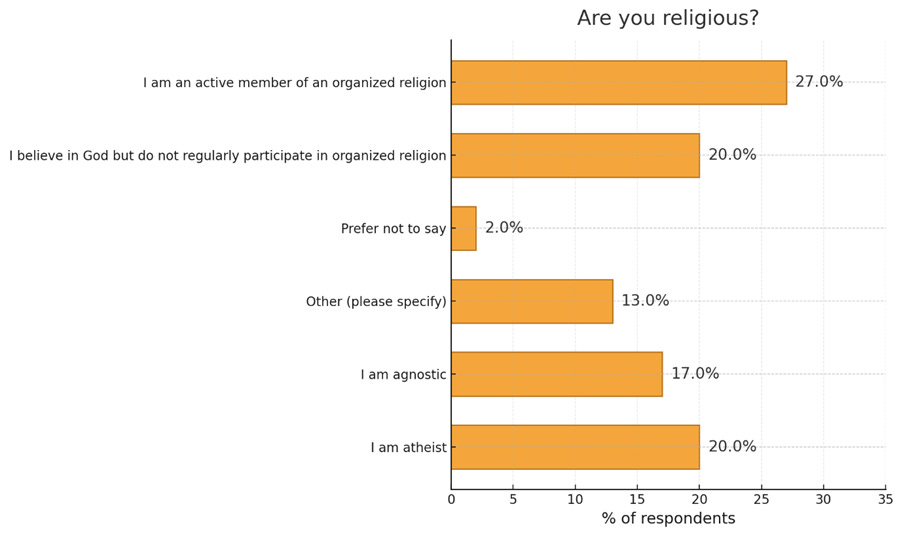
Next up, religion. Genspect is apparently both too religious and not religious enough – depending on who you ask. At the conference, atheists grumbled about “too much God talk,” while the religious crowd sighed that there wasn’t enough. I took it as a sign we’d found the sweet spot: when both sides are complaining, you’re probably getting it right.
In fact, 27% of attendees were active members of an organized religion, 20% believed in God but didn’t participate in organized religion, 17% were agnostic, and 20% were atheist. A broad church indeed – and we like it that way.
As for worldview, 75% described themselves as gender critical, 73% as scientifically minded, 51% as classical liberals, 40% as feminists, 39% as TERFs, 8% as radical feminists, and 3% as detransitioners or desisters.
Genspect’s delegates tend to be experts in their own fields. Medical professionals once claimed ownership of this domain, but it’s clear that many have failed to grasp the broader social and political forces driving the crisis. Those drawn to Genspect understand these realities as academics, scientists, philosophers, lawyers, clinicians, teachers, parents, and thinkers who’ve watched the system fail in real time. Their insight is grounded in experience, knowledge, and the courage to ask the questions officialdom avoids.
It turns out that, far from being a tribe of ideologues, Genspect supporters come from every corner of the political spectrum. Ever since its inception, Genspect has had to navigate the tribalism of modern politics. We are proudly cross-partisan – open to speaking with anyone. Yet the hyper-tribal nature of today’s politics can make our classically liberal stance feel almost impossible.
In a bid to explore forward-thinking solutions, we asked survey participants where they saw potential for real progress — what kind of policies could steer us out of the ideological swamp. Regarding the availability of medical transition, 33.5% said it should not be available to adults “under any circumstances,” while 16.2% said it should be available only “with strict safeguards.”
Echoing our forthcoming Gender Framework, when asked how society should balance the rights of transgender people with the rights of women and children, 91% said we need to prioritize biological sex over gender identity.
On the question of funding for medical transition, 47.0% believed it should be funded only through private means; 42.4% said it should not be funded under any circumstances; 5.7% favored public or insurance coverage with strict safeguards in place; and 0.4% supported funding on request with informed consent.
Looking ahead, few delegates (just 2.8%) thought more research was the answer to the current crisis in trans issues. Most (38%) pointed to legal and policy reform, while 24% favored raising public awareness — my own preferred route, since there’s no policy fix for mass misinformation.
Many delegates spoke about a sense of relief during the conference — the freedom to speak felt like throwing open a window in a stifled room. Yet that same freedom has been shadowed by the threat of violence. The assassination of Charlie Kirk hung over the conference like a storm cloud. We spent tens of thousands on security — far more than we ever anticipated — and chose our venue largely for safety reasons. That’s the price of speaking freely in 2025: bodyguards, metal detectors, and endless, exhausting, expensive protocols. All to ensure that no one is shot dead for the “crime” of expressing an unpopular opinion.
It’s a grim measure of how far we’ve drifted that speaking freely now feels like an act of rebellion. The gender wars have worked a strange, dark magic, turning mild-mannered liberals into the new radicals. The same people who once trusted the establishment now get called fascists by the very institutions they once relied on — simply for using biological terms correctly. Many who once assumed free speech was safely secured, a battle long since won, now whisper for permission to speak the truth.
At Genspect, we pride ourselves on cultural humility — recognizing that we don’t know what we don’t know, and that none of us has a monopoly on wisdom. This spirit shapes everything we do, from the speakers we invite to the tone of our discussions.
Still, tribalists struggle to believe that we don’t have a hidden agenda. The more conspiratorial insist we’ve been infiltrated by one side or the other.
But the data tells a different story. The people drawn to Genspect aren’t extremists. We come from all sides, all backgrounds, all belief systems. We argue, we disagree, and we challenge each other — but always with respect and curiosity. As long as children and vulnerable people are being harmed, we’ll keep the conversation going.
[1] Note – Classical liberalism is not “liberal” in the American sense of the word. It’s a political and economic philosophy that emerged in the 18th and 19th centuries, emphasizing individual liberty, limited government, free markets, private property, and the rule of law. Rooted in Enlightenment ideas from thinkers like John Locke and Adam Smith, classical liberalism prioritizes personal freedom, economic autonomy, and protection from state interference, viewing government primarily as a guarantor of individual rights rather than a provider of social welfare.
Meanwhile, in the contemporary United States, a liberal typically refers to someone who supports a more active role for government in addressing social and economic inequality, advocates for civil rights, environmental protection, and progressive social policies, and upholds individual freedoms within a framework of social justice. American liberalism, shaped by Roosevelt’s New Deal and various civil rights movements, contrasts with classical liberalism by favoring state intervention to promote equality and collective well-being.