




The Two-Bill Pipeline: How California Continues to Build a Legal Machine to Take Your Children
By Erin Friday

Experience has shown Genspect time and again that depriving gender distressed young people of their families is the last thing they need. Erin Friday’s trenchant article, originally published by Our Duty, shows how the State of California’s new bill, AB1967, building on an earlier bill, AB 665, makes it easier to do so, while creating perverse incentives to do so in more cases.
There is a specific kind of California bill that does not announce itself honestly. It arrives with a sympathetic framing, with some provisions that appear to be beneficial and a set of legislative findings that describe a problem real enough that most legislators will be loath to oppose. Read the Post Script to see how the Assembly Republicans were hoodwinked by this bill.
Assembly Bill 1967 is one of those bills. To understand how dangerous this bill is, we have to begin with a law that passed three years ago, AB 665, about which we wrote extensively. AB 1967 is not a standalone policy but is part of a bigger agenda. This agenda is to create a hellscape where “chosen families” replace biological families, where children’s autonomy replaces parental direction, and where parents’ hard-earned money is used to fund the entire operation.
Step One: Assembly Bill 665
In 2023, California passed AB 665, authored by Assemblymember Wendy Carrillo. It amended Family Code § 6924 to allow minors 12 and older to consent to mental health treatment and residential shelter services without parental consent and without notice to the parent. The sweetener in the bill was that Medi-Cal would cover mental health treatments for poor children. This aspect provided a pathway for the author to present a perceived benefit while ignoring the most pernicious provisions. This strategy is quite successful, especially when the press does not read the bill, fails to understand it, or needs a convenient hook to pivot from the genuine effect of the bill.
Prior to AB 665, California law had a gatekeeping requirement. A minor could only self-consent to residential shelter services if two conditions were both satisfied. The conditions were that the minor was mature enough to participate intelligently in the therapeutic process, and the minor was either in danger of serious harm to themselves or others, or was a victim of incest or child abuse. That second condition was a crisis predicate. It was the line between a state system responding to a genuine emergency and a state system substituting its judgment for a parent’s.
Under the new Family Code § 6924, operative July 1, 2024, a 12-year-old needs only to be deemed “mature enough to participate intelligently” in the outpatient or inpatient mental health sessions by a “professional person.” (Notably, Assemblymember Rick Zbur tried to pass a bill (AB 2242) that would have expedited licensure for those professionals who would commit to engaging in “gender affirming” medical or mental healthcare. It was vetoed, despite Governor Newsom’s desire to “see trans kids.”)
When a child leaves the family home, without consent or knowledge of the parents, and goes to a residential shelter, a definition that includes LGBTQ centers, the center needs only to make “best efforts” to contact the child’s parents. What does that mean? It means consulting the child first to determine whether parental involvement is “appropriate.” If the child objects to parental involvement and the professional agrees after hearing only from the child, the parent is not contacted. The parent is not afforded the opportunity to provide his or her position, inform the shelter of the child’s mental health or medical issues, or defend against any misrepresentations by the child. The record of that “appropriateness” determination gets tucked away into the client file, completely inaccessible to the parent. Should the professional believe that the parent is worthy of knowing where the child is, the professional determines whether their efforts were good enough. The record of any attempts is also kept in the private file.
Any argument that the purpose of AB 665 is to protect children is belied by the bill’s own legislative findings. Finding (h) identified LGBTQ+ youth who reported that needing parental permission was “sometimes or always a barrier” to accessing gender-affirming health care. Finding (i) bemoans the fact that school counselors cannot always get parental consent because of the parent or caretaker’s beliefs, like, say, in biological reality?
AB 1967 builds out the process such that a gender-dysphoric 12-year-old can now walk into a state-connected residential shelter, begin receiving gender-affirming counseling, without parent consent or notice, and start the process of finding another family.
Step Two: Assembly Bill 1967
AB 1967, authored by Assembly member Rick Zbur, amends section 329 of the Welfare and Institutions Code (“WIC”) to allow any minor residing in any residential facility licensed under Health and Safety Code § 1502 to file an application for dependency proceedings against the parents. Let me put that in simple terms. A child, of any age, can unilaterally choose his own family even when the child is placed in a safe and appropriate facility by the parents or self-places himself under the process created by AB 665.
The universe of licensed residential facilities includes shelters and crisis centers, group homes, short-term residential therapeutic programs, private alternative boarding schools, private alternative outdoor programs, children’s crisis residential programs, and faith-based residential facilities. A parent who places a child in any of these settings has, under AB 1967, handed that child a legal mechanism to initiate the removal of their own parents’ custody.
AB 1967 creates a streamlined process for a minor or for the child’s attorney to petition for a dependency that removes control of the child from the parent, temporarily or permanently, without provocation. The minor’s counsel can be affiliated with the facility housing the child or with a nonprofit that may financially benefit from the removal of the child from the family. The application does require the minor to allege abuse or neglect under the Welfare and Institutions Code § 300, but subsection (c) covers serious emotional damage. Social workers and dependency courts have been trained to consider a parent’s refusal to affirm a child’s gender identity to be emotional damage. Even a placement in a drug rehab, mental health facility, or a boarding school that has rules that the child does not like could be sufficient for the application.
No adult has to corroborate the allegation of the child. No mandated reporter has to observe anything. The child’s unverified statement is sufficient to set the machine in motion, while the parent is unaware that the application was filed.
The filing triggers a mandatory social worker assessment of the safety of the parents’ home. Assessment does not mean investigation, and therefore, a home visit at the pre-petition stage is not required. The parents may not know that the safety of their home is being assessed. The assessment can be completed based entirely on the child’s statements, without a physical visit to the home. The assessment can be based purely on the child’s statements.
The remarkable thing is that even if the facility where the child is actually living is safe and was chosen by the parents, the application triggers government interference and places the parents unwittingly at risk of losing control of their child. The child, too, is in danger because once the child is in state custody, the treatment plan that the parents determined was in the best interest of the child is not required to be followed.

Even in cases in which the social worker declines to file a § 300 petition because the social worker does not believe that the parents are unsafe, the minor or the minor’s attorney can override that assessment and demand a mandatory court review. The court must rule within 14 days. If the court orders the petition filed, a detention hearing is scheduled, which must be held no later than the next judicial day after the petition is filed. Remember, during this entire process, at no time do the parents know the child (or the child’s) counsel is seeking to place the child into state control.
The parents’ first realistic opportunity to learn that any of this is happening, if they are lucky, is at the detention hearing. The parents will have no time to find counsel, review the allegations, and obtain evidence to provide any meaningful defense. During that initial dependency hearing, the court can vest temporary custody of the child in the county child welfare department. From that moment, the county controls placement, controls visitation, controls the therapeutic program, and controls the reunification timeline.
That timeline for the dependency, under WIC § 361.5, runs up to 18 months for children three and older. During those 18 months, the dependency process does not adjudicate whether the original § 300 allegations were true. It measures parental compliance with court-ordered services that can include parenting classes, counseling, social worker contact, and compliance reviews. A parent who placed a child in a lawful therapeutic program and has done nothing wrong can spend 18 months in that process before any court has found they did anything requiring it. Visitation with the child is, for all intents and purposes, controlled entirely by the county social worker.
By way of example, in a case involving a gender-dysphoric child whose parents declined to affirm a transition, if visitation is granted, it is typically supervised, time-limited, held at county facilities, and conditioned on behavioral rules, including required usage of the child’s chosen name and pronouns, prohibition on speaking about the parents’ position on sex-rejecting interventions, and any discussion of religion. While the child is in custody of the state, under current law, the welfare system must affirm the child’s transgender identity, develop a case plan that includes gender-affirming services, and must assist the child in obtaining sex-rejecting interventions. The child must be provided accommodations in accordance with the child’s gender identity.
Cash for Kids!
Once the county takes control of the child following the detention hearing, the child must be placed in an AFDC-FC-eligible facility. To be AFDC-FC-eligible, a facility must be organized and operated on a nonprofit basis. The current AFDC-FC rate for short-term residential therapeutic programs is $17,616 per month in state and federal money.
A residential facility that is AFDC-FC-eligible and currently housing a child on private-pay funding has a direct financial incentive to facilitate a dependency filing because it converts the placement to county-supervised foster care with significant monthly guaranteed public funding. If the child was placed by the parents in a non-AFDC-FC-eligible facility, the county must move the child and place the child elsewhere. The parent loses all authority over the child’s treatment. The attorney helping the child may financially benefit from sending the child to the awaiting AFDC-FC facility. The bill does not have any conflict-of-interest safeguards against this scheme.
This financial incentive structure smacks of fraud, waste, and abuse, with California’s children at the heart of the grift.
Child welfare agencies and nonprofits incessantly complain that they don’t have enough social workers, that there are insufficient numbers of foster care homes, that more and more children need shelter, while asking for increases in spending, while at the same time, the legislature and those very same agencies and nonprofits work to create the very problem they are supposed to resolve. How Southern-Poverty-Law-Center of them.
Conclusion
AB 665 permits children to self-admit into residential facilities, which sets up their removal from their parents. AB 1967 permits children to extricate themselves from their parents’ residential choices. Together, they create a pathway towards the systematic dissolution of the biological family.
POST SCRIPT – WHY THE ASSEMBLY REPUBLICANS VOTED FOR AB 1967
AB 1967 sailed through the Assembly without one Republican voting against it, even dispensing with oral hearings in the Assembly Judiciary Committee, which has three Republicans (Sanchez, Macedo, and Dixon) on the committee, because of unanimous support before the hearing date. [1]The two Republicans (Castillo and Tangipa) on the Human Services Committee hearing uttered not a peep before voting for it. All of the voting Republicans in the Assembly thereafter voted in favor of the bill. I think I know why, though this does not excuse the oversight of the Republicans.
An error, or more likely a blatant maneuver, occurred. The bill, when introduced, failed to highlight the proposed new offending language, making it appear as though it was existing law. (See Photo 1.) With close to 2,000 bills in play, a complacent legislative staffer may have only performed a perfunctory review of the highlighted language and not read the entire bill. A full reading should have led them to compare existing law to the bill language — both highlighted and not — because it simply did not pass the smell test. The hijinks would have then become readily apparent. (See Photo 2.) But the Republicans fell for Zbur’s presentation that the bill was just about helping homeless and abused kids get help through the foster care system.
Pro-tip: Any bill authored by Assembly member Rick Zbur and members of the LGBTQ caucus, or any bill that touches on children, merits in-depth scrutiny.
Photo 1. The existing law. Note that there is no subsection (c).
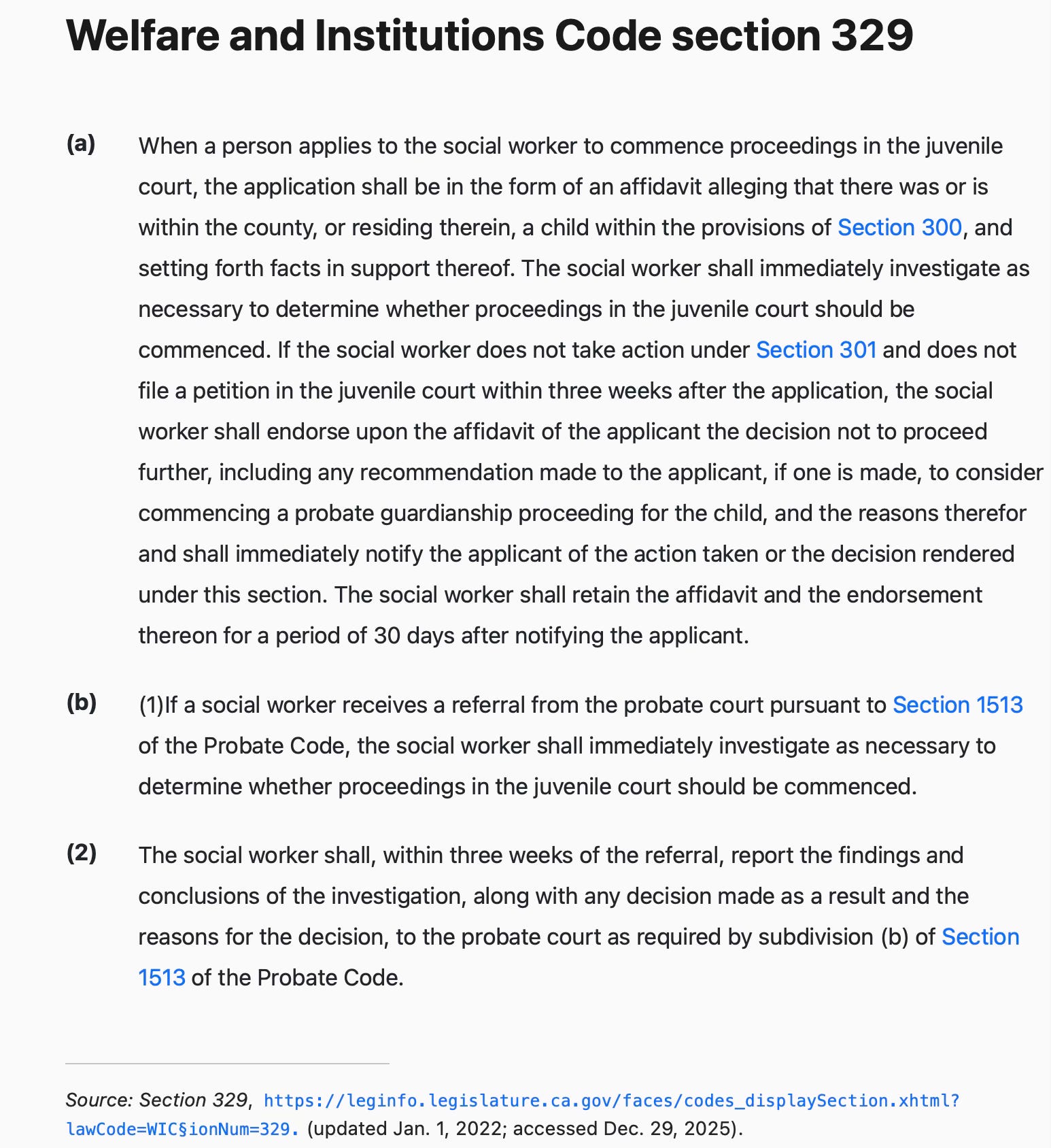
Then, look at the introduced bill. Subsection c was added but the entire subsection should have been in blue. The lack of highlighting in makes appear that on the terms “by the minor’s attorney” were added. Mistake or purposeful? Knowing Zbur, I vote purposeful.

[1] The technical term for this is “putting a bill on the consent calendar.”
Genspect publishes a variety of authors with different perspectives. Any opinions expressed in this article are the author’s and do not necessarily reflect Genspect’s official position. For more on Genspect, visit our FAQs.