




The Most ‘Careful’ Clinics in the World?
By Hermes Postma
Dutch transgender care is “careful” — that’s the mantra. And it’s one that is reiterated by the Health Council’s transgender care for youth committee
The Amsterdam University Medical Centre exported its approach to the Ghent University Hospital gender clinic. Toronto’s Gender Identity Clinic then began to copy the Dutch protocol, followed by Boston Children’s Hospital. Through these early adopters, the model reached the Tavistock and Portman NHS Foundation Trust’s Gender Identity Development Service (GIDS) in the UK and spread to many other clinics and countries. Concerns were later expressed at the Tavistock GIDS, prompting Michael Biggs to research the outcomes of puberty suppression and publish his papers.
Yesterday, two years after it was established, the Dutch Health Council’s temporary committee published its report on transgender care for young people. Their conclusion? “The treatments achieve the intended physical effects, and there are indications of some mental health improvement.” Though they admit that“possible effects on cognition and fertility have not been sufficiently researched”; “long-term data are lacking” and “due to short follow-up periods and substantial dropout in studies, the number of people experiencing regret cannot be reliably established from the available literature.”
But at least it is “carefully organized”
Geert-Jan Edelenbosch, one of the Netherlands ’ gender-critical voices, and a friend, pointed out the gaps in the Health Council’s logic on X:
‘The question is not whether “transgender treatment for teenagers” is carefully organized, but why an extremely invasive and partly irreversible treatment for children is justified at all when there is so little evidence.
If you start from the idea that gender dysphoria is primarily an expression of an underlying gender identity, then medical intervention quickly becomes a logical next step. But if gender dysphoria is seen as suffering with a wide range of possible causes (puberty, sexuality, autism, trauma, depression, social pressure, body image), then medical treatment is not self-evident.
The Health Council now presents the advice as a kind of carefulness test, but that leaves the real questions open: can you determine with sufficient certainty a “gender identity different from the body” in children? Is that enough to justify such drastic interventions? What does “affirming” a gender identity mean when it comes to children who are still developing? And why is the uncertainty about such far-reaching consequences ultimately placed on the child? That is what the Health Council should provide clarity on.’
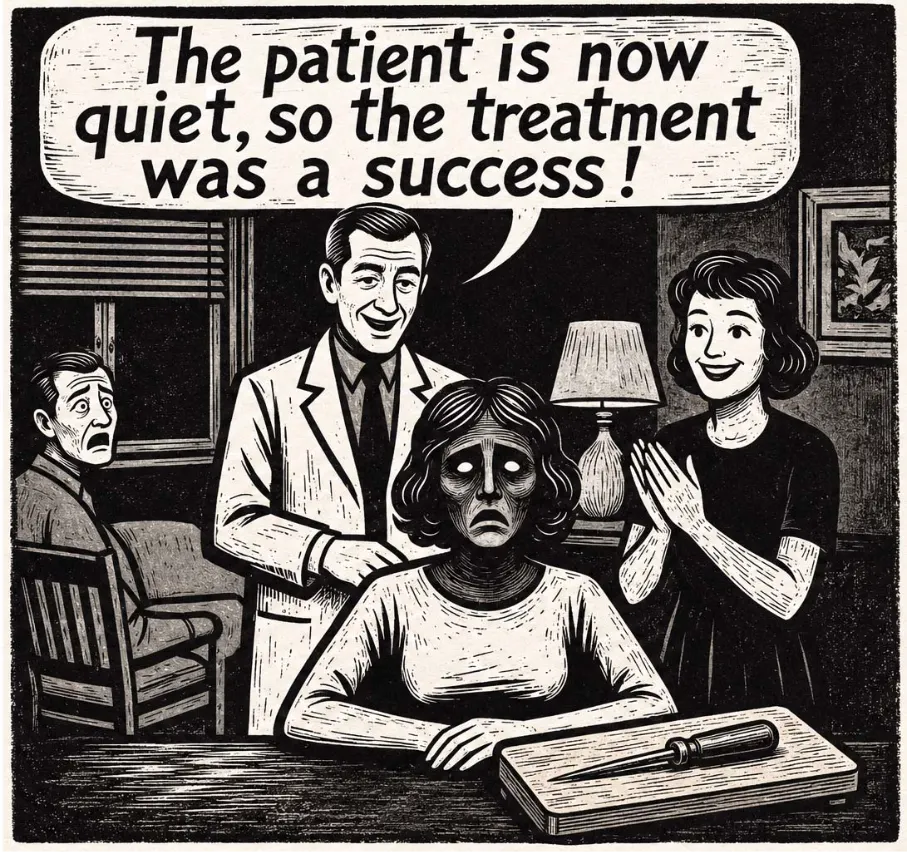
Fighting Absurdity with Humour
Do the authors of the report expect us to take them seriously when they say, “Hormone treatments are physically effective”? What are they saying?
The absurdity of the Health Council’s position statement can be summed up this way:
‘Men get breasts from estrogen, and girls get a deep voice. So the treatment is a success!’
‘We amputated penises and breasts, and now the patients have no penises and breasts anymore, so the treatment was a success!’
“The brain transfer surgery was a great success. Yes, both patients died, but we certainly swapped those brains around.”
It’s All Very ‘Monty Python’

PROSECUTOR: We know she’s a witch — she looks like one, dresses like one, and has a huge wart. She even turned a guy into a newt (he got better). Witches burn. Wood burns. So, witches are made of wood. Wood floats. Ducks float. If she weighs the same as a duck… she’s made of wood. The crowd puts a stone around the woman’s neck and throws her in the pond. She drowns.
PROSECUTOR: Very good. We have now proven that she is not a witch. The Prosecutor kicks the corpse.
PROSECUTOR: Let it be recorded that she has expressed no regrets.
Critical Input
Before the committee’s report was published, I and 50 other critical parents requested a meeting with them. Our request was rejected three times. Since then, the number of critical parents has more than tripled. We collected information and produced a 260-page report titled Tekortkomingen in de Nederlandse Genderzorg (Shortcomings in Dutch Gender Care), which we sent to the committee in April.
It may come as no surprise that our report was also ignored. I will return to its contents in due course, but their decision not to engage with it demonstrated beyond doubt that the committee failed to fulfil its remit. In the meantime, we should challenge this inadequate report, not just with logical arguments alone, but with humour and controversy.
Just over a month ago, I learned that a former patient of the Amsterdam gender clinic (aka the most careful clinic in the world) underwent euthanasia. Her phalloplasty went badly wrong, causing her so much excruciating pain in her genital area that dying by euthanasia appeared to her to be the only way out.
I immediately informed the committee, but publication completely ignores her death, and not just hers, but also the other 22 deaths mentioned in the Shortcomings in Dutch Gender Care report.
So, my question to the careful committee is as follows: Is the above-mentioned euthanasia death due to negligence, and will the committee members be jointly liable if this happens again?
Genspect publishes a variety of authors with different perspectives. Any opinions expressed in this article are the author’s and do not necessarily reflect Genspect’s official position. For more on Genspect, visit our FAQs.