




The Cost of Complacency
By Nancy McDermott
“The opposite of love isn’t hate; it’s indifference.” —Elie Wiesel
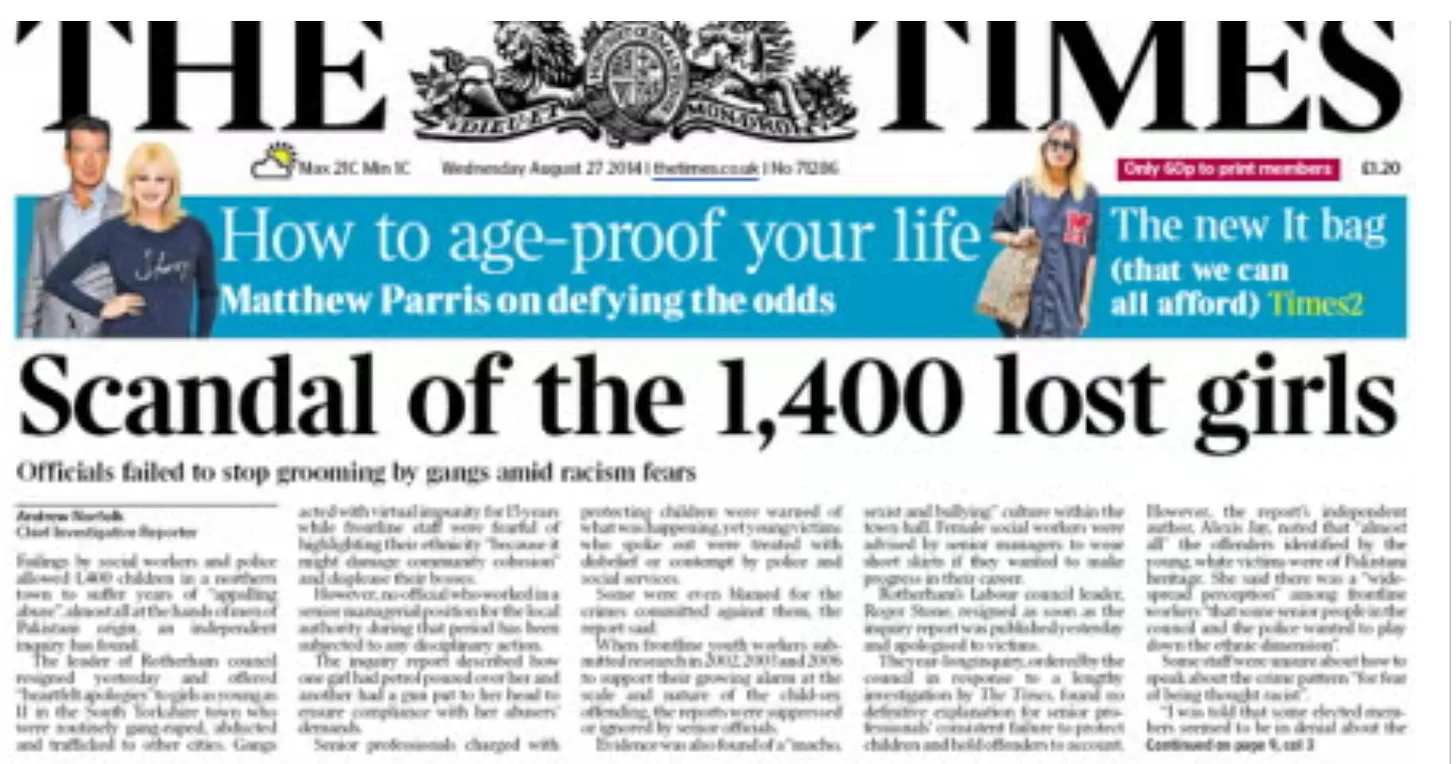
The UK grooming gangs scandal resurfaced as a major political issue this week with the publication of Baroness Louise Casey’s national audit of group-based child sexual exploitation. The report details the decades-long serial rape, abuse, and sex trafficking of thousands of young, white, working-class girls by groups of men, predominantly from the UK’s Pakistani community. It highlights the repeated failure of Britain’s institutions to acknowledge the problem, act to protect the victims, or hold the perpetrators responsible, largely due to fear of appearing racist.
The report’s publication put intense pressure on the Labour government to act, and Prime Minister Keir Starmer, who previously dismissed the need for further investigation, reversed course this week and announced a full national inquiry. As of this writing, it is unclear how robust the inquiry is likely to be. While Starmer has stated that the government will implement all 12 of Casey’s recommendations, including mandatory ethnicity data collection and tougher laws for sexual offenses against children under 16, he gives the impression of one dragged kicking and screaming to a distasteful task. Critics like Conservative leader Kemi Badenoch and survivors like Sammy Woodhouse have expressed concerns about potential delays or the narrowing of the inquiry’s scope. They have, sadly, seen it all before.
The Dual Meanings of Childism
For those of us working to bring the scandal of gender medicalization to an end, the parallels between the grooming gangs fiasco and the scandal of pediatric sex change are striking. In both cases, the majority of the victims are vulnerable adolescent girls1. Both represent a massive institutional failure to safeguard children and disinterest in the harms that resulted. Institutional capture is also a theme: people in authority who turned a blind eye or, worse, attempted to bury the truth for personal or political reasons. Exposés in the press were ignored; evidence was not collected. These two scandals—twin scandals—reveal a lack of political will that is more than just cowardice. They pull back the curtain on a callous indifference to the welfare of children. Where does this indifference come from? The concept of “childism,” used both in the sense of prejudice against children as a group and in the sense of the movement to empower children (similar to “feminism”), helps to shed light on what is happening.
Prejudice against children has become so normalized we scarcely notice it. Children are seen as little carbon footprints killing the planet or, during the COVID-19 pandemic, vectors of contagion. They inspire selfishness on the part of families who “hoard their privileges” for their own offspring instead of spreading their talents and resources more widely. “Child-free” adults who regard children as something to be strenuously avoided blithely refer to them as “crotch spawn,” “semen demons,” “parasites,” or simply “financial burdens.” They’re just kidding—except that they aren’t. But there is a much darker side to anti-child prejudice that comes into play in the grooming gangs scandal.

A Watershed Moment
In 1993, two-year-old James Bulger was abducted, tortured, and murdered by two ten-year-old boys, Robert Thompson and Jon Venables. The case shocked the nation and quietly led to a fundamental change in the dominant way we regard children.
A Times editorial from 25 November 1993 opined, “Children should not be assumed to be innately good. In the lexicon of crime, there is metaphysical evil, the imperfection of mankind; there is physical evil, the suffering that humans cause each other; and there is moral evil, the choice of vice over virtue. Children are separated by necessity of age from none of these.”2
This was not simply class prejudice, though it dovetailed with the American concept of the permanent “underclass,” which was popular at the time. It changed children in the public imagination so that they began to be seen as a problem to be managed. It is perhaps unsurprising that public policy and child-rearing took on a managerial quality. The election of New Labour in the UK and Bill Clinton in the US heralded the age of expertise, when policy and indeed parenting became about achieving optimal outcomes. But a funny thing happens when we hand over the messy work of striving to live well together, to maintain and improve our communities, and to raise our children to the experts. We lose something of our humanity. We become means to someone else’s end rather than people with moral agency.
It is not surprising, then, that the young girls of Britain’s northern towns—Leeds, Sheffield, Blackburn, and Huddersfield—could be pigeonholed as “troubled” and written off as prostitutes. They were not treated like children in need of protection and guidance. They were not treated like children at all.
Childism as Adultification
Another meaning meaning of childism – which implies that children are just as capable as adults and that treating them differently is a form of discrimination also come into play. British medical historian Harry Hendrick, in his history of parenting culture, posited that contemporary child-rearing, with its contrived “solutions” to normal childhood behavior and intense emotional enmeshments between children and adults, is “fueled by an unacknowledged and deeply repressed ‘childism.’” By this, he means both cultural prejudices against children and the more insidious way in which adults make use of children for their own purposes. This is obviously the case with group sexual exploitation but also applies in the case of over-identified parents. At the extreme end, there is Munchausen syndrome by proxy, in which a narcissistic adult, usually a mother, induces symptoms in her child in an effort to gain attention, sympathy, and manipulative control over other adults. The more garden-variety form occurs when parents become so overly focused on managing their child’s outcomes that they begin to view their children through a solipsistic lens. This might take the form of over-interpreting developmentally normal behavior, such as refusing to wear an item of clothing, and giving it adult significance (e.g., “my three-year-old told me they’re trans”) or backing away from the responsibility to guide children and allowing them to lead on the premise that they are just as capable.
The results of both kinds of childism—as prejudice and adultification—are the same. Children become like anyone else, able to consent and thus liable for the consequences of their decisions, good or bad. The girls in the grooming gang scandals were “no angels”; and thus played some role in getting themselves into trouble. Meanwhile, the children seeking puberty blockers, cross-sex hormones, and various surgeries “know who they are.” Move along. Nothing to see here.
As the public wakes up to the harms committed by the grooming gangs, it is important to highlight the clear parallels between these scandals. We can not allow another generation of children to be lost to either. It’s time to shake off our complacency and hold leaders accountable for protecting our children from indifference and exploitation whether it occurs on the streets of Britain’s northern towns or the halls of the gender clinic.
Genspect publishes a variety of authors with different perspectives. Any opinions expressed in this article are the author’s and do not necessarily reflect Genspect’s official position. For more on Genspect, visit our FAQs.
1 This does not diminish the plight of the boys caught up in the medical scandal. If anything, their presence makes the scandal even more tragic.
2 This quote is referenced on page 242 of Harry Hendrick’s book, Narcissistic Parenting in an Insecure World: A History of Parenting Culture 1920s to Present, is essential reading for anyone curious to understand how contemporary child-rearing became so hostile to children.