Genspect’s repathologization campaign seeks to restore clinical clarity and responsibility in the treatment of gender-related distress. It arose in response to WPATH’s depsychopathologization campaign, which reframed a clinical phenomenon in ways that departed from established principles of mental health care. Genspect’s position is that gender-related distress should not be instrumentalized for political or ideological purposes and that appropriate clinical understanding and care must be reinstated.
What follows outlines the background and timeline of WPATH’s campaign to redefine transgender identity as an innate and immutable state, knowable only through individual self-report. This account demonstrates how the depsychopathologization initiative reflected a political and advocacy-driven shift rather than a decision grounded in clinical evidence or therapeutic practice.
Houston “Roundtable Years” ▼
Houston trans-identified attorney
Phyllis Frye convenes grassroots meetings of trans activists and legal experts that form the precursor for the International Conference on Transgender Law and Employment Policy.
Late 1980s – 1991
International Conference on Transgender Law and Employment Policy (ICTLEP) ▼
Early trans activists view psychiatry itself as the main obstacle to accessing medical interventions. At the annual
ICTLEP conferences, activists and legal experts reframe transgender identities as healthy in order to circumvent psychiatric “gatekeeping” and advance self-declaration of “gender identity” as a human right.
1992 – 1994
International Bill of Gender Rights ▼
At the 4th ICTLEP conference in Houston, the
International Bill of Gender Rights is adopted. This declaration asserts the right to self-declare gender identities and access medical interventions, stating that “individuals should not be subject to psychiatric diagnosis…on the basis of their gender identity.”
December 1995
The Transgender Emergence by Arlene Istar Lev ▼
Social worker Arlene Istar Lev’s book
The Transgender Emergence becomes foundational in the movement to depsychopathologize transgender identities, arguing that clinicians should treat transgender identification as a healthy variation to be affirmed. Lev is a prominent HBIGDA member and later contributes to WPATH’s Standards of Care 7.
2004
Yogyakarta Principles ▼
Drafted by human-rights lawyers and trans activists, the
Yogyakarta Principles draw on the 1995 International Bill of Gender Rights, asserting the right to self-declaration of gender identity without psychiatric approval. While not legally binding, it forms the blueprint for modern trans activism.
2006
HBIGDA Rebrands as WPATH ▼
2007
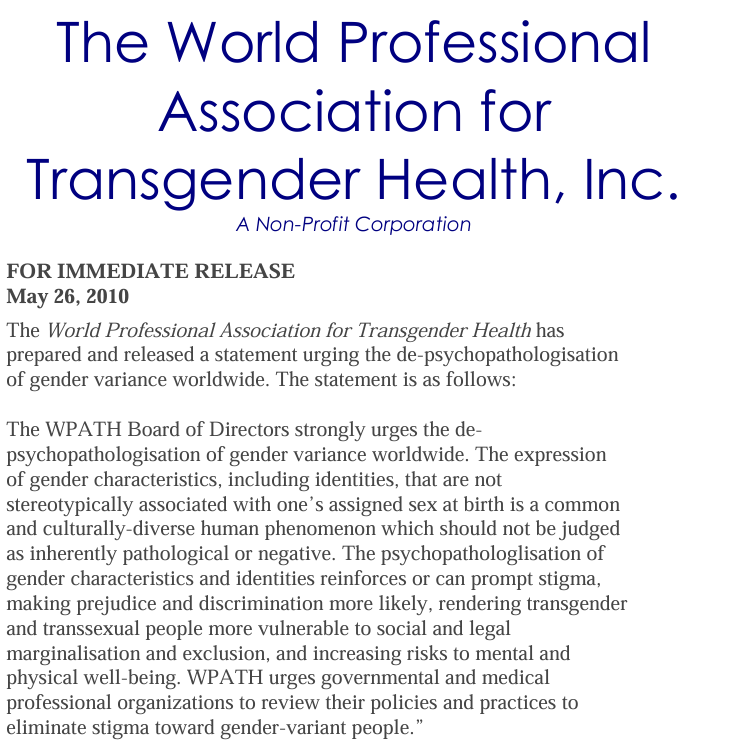
WPATH Depsychopathologization Statement ▼
The
WPATH Board of Directors strongly urges the depsychopathologisation of “gender variance” worldwide, framing transgender identities as healthy and psychopathologisation as stigmatizing. This is a political move with no grounding in scientific discovery.
2010
WPATH Standards of Care 7 ▼
SOC7 frames transgender identities as healthy and shifts the goal of psychotherapy to facilitating medical transition.
2012
Depsychopathologization Introduced to Pediatrics ▼
2012
American Psychiatric Association Publishes DSM-5 ▼
This pivotal moment shifts the pathology from the identity to the distress felt because body and mind are misaligned. This revision is the result of
activist pressure on the APA, largely from WPATH, to depsychopathologize transgender identities.
2013
Time Magazine: “The Transgender Tipping Point” ▼
Laverne Cox appears on
the cover of Time magazine, launching the modern trans rights movement. This marks the beginning of an aggressive international messaging campaign pushing trans identities as healthy and celebrated.
2014
Pediatric Gender Clinics See Surge of Referrals ▼
Coinciding with the widespread media promotion of transgender identities as healthy, a new cohort of adolescents, most girls, starts to appear in
pediatric gender clinics. The inflection point strongly indicates a social contagion.
2014
APA Calls for Depsychopathologization in Schools ▼
2015
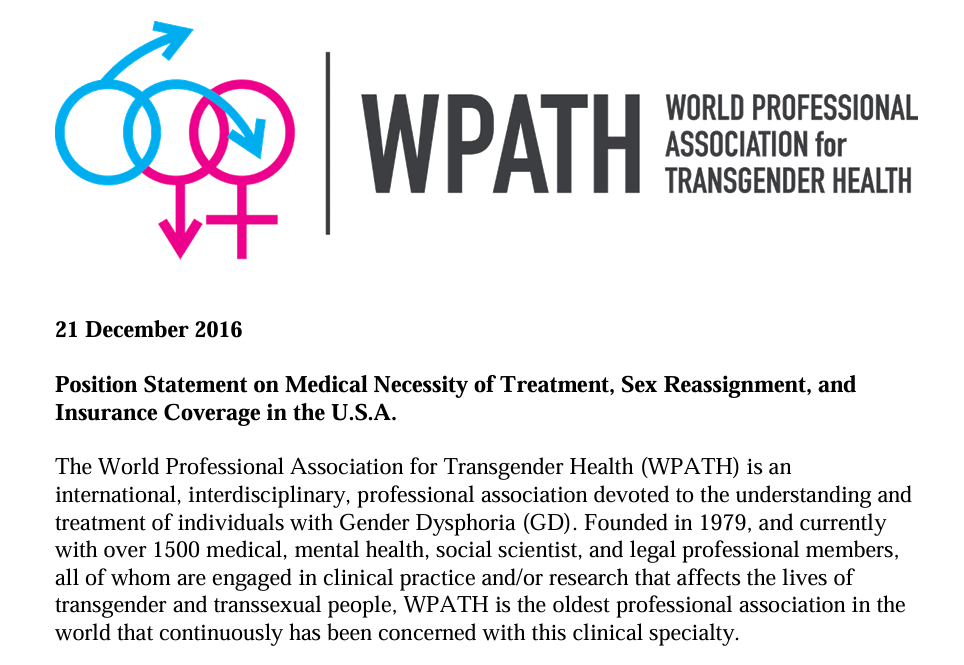
WPATH Position Statement on Medical Necessity ▼
This
statement frames transgender identity as healthy and declares all hormonal and surgical interventions “essential” to the well-being of trans-identified people. This becomes a key document used to pressure insurance companies to cover gender-related medical procedures.
2016
WHO Redefines Gender Identity Disorder ▼
Under pressure from trans activists,
WHO reclassifies gender identity disorder (ICD-10) as gender incongruence in ICD-11, moving it out of Mental and Behavioral Disorders into the newly created Conditions Related to Sexual Health—a chapter created specifically for depsychopathologization.
2018
AAP Endorses Depsychopathologization for Minors ▼
2018
AACAP Defines Psychotherapy as Conversion Therapy ▼
The
AACAP policy on “Conversion Therapies” states defining “gender diverse identities” as pathological is a “false premise,” urging that therapeutic intervention for gender identities be considered conversion therapy.
2018
WPATH Standards of Care 8 ▼
SOC8 asserts transgender identities are natural and must not be considered pathological. It removes almost all lower age restrictions for hormones and surgeries and expands medical treatment to “eunuchs” and “nonbinary” identities.
2022
Genspect Calls for Repathologization ▼
Genspect’s repsychopathologization campaign recognizes that a trans-identified person’s compulsive pursuit of hormonal and surgical body modification reflects a pathological condition driven by an extreme overvalued belief—an all-consuming, culturally reinforced conviction that compels harmful behavior. This new framing recognizes that cultural and social reinforcement mechanisms are central to how this belief develops and spreads.
2025