




Not a Story—A Diagnostic Code: A Rare Disorder as a ‘Control’ for Puberty Blockers
By James Linehan
What Congenital GnRH Deficiency Reveals About Puberty Blockers and the Developing Brain
This is a follow-up to “Frozen in Time.”
When Jonni Skinner told The Free Press what a decade of puberty blockers and cross-sex hormones, begun at thirteen, had done to his body, the response wasn’t about the medicine. It was questioning whether he was telling the truth.
I’ve met Jonni. Our treatments had nothing in common — his puberty was stopped, mine never started — but a great deal of what he described resonated with me anyway: the shape of the struggle, the years of being told the thing happening to your body wasn’t happening. Since then he’s been asked, publicly and repeatedly, to produce his medical records.1 It’s an ugly position to put a person in. The records are private, the demand can’t be met without surrendering that privacy, and declining gets read as an admission. Every detransitioner ends up in the same limbo: the claim rests on testimony, and testimony may always be doubted.
I can’t hand over Jonni’s records, but I can hand over mine.
My Medical Record as a Control Condition
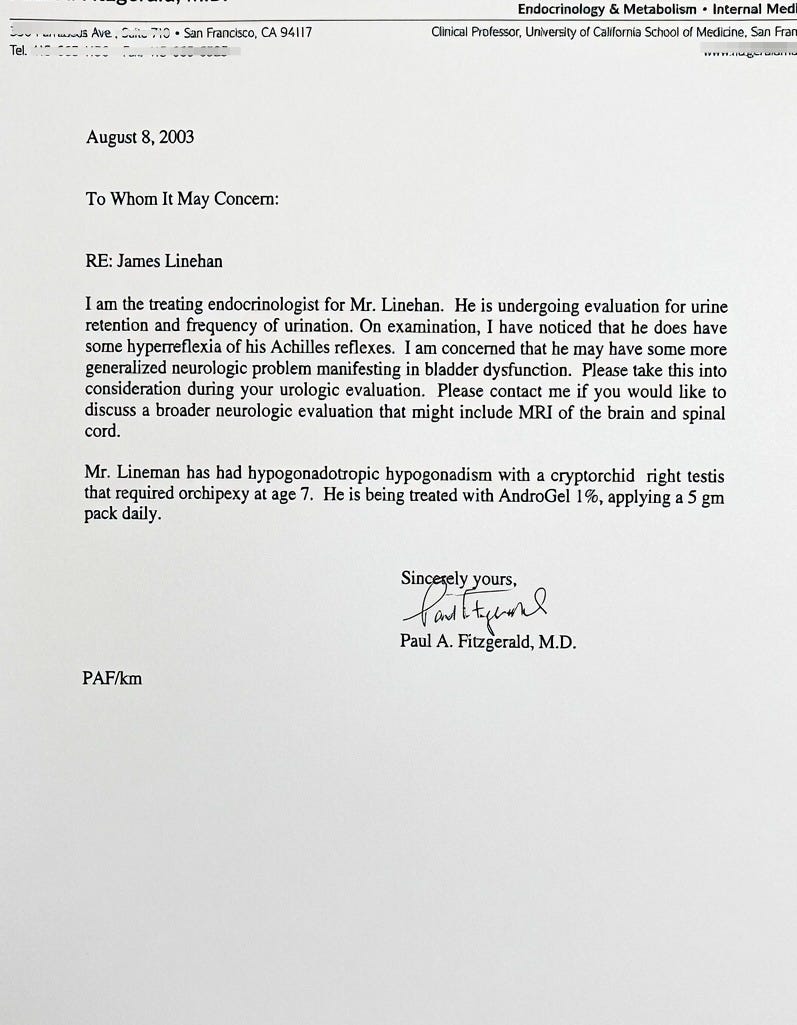
Here it is. A letter from Dr. Paul A. Fitzgerald, Clinical Professor of Endocrinology at the University of California, San Francisco School of Medicine, dated 8 August 2003. It names the diagnosis — hypogonadotropic hypogonadism — and notes the cryptorchid right testis that required an orchiopexy when I was seven. Testicular descent is androgen-dependent, so that undescended testis is a marker that my axis was already quiet before I was born. The letter was written twenty-three years ago to another physician about a patient who had no opinions on gender medicine because he was busy being a patient.
That’s the difference between us.
Jonni and others have a story of devastating experimental medicine used to treat psychological distress. I have an ICD-10 code that describes an objective medical condition, E23.0. Nobody groomed me into it. I didn’t find it on TikTok. There was no clinic, no influencer, no checklist scored 53 out of 60. My brain simply never sent the signal to start puberty, and at fifteen I was still Tanner Stage 1 while my classmates’ voices broke around me. I’ve told that story already, and I won’t repeat it here.
But one piece of it belongs next to the science, because it’s the part people find hardest to picture. I spell like a second grader. Not poorly — absently. I’ve come to think of it as a kind of spelling blindness. It took me six years to get through community college with a Franklin electronic speller at my elbow, working one word at a time. And here is what I want you to notice about that. It was never the sentences. It was never the paragraphs. It was never the ideas. Whatever went wrong was underneath all of that — in the low-level machinery we assemble early in childhood, when we’re learning our letters and our grammar and how a word is built.
I can’t prove my hormones did that, and I won’t try. I’m one man, and plenty of people who went through an ordinary puberty can’t spell either. But the Swedish registers (the world’s most comprehensive population-based research) show that people with my diagnosis carry ADHD at three times the rate of controls, and intellectual disability at eighteen times. I have the ADHD. I have the learning disability. I’m one data point inside a published distribution — which is a different thing from a story.
I arrived in this position before I had a single opinion to defend. That isn’t a position I engineered — it’s an accident of biology that makes me something this debate has almost none of: a control condition. An axis silenced without anyone choosing it, and a brain that developed without the hormones it was scheduled to receive. Nor am I a single case. There are 264 of us in the Swedish national registers.
Now, reread Dr. Fitzgerald’s letter. The part that actually matters has nothing to do with my gonads. He is concerned about my nervous system: the hyperreflexia of my Achilles reflexes, he suspects I might have “some more generalized neurologic problem,” and his recommendation for an MRI of my brain and spinal cord. What I can offer is documented proof; back in 2003, my endocrinologist was already treating congenital GnRH deficiency as a condition that might not stop at the waist.
Hold onto that, because it’s the thesis of this article, and I didn’t write it. A board-certified specialist did, two decades before I knew there was an argument to have.
The Evidence: Breadcrumbs from Unrelated Labs
In the absence of strong causal evidence (controlled interventions designed to isolate cause and effect), we must piece together some understanding based on what we have. The problem then is a clean one: the causal evidence isn’t human, and the human isn’t causal. Every crumb has a reasonable objection attached to it. But there are a lot of crumbs. They come from unrelated laboratories, use unrelated methods, involve unrelated populations, and all point in the same direction. That is what convergent evidence looks like in a field where the decisive experiment hasn’t been run — and, more to the point, where nobody has tried to run it.
These Are Brain Hormones, Not Just Sex Hormones
The system in question is the hypothalamic-pituitary-gonadal axis. The hypothalamus releases GnRH in pulses. GnRH tells the pituitary to release two gonadotropins — LH and FSH. Those drive the gonads to make testosterone and estrogen. Puberty blockers are GnRH agonists: they flood the system with a constant GnRH signal, which paradoxically shuts the axis down, collapsing LH, FSH, and the sex steroids together. But that is only part of the story. Here is what gets left out. Receptors for all three upstream hormones are found not only in the gonads but in the brain — specifically in the hippocampus and cortex, the regions that do memory and learning. GnRH reaches the brain’s ventricular fluid. LH’s receptor is expressed most densely in the hippocampus. FSH receptors sit on hippocampal and cortical neurons. These are not couriers that only ever visit the ovaries and testes. They “talk” directly to the machinery of thought. That single fact is why interrupting them is not obviously neutral — and it’s what Dr. Fitzgerald was circling in 2003.
The Sheep Didn’t Recover
Readers may be familiar with this experiment, so I’ll be brief. A group of researchers headed by Neil Evans, a Professor of Integrative Physiology at the University of Glasgow, gave peripubertal rams the same class of GnRH agonist prescribed to children. Long-term spatial memory was impaired — roughly 1.5 times slower on the maze — and it stayed impaired after the drug was withdrawn and puberty resumed (Hough et al., 2017). Testosterone replacement didn’t rescue it (Hough et al., 2016), which means the damage wasn’t only the missing sex steroids. It implicated the disruption of GnRH signaling itself, acting on those hippocampal receptors. Hold onto one detail, because the next section turns on it: the deficit didn’t come back when the hormones did.
The Finding Nobody in This Debate Is Talking About
If silencing the axis harms cognition, does restoring it help? In 2022, a French-Swiss team published a paper in *Science* with a title that says it plainly: “GnRH replacement rescues cognition in Down syndrome” (Manfredi-Lozano et al.). They had noticed that in Down syndrome the GnRH-producing neurons wither after birth, and that the loss of smell and the cognitive decline track that withering. In a mouse model, restoring GnRH reversed both. They then ran a pilot in seven adult men with Down syndrome: six months of pulsatile GnRH therapy improved their cognition and strengthened connectivity between cortical regions on brain imaging.
It’s a small, open-label study with no placebo, involving only seven men. It’s not strong evidence, but hold that against the sheep experiment for a moment. Block the GnRH signal and memory doesn’t come back. Restore the GnRH signal and cognition improves. Two unrelated laboratories, two different species, two opposite manipulations — and the arrow points the same way both times. That’s the shape of a real effect, not a fluke.
And then there’s the detail that stopped me cold. The researchers didn’t just test GnRH against nothing. They compared pulsatile GnRH — delivered in the natural rhythm, a pulse every two hours — against continuous GnRH. Same molecule. Same dose. Only the pattern differed. Pulsatile restored cognition. Continuous worsened it.
Continuous GnRH stimulation is precisely how puberty blockers work. That is not an incidental feature of the drugs; it is their entire mechanism.
Absence Leaves a Mark — and It Scales
In 2019, a team at the Karolinska Institutet did for my condition what nobody has done for puberty blockers: they included everyone in a national population with a silenced GnRH axis and compared them with matched controls (Ohlsson Gotby et al., *Journal of Neuroendocrinology*). The odds of intellectual disability were roughly eighteen times those of controls — twenty-eight-fold in men. Autism, around six times. ADHD, three. The risk scaled with severity. The signal survived adjustments for obvious confounders. And the authors themselves called for research into whether early hormonal therapy could prevent adverse neurodevelopmental effects in critical postnatal periods.
The Paradox You Need to Understand
In the aging brain, elevated LH and FSH are detrimental to cognition, and lowering them can help (see Xiong et al., *Nature* 2022, on FSH and Alzheimer’s pathology). But the adolescent brain and the aging brain are different machines with opposite needs. These molecules are potent, neuroactive, and ruthlessly timing-dependent. The one thing you cannot safely assume is that removing them during the developmental window is free of charge.
What We’ve Never Bothered to Measure
The most thorough recent appraisal is Sallie Baxendale’s 2024 systematic review in *Acta Paediatrica*. In humans: no study has systematically tracked neuropsychological function with an adequate baseline and follow-up. The sparse human data that does exist isn’t comforting. A companion editorial (Landén et al.) called it an urgent, unmet research priority. We are administering a drug whose long-term cognitive effects have never been properly measured in children during the single most important window of their brain development.
What It Adds Up To
These hormones act directly on the brain’s memory and learning circuits. Blocking the axis during puberty produces lasting, non-recovering memory deficits in the best animal model we have. Restoring the natural pulsatile signal improves human cognition, whereas continuous-signal blockers worsen it. Congenital absence of the signal is associated with dramatically elevated intellectual disability, on a dose-response gradient that survives excluding the genetic confounders.
The confident language of “safe” and “fully reversible” is not supported by the evidence — and there are specific, mechanistic, cross-species reasons to expect that interrupting this system during its developmental window is not neutral. My endocrinologist once described puberty to me as a symphony of hormones that has to play in sequence, on a clock that doesn’t wait. You don’t get to pause a symphony and hear it resume unchanged. Before we tell another generation of children otherwise, the least we owe them is to measure what we are doing to the instrument.2
This article is dedicated to: Jonni Skinner, Chloe Cole, Keira Bell, Luka Hein, Prisha Mosley, Grace Lidinsky-Smith, Helena Kerschner, Ritchie Herron and so many others. Their credibility has been questioned. Their courage never has.
And also for the parents — the ones who fought quietly, in the background, with no audience and no allies, for a son’s or a daughter’s health. My own mother was panicked and distraught when I went for my treatment. She had every reason to be. But I got good care. And what she ended up with was a son who grew up. That is all any of them ever wanted. I’ll be with you always.
James Linehan is a public speaker and health advocate who draws on his personal experience with congenital hypogonadotropic hypogonadism (CHH), a DSD that can mimic puberty suppression effects. As a Santa Clara University adjunct lecturer, he brings a unique voice to advocacy and education.
Genspect publishes a variety of authors with different perspectives. Any opinions expressed in this article are the author’s and do not necessarily reflect Genspect’s official position. For more on Genspect, visit our FAQs.
1 On Ask Dr. Drew, Brianna Wu said Skinner wasn’t credible, citing his failure to release his medical records and a review of photographs of him.
2 Don’t Take My Word for It — See the Data Yourself
I built a brain maturation simulator on the Gogtay data — a landmark time-lapse MRI study that scanned the same children repeatedly across adolescence. Drag the slider from six to twenty and watch the cortex mature in its true back-to-front order. Then experiment with “Freeze Tanner” (puberty blocker), “Lupron (IHH)” (my condition), and cross-sex hormones. Turn on the fMRI overlays if you prefer the raw data. I’d rather you felt the difference between a delay and a subtraction than took it on my authority.
Sources:
- Phoenix CH, Goy RW, Gerall AA, Young WC. Organizing action of prenatally administered testosterone propionate… Endocrinology, 1959.
- Gogtay N, Giedd JN, et al. Dynamic mapping of human cortical development during childhood through early adulthood. PNAS, 2004.
- Sisk CL, Zehr JL. Pubertal hormones organize the adolescent brain and behavior. Frontiers in Neuroendocrinology, 2005.
- Ohlsson Gotby V, et al. Hypogonadotrophic hypogonadism, delayed puberty and risk for neurodevelopmental disorders. Journal of Neuroendocrinology, 2019;31(11):e12803.
- Hough D, et al. A reduction in long-term spatial memory persists after discontinuation of peripubertal GnRH agonist treatment in sheep. Psychoneuroendocrinology, 2017;77:1–8.
- Hough D, et al. Spatial memory is impaired by peripubertal GnRH agonist treatment and testosterone replacement in sheep. Psychoneuroendocrinology, 2016;75:173–182.
- Manfredi-Lozano M, et al. GnRH replacement rescues cognition in Down syndrome. Science, 2022;377(6610):eabq4515.
- Xiong J, et al. FSH blockade improves cognition in mice with Alzheimer’s disease. Nature, 2022;603(7901):470–476.