




Is Trans Identification Declining? And A Training Announcement
By Jaco van Zyl, Clinical Psychologist

News went viral in genderland this week when Professor of Politics Eric Kaufmann declared on X that “trans identification is in free fall among the young.” He was referring to the Centre for Heterodox Social Science report titled, “The Decline of Trans and Queer Identity among Young Americans.” This study draws from several survey sources, including those conducted by the Foundation for Individual Rights and Expression (FIRE), the Higher Education Research Institute (HERI), the Andover Philips Academy and Brown Daily Herald. In the report, Kaufmann shows several graphs indicating trends in non-binary gender identification over the last 10 years. A gradual rise and sudden drop, at least from the Andover, FIRE and Brown surveys over the period of 2021 to 2025, is visible from the above graph.
This has unleashed quite a fiery debate online, particularly between Kaufmann and Benjamin Ryan. Ryan summarised his objections to the above conclusions in his Substack entry, stating that Kaufmann “only had data about shifts in nonbinary identification among students, which had swiftly risen and fallen in recent years – and only among students at elite schools at that.” Kaufmann defended his rationale on X, stating that the survey format used did not offer transgender as an option, in which case, the “Nonbinary” option would track best with trans-identification.
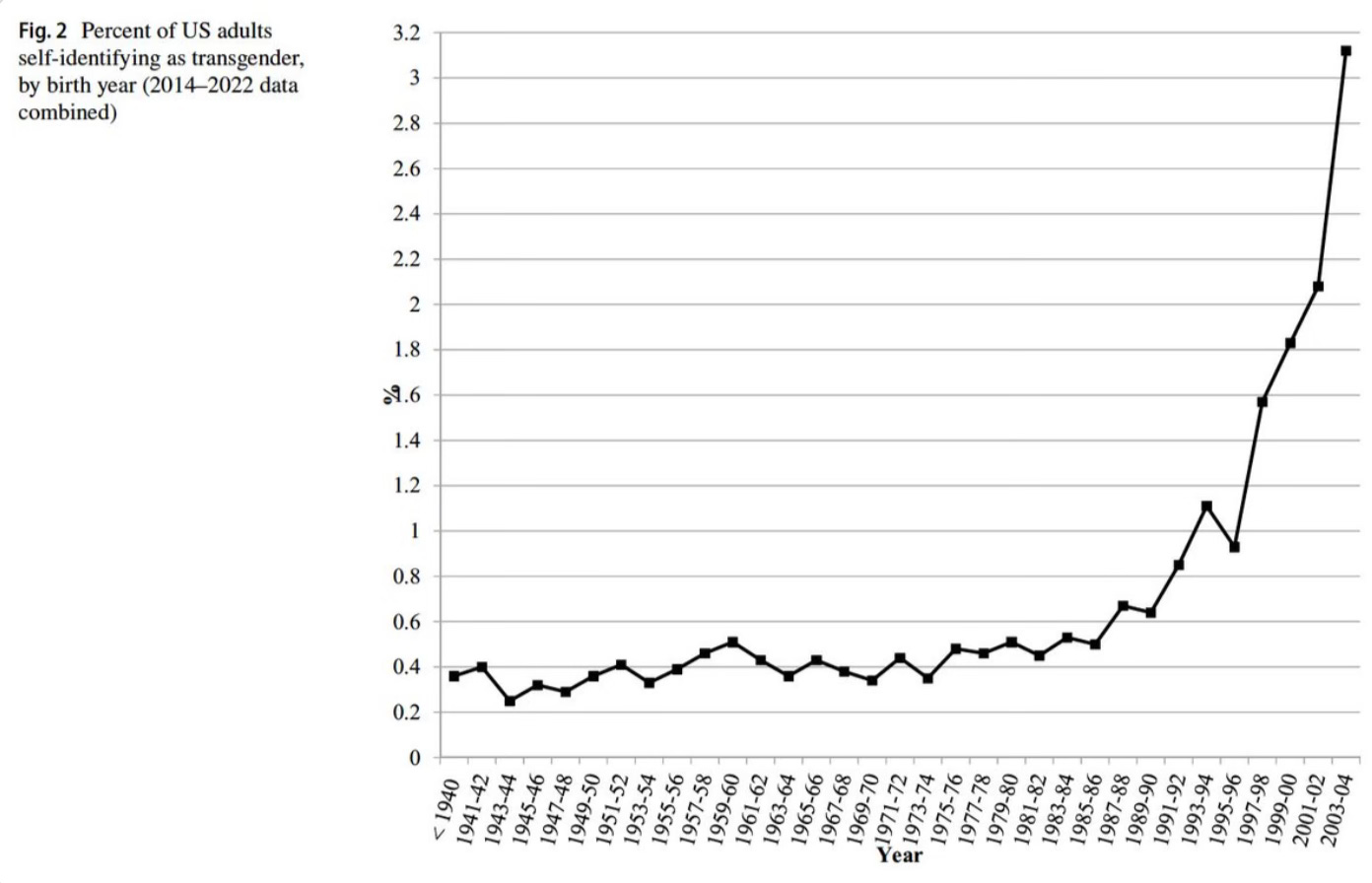
Ryan furthermore pointed to evidence from a 2024 paper indicating an exponential rise in trans-identification among young adults born between 1995 and 2004 (aged between 20 and 29 years old):
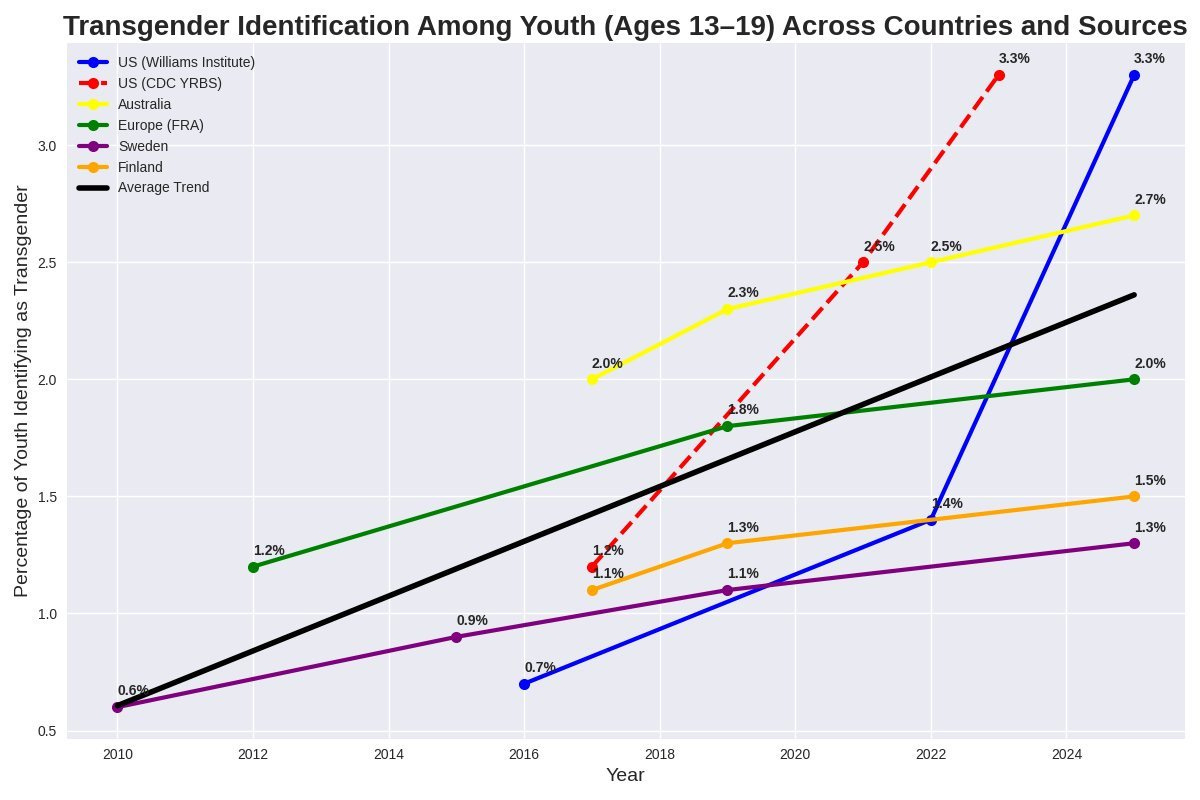
Vincent Diboni, a counselling psychologist from South Africa, added to the debate, showing how there is a persistent, steep increase in trans-identification among youth aged 13 – 19 years:
The debate is still raging on, and necessarily so. Trans-identification carries all the hallmarks of a mass psychogenic illnesses. These include a vulnerable population prone to psychological distress (puberty and adolescence, psychiatric illness, historical trauma), the trend of trans-identification as a fashionable identity, increased media coverage of trans-identification, physical proximity (peers identifying as trans), and iatrogenic exacerbation by institutions (see Halimi et al., 2025; Haltigan et al., 2024 and Littman, 2018).
Institutional response has had a significant impact on the iatrogenic spread of trans-identification. The politicisation of transgenderism and the cultural shift towards victim fetishisation have infiltrated the psychology and psychotherapy fields in particular. This must be counteracted, and mental health practitioners ought to remain politically neutral and clinically responsible when dealing with matters of political salience. To meet this need, The organisation, Critical Therapy Antidote (CTA), is hosting its inaugural training event called, Second Therapist in the Room: Reclaiming Clinical Neutrality, on 24 November 2025.
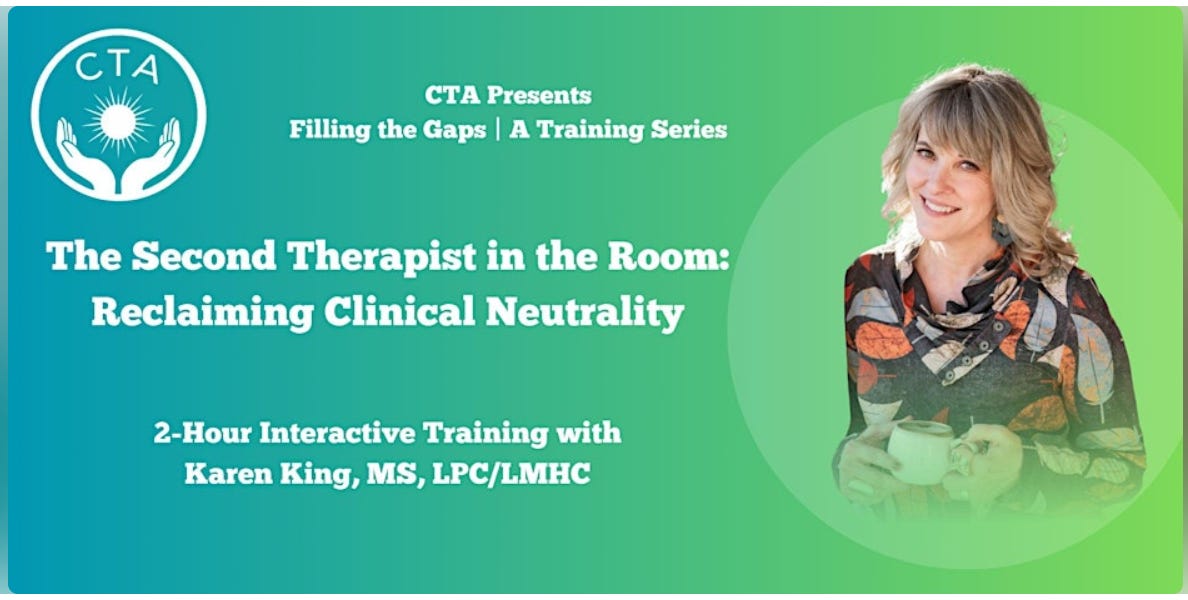
This is a 2-hour interactive workshop presented by licensed mental health counsellor Karen King on clinical neutrality as a steadying, relational presence free from ideology or agenda. In the first hour, attendees will explore neutrality’s therapeutic roots, its evolution in modern practice, and the cultural forces that have challenged its role. They will discuss how neutrality functions as a “second therapist in the room” to create reflective space, protect client autonomy, and deepen psychological work amid ideological tension. In the second hour, they will put these ideas into action through role plays and group debriefs, strengthening their ability to stay grounded when facing charged statements or identity-related concerns. Attendees will leave with concrete tools to maintain an open, non-reactive space in a polarized world – preserving both ethical clarity and the client’s freedom to think and feel authentically.
This training workshop will be the first in a series of sessions called, Filling the Gaps, aiming at addressing areas in psychotherapy generally neglected in training institutions these days. Please register here on Eventbrite.
Genspect publishes a variety of authors with different perspectives. Any opinions expressed in this article are the author’s and do not necessarily reflect Genspect’s official position. For more on Genspect, visit our FAQs.