




Ireland’s Spending Spree on Trans Surgeries Abroad
By Paddy O'Gorman
What’s behind the Irish Health Service’s push to transition Irish patients abroad?
The Irish health service has massively increased its spend on sending Irish patients abroad for transgender surgical treatments. Spending for this purpose rose from €21,000 in 2022 to over €333,000 in 2024. We know about this astonishing, sixteen-fold increase in just two years because the Minister for Health was asked a parliamentary question about it by a TD (member of the Irish parliament).
That TD, Deputy Ken O’Flynn, tells us that the Minister for Health has not yet provided a cost breakdown for this hugely increased trans healthcare spend; nor has the Minister said what sort of transgender surgical procedures have been carried out on those Irish patients who have been sent abroad; nor, so far, has information been made available by the Minister as to what post-procedure tracking, if any, is being done to see how these patients have been getting on since receiving their transgender surgeries. Deputy O’Flynn tells us he has submitted further questions to the Health Minister on all of these points.
The information elicited so far by O’Flynn is disturbing. The Treatment Abroad Scheme (TAS) is a service provided by the Health Service Executive in Ireland to pay for patients to get necessary medical procedures abroad if those procedures are not available in Ireland or not available within a clinically necessary time. The HSE specifically excludes TAS funding for partaking in clinical trials. Any treatment paid for by TAS, says the HSE, must be “a proven form of treatment”.
So, since when has it been shown that cutting off a person’s healthy body parts is “a proven form of treatment”?
Out of Step with the Rest of the World
Just recently, we have had a major study in Finland that concludes that transgender medical treatment does not improve the well-being of those on whom it is performed. “The findings point towards a need for thorough psychiatric assessment and treatment before any gender-related medical pathway is considered”, the Finnish study states. The Cass review in Britain, two years ago, reached the same conclusion, causing the British government to suspend the use of puberty blockers on adolescents.
Dr. Stella O’Malley of Genspect observes: “It is extraordinary to see Irish health authorities moving against the tide at exactly the wrong moment. A 16-fold increase in spending on trans surgeries from 2022 to 2024 is startling, especially given the growing recognition since 2022 of the lack of a robust evidence base for these radical and irreversible interventions. Other Western countries are beginning to recognise that, when measured objectively, long-term outcomes – including psychiatric morbidity, employment, criminality and suicidality – remain poor, and they are attempting to quietly reverse course from increasingly exposed legal and political positions. Ireland, by contrast, is storming ahead in the opposite direction at precisely the moment others are pulling back.”
We might reasonably hope that these international studies, such as those that Dr. O’Malley refers to, would give the Irish government pause for thought about the wisdom of continuing to pay to send Irish people abroad for transgender surgery. But, it seems, no such pause is happening. In further information obtained by Deputy O’Flynn, we see that prospective transgender patients are rarely refused TAS funding. In the last three years, 89 such patients have been approved for TAS, and just 2 have been refused. The Irish government is paying for trans surgery abroad almost on demand.
So why do we in Ireland remain so invested in promoting medical procedures of the sort that so much of the rest of the world is now having serious second thoughts about?
Most Irish people are unaware of what our government’s trans policies are. That’s because, for more than a decade now, there has been virtual unanimous agreement among political parties of both Right and Left in Ireland, supported by a compliant media, that trans demands should not be held up to scrutiny. Ireland’s Gender Recognition Act, which allows a person to change their legal sex by self-declaration, was passed in 2015, with most of the Irish public not even noticing. In Ireland, “no debate” has been a spectacularly successful strategy for the trans lobby.
More recently in Ireland, the two centre-right parties in government and also the main Opposition party, Sinn Fein, have been quietly ditching their previous pro-trans policies, once they had come to realise that these policies might prove to be unpopular with voters. The Left-wing opposition parties- Labour, Social Democrats, Greens and assorted smaller groups- are remaining staunchly pro-transgenderism and seemingly insensible to incipient voter concerns about same (which is in keeping with the sort of behaviour that has ensured that we have never yet had a Left-led government in the history of the Irish state). But almost all our politicians, Government and Opposition, Left and Right, remain in a consensus that it is safest not to do or say anything that might upset the trans lobby.
So it’s not surprising that it is a politician from outside of that consensus who is now asking important questions of the Minister for Health. Deputy Ken O’Flynn is part of a group of 3 TDs (out of total of 178 in the Dáil) who have formed themselves into a centre-Right political party that goes by the name Independent Ireland. Another small, socially conservative party, Aontú, which has 2 TDs and also some rural-based Independent TDs, has, likewise, been challenging the trans hegemony in Irish politics. All of that is a welcome development.
Because the Government needs to be challenged. We are doubly unfortunate in Ireland that we have, in our Department of Health, a Minister who is a committed trans champion and a Junior Minister who is even more so. The presence of these two Ministers helps to explain, I believe, why our Department of Health remains so keen to promote trans surgical interventions despite mounting international evidence that these interventions do no good.
Ireland’s Trans Champions
To start with, the Minister for Health, Jennifer Carroll MacNeill, supports transgenderism to the point that she opposes women having any safe spaces from which men would be excluded. Speaking in the Dáil in December of 2025, she had this to say: “We all know the sheer nonsense that a man would dress up as a woman and come into a changing room for the purposes of attacking me… Did you ever hear such nonsense? Did you ever have examples of it from any time since the Gender Recognition Act was passed?”

Actually, yes, Minister. I, for one, have documented plenty of examples of women having been physically and sexually assaulted by men in dresses in what were once women-only spaces in prisons and domestic violence refuges. Carroll MacNeill callously dismisses the voices of such women: “Since the gender recognition change in 2015, neither I nor any woman with whom I am personally acquainted has raised the spectre or fact of men coming into women’s places in order to attack them”. I suggest, once again, to Jennifer Carroll MacNeill that she should broaden the circle of women with whom she is personally acquainted.
And, anyway, why should women have to establish, to Carroll MacNeill’s satisfaction, that men who want to come into places where women undress might want to attack them? Why can’t women just say “no” to any man, in any garb, who wants to come into a women’s changing room? Why are women’s wishes to be able to use a public toilet without men in it “nonsense” to our Health Minister?
Our Junior Health Minister, Mary Butler, is even more zealously committed to the trans agenda than is her boss. Butler actively promotes the transing of young people who say they are a different sex to the one they were born. She says we “damage” such children if we refuse to use their preferred pronouns. Butler is certain she knows best because, as she explains, she is the mother of a trans-identified child. Butler has a teenage daughter whom she calls her son.
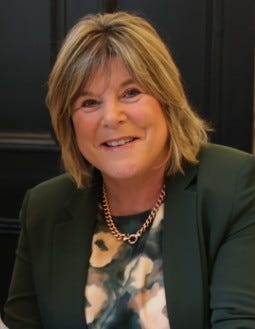
Mary Butler explained her thinking in a tearful address she made to the Dáil in June of 2025: “There is no replacing lived and living experience in the crafting of good policy”. So, for our Junior Health Minister, the expressed wishes of a teenager are the ultimate authoritative source for the crafting of government policy. That’s an appalling responsibility to put upon the shoulders of one so young. Mary Butler should never have thrust her child into public discourse in this way. It’s an appalling pressure to have put on a young person who might one day come to change their mind.
And Mary Butler knows that young people can change their minds. It’s ironic that, just a few years back, in 2018, Mary Butler, then a backbench TD, brought a private member’s bill before the Dáil to ban people under 18 years of age from getting a tattoo (the bill failed for lack of support). So if Butler’s school-going child had then said, “Mum, I want to get a tattoo”, her mother would have told her “no”, because she was too young to make a decision to alter her body in that way. It’s mind-boggling that Butler doesn’t allow that a teenager might also be too young to decide to embark on the far more drastic body-altering procedure of trying to look like they have changed sex.
So now that we know that the Department of Health has, in the last two years, increased its spending sixteen-fold on the provision of body-altering surgeries abroad for Irish patients, it’s impossible not to see the hand of Junior Health Minister Mary Butler in this. Butler told us in October 2025 that she was “working behind the scenes to deliver healthcare support for young trans people”, adding that this was “very hard to speak openly about”. Thanks to Deputy Ken O’Flynn’s PQ, we are now getting to learn a bit about some of the stuff that Mary Butler was trying to keep “behind the scenes”.
I hope O’Flynn gets a sex breakdown on the 162 Irish patients that have been sent abroad for transgender surgery since 2020. My guess is that there will turn out to be far more women among those patients than men. Most of the trans-identified men I have become aware of in recent years in women’s prisons and women’s hostels have been sex offenders. Their aspiration to have their male parts cut off remains just that: an aspiration. How can these men continue to sexually abuse and intimidate women and kids if they don’t have their penis? And why would these men want to have their favourite plaything surgically taken away from them? But the women who say they want to change sex are, I believe, in dead earnest. I think we will find that, through the Treatment Abroad Scheme, we have paid for far more breasts to be cut off than penises.
Deputy Ken O’Flynn has done us a good service in helping to bring all of this to public attention. In Ireland, there is public anger at some of the shortcomings of our national health system. We have seen children in need of spinal surgery deteriorate and even die while on long waiting lists for treatment. I think we, the public, would prefer to see our budget for healthcare spent on treating such children rather than being used to pay for transgender surgeries, which are, at best, of dubious value to the people on whom they are performed.
Genspect publishes a variety of authors with different perspectives. Any opinions expressed in this article are the author’s and do not necessarily reflect Genspect’s official position. For more on Genspect, visit our FAQs.