




Institutional Failure
By Hermes Postma
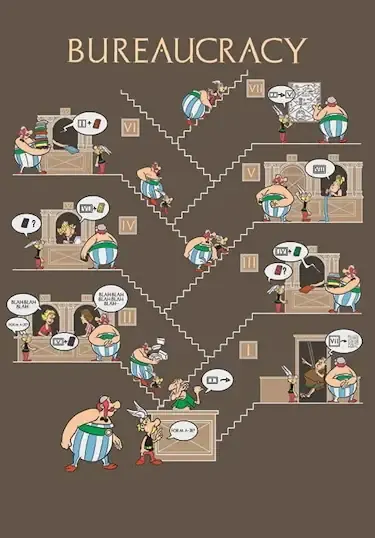
Hermes Postma on the self-reinforcing bureaucracies and the erosion of responsibility that hollow out institutions
In The Twelve Tasks of Asterix, one of the most scathing critiques of bureaucratic madness is delivered as pure comedy. Asterix and Obelix are trying to obtain a simple permit 838 in “The Place That Sends You Mad.” The deaf receptionist directs them to the left corridor and tells them to go to the last door on the right. As there is no door on the right, they go to the door on the left. The man there tells them to consult the plan on the sixth floor. This directs them back to the ground floor and Window 1, where the woman sends them to Window 2. However, this is not next to Window 1, but somewhere else entirely. The person at Window 2… and so on. You get the point: it’s madness.
It seems that no one has authority. No one remembers why the system exists. No one can see the whole picture. Yet every employee fiercely defends their own procedures, protocols, and jurisdictional boundaries, acting as if the survival of civilization itself depended on it. This is institutional failure at its most basic level: a system that has completely lost sight of its original purpose, yet continues indefinitely through internal justification. And this is precisely the mechanism we see at work in modern pediatric gender care.
Not as an isolated medical error. Not as an occasional misdiagnosis. But as a fully self-reinforcing institutional ecosystem in which protocols, activism, science, media, bureaucracy, and politics mutually legitimize one another—even as the empirical foundation beneath the system has grown dangerously thin. The real tragedy is not just that this could happen. The tragedy is that almost every safeguard that should have prevented it has been consumed by the system itself.
The WPATH guidelines were presented as an international medical consensus. In reality, however, they rested largely on weak evidence, small studies, high loss-to-follow-up rates, activist assumptions, and circular citations among a small, ideologically aligned group of researchers and organizations. These groups cite one another to provide supposedly independent validation, despite essentially drawing from the same narrow epistemic pool.
The Cass Review exposed this mechanism in painful detail: circular referencing, the systematic overestimation of the quality of evidence, and the presentation of speculative benefits as established science. Yet governments worldwide were told that “the science is settled.” If a science primarily cites itself, it is no longer science. It becomes liturgy. Once that liturgy is fused with moral status—inclusion, progressivism, DEI, human rights—criticism is no longer treated as a scientific necessity, but as moral contamination.
Gender care thus shifted from an uncertain medical field to a sacralized ideology. Politicians were afraid of being labeled as transphobic. Media outlets were reluctant to deviate from the established moral narrative. Doctors did not want to risk damaging their reputations. Universities strived to be inclusive “safe spaces” for everyone (except those who disagree). Researchers did not want to face social ostracism. Regulatory bodies merely checked for compliance with protocols. Activist organizations acquired institutional power without accountability.
A closed circuit emerged. Each actor could point to another. The clinician pointed to the protocol, the protocol to WPATH, WPATH to “international consensus”, the government to the experts, the experts to peer reviews, peer reviews to activist academic networks, the inspectorate to procedural compliance, the media back to the experts. Meanwhile, all dissenters were portrayed as either dangerous or immoral. No one controlled the system. Yet the system controlled everyone. This is why institutional failure is so insidious and dangerous: it does not require a central conspiracy. The system generates its own blindness.
In the process, core medical principles faded into the background. Proper control groups, long-term follow-up, rigorous causal analysis, thorough psychiatric differential diagnosis, informed consent for minors, and systematic tracking of regret, detransition, and complications should have been part of the process. However, none of this happened. Patients disappeared from studies. Outcomes were selectively reported. Negative data was mostly overlooked. Critical researchers were socially isolated. Clinics shielded themselves behind privacy constructs that hindered public scrutiny. Parents were treated as obstacles rather than protective factors. Suicide was weaponized as rhetorical blackmail. “Affirm, or your child will die.” This is not an environment in which science can function freely. Rather, it is an environment of moral blackmail under institutional pressure.
The very bodies that were supposedly there to protect the public—inspectorates, medical associations, and regulators—largely operated as procedural gatekeepers. They did not ask “Is this true?” but “Was the protocol followed?” That distinction is everything. Once a flawed protocol becomes institutionally entrenched, oversight transforms into system maintenance.
History shows that modern institutions rarely collapse through outright malice. They erode because procedures become more important than reality. Because people learn that loyalty is safer than truth. Because career incentives, ideology, and bureaucratic self-preservation slowly fuse into a closed epistemic regime. And such regimes have a terrifying property: they can function for years while their foundations rot.
This is why the comparison to M.C. Escher’s Relativity is so apt. People walk up and down impossible staircases within an architecturally coherent yet externally absurd space. Everyone acts rationally within their local rules — yet the overall picture is insane. The absence of gravity can be read as a metaphor for the loss of common sense.

Escher went even further. In another work, he depicts ants walking along a Möbius strip: an infinite loop without beginning or end. The image is chillingly precise. The ants cannot break the madness themselves. An external force is needed—a knife or an outside intervention—to break the loop. His drawings are not frivolous optical illusions. They are disturbingly accurate reflections of reality.
We see precisely the same mechanism reflected in the biological phenomenon known as the ant mill. Ants instinctively follow one another’s pheromone trail. Normally, it is a brilliant system. But sometimes a closed circle emerges. Then the entire colony begins following itself in circles. Every ant places blind trust in the ant ahead of it. Not a single ant perceives the error. Not a single one of them consciously chooses destruction. Yet, collectively, they keep marching until they collapse from exhaustion and die.
This is the deepest horror of institutional failure. Not that people are evil. Not that everyone is lying. But that entire systems can trap themselves in a circular reality where loyalty replaces truth, protocol replaces reality, consensus replaces evidence, and moral status destroys critical thinking.
Until the damage can no longer be hidden …
Genspect publishes a variety of authors with different perspectives. Any opinions expressed in this article are the author’s and do not necessarily reflect Genspect’s official position. For more on Genspect, visit our FAQs.