




Genspect response to NHS England consultation on cross-sex hormones for minors
By Genspect
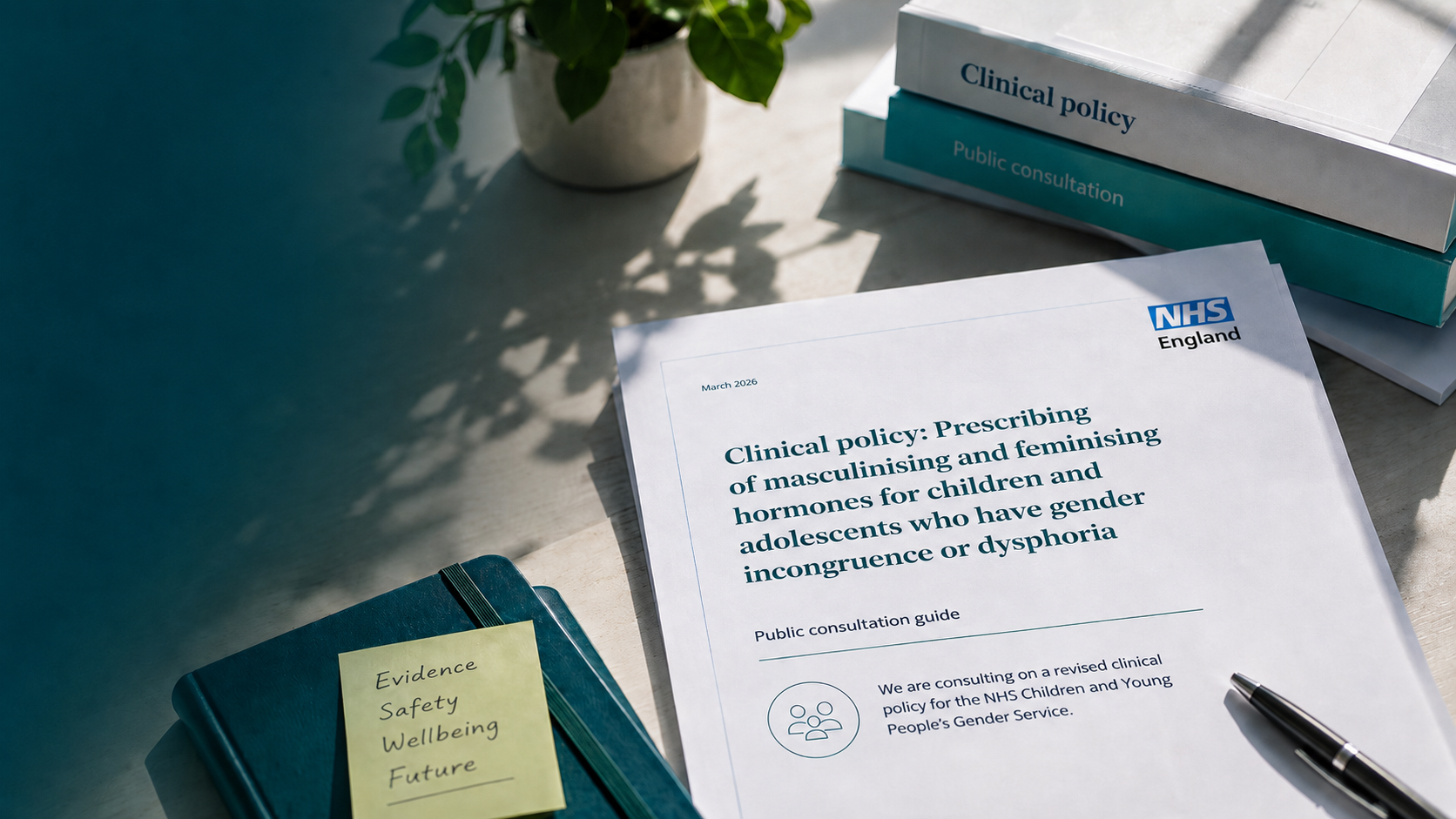
Genspect has submitted a response to NHS England’s public consultation on the proposed clinical policy for prescribing masculinising and feminising hormones to children and adolescents with gender incongruence or gender dysphoria.
The consultation concerned whether these interventions should continue to be routinely commissioned for under-18s through NHS England’s Children and Young People’s Gender Service. NHS England’s proposed policy states that masculinising and feminising hormones should not be available as a routine commissioning option for children and young people through the service.
Genspect welcomes NHS England’s commitment to evidence-based care and supports a precautionary approach where the evidence of benefit is uncertain and the long-term safety profile remains unclear.
Our position
Genspect’s submission argues that the available evidence does not provide reliable support for the routine prescribing of masculinising or feminising hormones to minors.
The commissioned evidence reviews found no reliable evidence that these interventions improve clinical outcomes for under-18s, and insufficient evidence to establish their safety. Genspect’s response also highlights the need to consider potential long-term risks, including effects on fertility, cardiovascular and metabolic health, psychiatric outcomes, sexual function, and irreversible physical changes.
Where benefits remain unproven and important uncertainties remain regarding safety, especially in relation to interventions with potentially irreversible effects, Genspect believes that a precautionary approach is justified.
Key issues raised in our response
1. Lack of reliable evidence of benefit
The systematic reviews commissioned by NHS England did not identify reliable evidence that masculinising or feminising hormones improve clinical outcomes in children and adolescents.
Genspect’s response argues that this absence of reliable benefit is, by itself, a sufficient basis for not routinely commissioning these interventions for minors.
2. Uncertainty around long-term safety
The response notes that the absence of direct evidence of harm should not be treated as proof of safety. Many potential adverse outcomes may be delayed, underreported, or insufficiently studied in the existing literature.
Genspect recommends that NHS England consider a broader assessment of harms, including evidence from adult outcome studies, pharmacological data, histological research, adverse event reporting, and long-term observational evidence.
3. Potential risks across multiple areas of health
The submission raises concerns about a range of possible risks, including:
- fertility and reproductive health
- cardiovascular and metabolic effects
- psychiatric outcomes
- sexual function
- irreversible physical changes
- detransition and regret
These concerns are particularly important because adolescence is a period of continuing physical, psychological, neurological, and reproductive development.
4. The importance of support for young people
Genspect’s response emphasises that young people experiencing gender-related distress should have access to timely psychological and psychosocial support.
The withdrawal of one medical pathway should be accompanied by appropriate alternative care, clear communication, and long-term follow-up.
5. Research priorities
Genspect recommends that future evidence should be generated through rigorous long-term follow-up of existing cohorts, rather than through recruiting new cohorts of children into experimental treatment.
The response also calls for greater investment in the development and evaluation of non-medical approaches for young people experiencing gender-related distress.
Download the documents
Genspect consultation response
Read Genspect’s full submission to NHS England.
NHS England consultation guide
Read the consultation document published by NHS England.
[Download NHS England consultation guide]
Summary
Genspect supports NHS England’s proposal not to routinely commission masculinising or feminising hormones for children and adolescents through the Children and Young People’s Gender Service.
The current evidence does not demonstrate that the benefits of these interventions outweigh their potential risks in minors. In the absence of reliable evidence of clinical benefit, and with continuing uncertainty about long-term outcomes, a cautious and evidence-based approach is necessary.
Young people experiencing distress deserve careful, compassionate, and developmentally appropriate support. They also deserve policies grounded in robust evidence, transparent communication, and a clear commitment to long-term wellbeing.