




“Feed Her with Joy”
By Elizabeth Edens
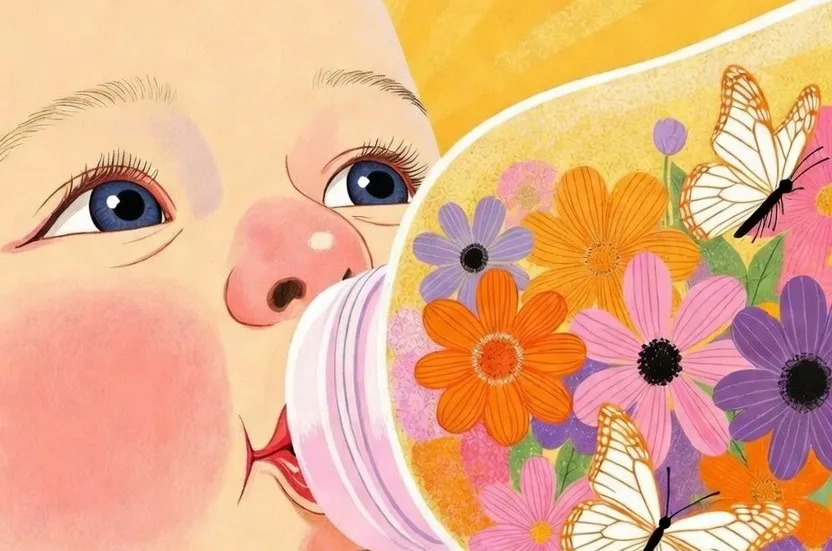
My experience feeding my baby post-mastectomy by Elizabeth Edens
“Well, you can’t breastfeed, so you’ll just have to feed her joyfully with what you can.”
This was my midwife, Martha’s matter-of-fact response when I explained my situation. We were discussing my pregnancy and impending birth over the phone. Martha was a brusque and busy woman — straight to the point. Dedicated to her craft, she had delivered most of the home-birth babies in my local region.
I had opted for this method of welcoming my baby into the world because of my complicated relationship with the medical system after surviving transition. The home birth community opened up a whole world of women who know what a woman is and how Holy and Sacred our biology is. But there was also an explicit expectation that I would breastfeed my baby, which brought up a new wave of grief related to my uninformed decision to have “top” surgery as a teen.
“Feed her with joy?” What did Martha mean by that?
She told me about another woman in her care with an inability to express milk after breast reduction surgery in her teens, which led to the same issue I faced. Martha showed her how to make a formula substitute from scratch and how to locate milk donors in her area. I followed suit. It helped me to know there was another mom out there, crunchy as could be, trying to do the best for her baby, who also had to rely on alternatives to breastfeeding.
Learning to do hard things with a positive attitude is the first lesson of motherhood. For me, this was the very first thing I did to grow into a mom.
Before my pregnancy, I had mostly made peace with the aesthetic loss of my body parts. No sooner had the algorithm figured out that I was expecting than I was inundated with ads for breast pads, hakas, and other products designed to aid in breastfeeding. Every day, I saw questions in my due date group about breastfeeding, and this brought on a whole new wave of regret and grief.
Right after she was born, my chest would ache when my daughter cried. Not metaphorically, literally. I took Sudafed to dry up the milk supply that couldn’t be expressed and stuffed my bra with cabbage. My husband took care of her those nights so I could at least stop the cycle of milk production and get some sleep. Researching how to stop milk production was a particularly painful experience because it was my heart’s deepest desire to be able to breastfeed her.
Martha talked to me about the importance of staying positive for the baby. So, when this new grief visited me late at night, I told it, “Thank you for letting me know something was wrong, but I don’t need you anymore”. I thought instead about how I looked forward to teaching my daughter how to do things and to exploring the world with her. Not every thought or feeling needs attention. Sometimes they need to be dismissed on purpose.
On nights it got to be too much for me to handle, I asked God to do for me what I could not do for myself and bear some of the weight of my feelings. The tool of prayer would go on to serve me when I got up in the middle of the night for bottle feedings. My daughter and I bonded in the middle of the night, whispering prayers of gratitude and just looking into each other’s eyes.
Before she was born, I feared I would not be able to bond with my daughter if I could not breastfeed. I have not found this to be the case. She is now two going on three and has a solid bond with me and with my husband. One bright side of not breastfeeding was that her dad could handle half the feedings, giving me time to rest and him time to bond with her.
Picking up milk from other local mothers was an experience unlike anything I had experienced before. The “Human Milk for Human Babies” Facebook group was my primary source for donor milk. Meeting the other moms who wanted to help was a fantastic opportunity to see the beautiful side of humanity and to regain some faith in others.
The cult tried to tell me I had to honor every feeling that came to me. It tried to teach me to get stuck in envy and negativity. It told me if I was uncomfortable, it was someone else’s problem.
Becoming a mother has taught me the opposite of that. I’ve been startled by how matrescence grows your capacity to do things you don’t think you can do. With Joy!
Genspect publishes a variety of authors with different perspectives. Any opinions expressed in this article are the author’s and do not necessarily reflect Genspect’s official position. For more on Genspect, visit our FAQs.