




Adolescent Transition in France: A Conversation
By Céline Masson
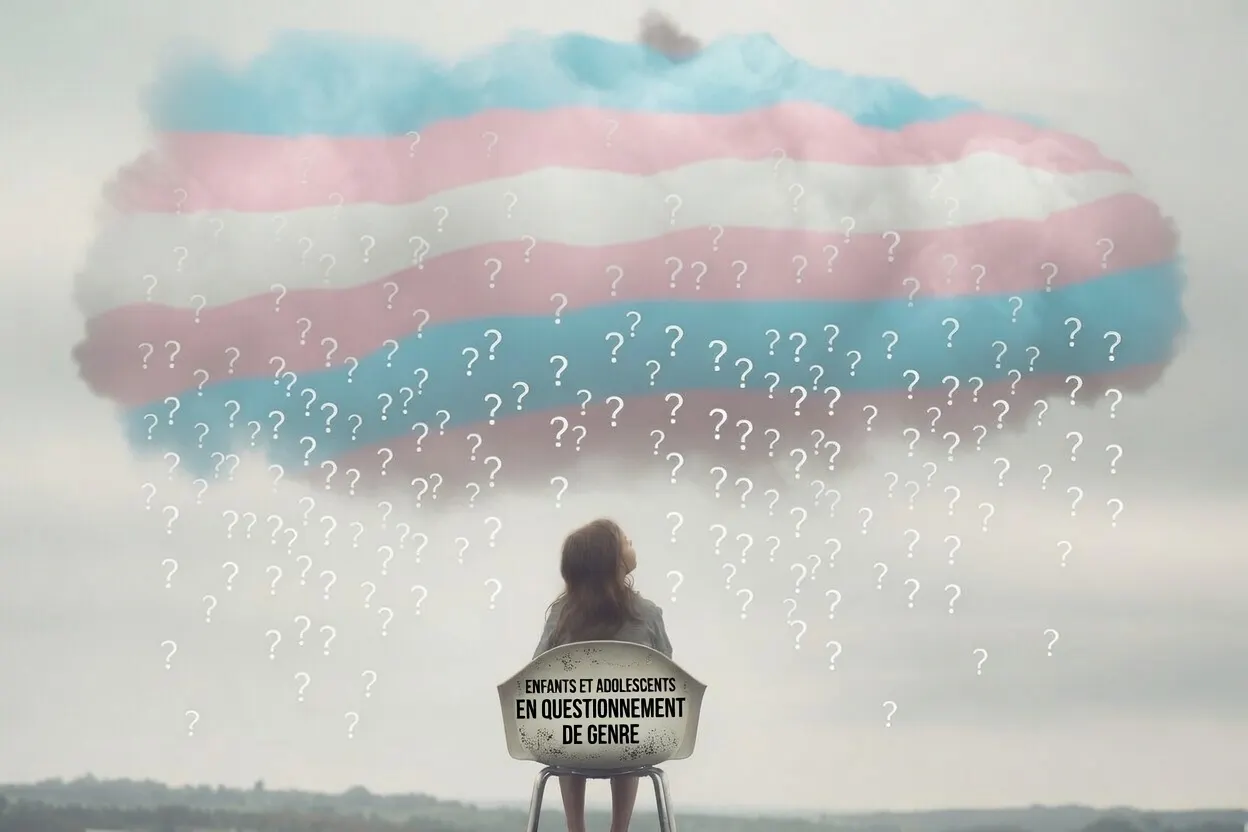
Céline Masson of the French organisation, Observatoire La Petite Sirène (OPS), in conversation with a trans-identified male support worker about the importance of moderation
Emerging ideas, clinical perspectives, and policy developments from across the world can offer valuable insights into the trans phenomenon. The conversation surrounding trans medicalization is evolving rapidly, and important contributions often come from people who approach these issues from very different starting points.
This interview, conducted by Céline Masson of the Observatoire La Petite Sirène (OPS), features a trans-identified male support worker (self-described as ‘transfeminine’ in this interview) reflecting on the experiences of young people, families, clinicians, and trans communities in France. Whether readers agree or disagree with every point raised, the discussion provides a fascinating window into debates taking place beyond the English-speaking world and highlights the importance of engaging with a broad range of perspectives as we work towards thoughtful, evidence-based ways to support vulnerable trans-identified individuals and their families.
Lisez l’entretien dans sa version originale en Français here.
Participants
[CM] = Céline Masson
[T] = Trans-identified witness involved in an association
[CM] Could you introduce yourself?
[T] I am a transfeminine person involved in the world of advocacy and support organisations. Very quickly, I began to notice certain problematic trends.
[CM] What kind of trends are you referring to?
[T] I have been involved in associations for five or six years. I noticed that, most of the time, it was parents contacting me because their daughter wanted to transition. The average age is around 15, ranging from 12 to 18 years old. Today, about 80% are female-to-male cases, often adolescent girls.
[CM] What are they seeking? How do they come to you?
[T] Generally, it is not the young people themselves who come to me, but their parents who feel completely helpless. It is not easy when your child tells you that they want to transition. I am there to help parents. As a parent myself, I know what I am talking about.
I try to calm things down on both sides and help the young person understand what a transition really is. It is not what you see on the internet. There are things you lose, and it is important to think carefully.
In general, my message is less well received by the adolescent and better received by the parents. But I try to help them understand that they need to give it time. I still help them with name changes, because it gives them the feeling that they are starting something, and it can prevent them from going further too quickly.
[CM] And what about surgery?
[T] I am opposed to surgery before the age of 18. People say it doesn’t happen, but we know very well that there are professionals who carry it out anyway. This is especially true for girls who want to become boys. The main procedure is still a mastectomy. And adolescents want everything immediately.
I tell the parents of very young trans girls, aged eight or nine, to give it time, to let them dress how they wish at home, and to treat them as girls. It’s less drastic. However, adolescent girls have a much greater sense of urgency. They want breast removal and hormones. Boys who want to become women appear to have a greater capacity to wait until age 18, even though they may be prescribed puberty blockers.
[CM] Do you know why this phenomenon affects girls more?
[T] I think there’s some hidden homosexuality involved. That’s just my personal opinion, though—I’m not a psychiatrist. That’s the impression I get from people who underwent breast surgery on the first day after turning 18 and then returned four months later, saying, “My girlfriend left me because I don’t look feminine anymore.” I think there is confusion between homosexuality and transgender identity.
[CM] Why is it so difficult to discuss this issue in trans activist circles?
[T] Adolescence is a time when people need to determine who they are and assert themselves. In the large associations, the tendency is to want to show that we are kind and that we help everyone. But it is not kindness to act without considering the consequences. Like in chess, you have to think two or three moves ahead. I think there will be a backlash in five or six years.
I have a concrete example. A head of a civil registry department told me that out of 25 applications to revert to a previous first name, 24 involved people who had transitioned in a masculine direction and were reclaiming a female name. That suggests that these young women were not actually transgender. They were on a journey of identity exploration and passed through this phase. But once they leave the framework of transgender identity, they stop speaking publicly because doing so could undermine the entire narrative around self-determination.
I think that those who advocate for self-determination in the large associations are often people like me: over fifty years old, having known for a long time that they are transgender, having built a life, and not wanting young people to suffer as we did by having to hide. That’s admirable. But I still think that puberty blockers are a lesser evil than moving too quickly. I would rather see a young person take puberty blockers than pick up a razor blade. When I see young people with scarred arms, I would rather they change their name, take puberty blockers, and then, at 18 or 20, be able to say, “I was mistaken.”
[CM] Are you familiar with the studies showing that puberty blockers are followed by transition in 98% of cases?
[T] I am familiar with those studies. But I still see puberty blockers as the lesser evil. What we really need are more psychiatrists who are trained in this area and who are neither trans-affirming nor transphobic.
[Note from Céline Masson: Puberty blockers are not simply a “pause button”. Approximately 98% of children who take them go on to take cross-sex hormones. This has been demonstrated by several studies.1]
[CM] Could you give us a concrete example of how you support these young people?
[T] I worked with a young adult woman who was immersed in the trans community because her partner was a trans woman. She started hormones after only two months. The relationship ended, and she stopped taking hormones. She told me, “Thank you for not letting things go any further.” Because I listened to her. We changed her name, and we spent hours talking. Today, when I see her, she is thriving. What she needed was to be heard. That’s where the problem lies.
Changing a name and acknowledging their distress can remove a thorn from their side. If, after two years on puberty blockers, they still are not feeling better, then transgender identity is not the issue.
[CM] Do you share our position at the OPS, namely, listening without immediately affirming a gender identity?
[T] Yes, but there is an important issue of legitimacy. When a “cisgender” psychologist questions a young person, that young person immediately thinks, “She’s against me.” When it’s me, someone who has fully transitioned, it’s completely different. In their eyes, I have legitimacy.
The problem with all associations in France is that the slightest questioning is labelled “transphobic”. Many associations do not like my message, but I would rather prevent problems than have to deal with the consequences later. It’s similar to what happened in Denmark and Sweden, where affirmation was widely embraced and now there is a move in the opposite direction.
[CM] You mentioned the politicisation of trans associations…
[T] That’s a central problem. These issues belong in the fields of health and psychology, yet they have been turned into political issues. Worse still, they have become associated with extreme politics. La France Insoumise (LFI) has taken up this cause, and they do not really understand it. At Pride events, they arrive carrying Palestinian flags. I’ll be frank: LGBT people have no rights in Palestine. I am completely opposed to the politicisation of this issue. It should be non-political.
[CM] Indeed, transgender or homosexual people can even be in danger in that region. Some have sought refuge in Israel. I met several of them in Tel Aviv, a city well known for its LGBT community.
[CM] What connection is being made between the LGBT movement and pro-Palestinian causes?
[T] It’s what is called the “convergence of struggles.” The broader the coalition, the more voters you attract. La France Insoumise (LFI) is trying to appeal both to immigrant communities and to LGBT people, two constituencies that do not necessarily have much in common. That’s one reason why many associations no longer participate in Pride events. They no longer recognise themselves in that cause. Since 7 October [the Hamas attack in Israel], things have become even more radicalised. And that harms trans associations as well.
[CM] Indeed, an organisation such as OUTrans, which is a partner of the Ministry of Higher Education, displayed its logo alongside that of Samidoun during International Women’s Day on 8 March. Samidoun is listed as a terrorist organisation in several countries because of its links to jihadism and terrorism. It is difficult to understand how LGBT organisations can associate themselves with that.
[T] What makes me laugh is when they chant “death to the police” while at the same time expecting the police to protect Pride events because participants might be attacked. It’s absurd. You cannot call for the death of the police while relying on them for protection during Pride marches.
[CM] What do you think about LGB organisations that do not include the T?
[T] I think that by wanting everything, we may end up with less. We are given special consideration in the name of fighting discrimination, and some people think that simply invoking discrimination is enough to win support. But if you push things too far, you create backlash. Inclusivity can sometimes create exclusion. “Wokeness” and proselytising make us visible in the wrong way, and that generates transphobia.
[CM] So you are in favour of invisibility? I remember a Swiss trans person who told me, “We have a right to invisibility.”
[T] Exactly. If we want to live our lives, then there should no longer be visibility days and no more stigmatisation. But in order to become invisible, people first need to understand that we are not sexual deviants. That is one reason why we replaced the term “transsexual” with “transgender”. In people’s minds, “transsexual” suggested a sexual problem, which is not what this is about.
Being transgender has nothing to do with sexuality. Since I began my transition, my libido has never been lower. I won’t say it is “minus ten”, but you get the idea. Yet many people associate being transgender with homosexuality, even though there are as many heterosexual as homosexual people among the transgender population. They are two completely separate things.
[CM] How can we return to a more measured approach, like the one you embody…
[T] I think that in just a few years we’ve gone from “everything is forbidden” to “everything is permitted.” That’s harmful and will be for many young people.
The problem is that when one side adopts a rigid position, the trans associations on the other side adopt an equally rigid position. Today, the person who feels oppressed is assumed to be right, and that’s true across many issues, not just transgender identity. So you will automatically be seen as wrong. Then, in 2027, we may have a change of government that swings in the opposite direction, as happened in the United States. We cannot keep lurching between extremes.
I am a moderate. We need a moderate message. I always try to put myself in the other person’s shoes. Take my ex-wife, for example. When I go to see her, I wear jeans and no makeup because she asked me not to arrive wearing makeup and a skirt. I respect that. It doesn’t make me any less of a woman. Makeup does not define womanhood. And if it helps my ex-wife feel less uncomfortable, I’m happy to do it.
What amuses me is that I get called “transphobic” because my views are not activist. I don’t define myself as a trans activist or a campaigner. I don’t even like those terms. I see myself as someone who helps others.
I participated in drafting the Blanquer circular. I was part of one of the four associations involved in its development. I’m in favor of awareness raising, but not until after middle school or high school—not before that. I am more comfortable with discussions taking place at upper secondary school level because by then young people have passed certain developmental milestones, including first romantic feelings and the early stages of physical maturation.
When a 12- or 13-year-old comes to you completely distressed, what should be done? I speak in classrooms for students aged around 13 to 15, not to tell them that everyone is transgender, but to help them understand that a transgender person could be their neighbour or their cousin. The aim is simply to reduce bullying and suicides linked to discrimination.
But there is also a problem with child and adolescent psychiatry. These young people need to see a psychologist first and foremost. By affirming self-determination, we bypass the stage of psychological assessment and support.
When young people come to see me, I tell them, “I know transgender people have historically been pathologized, but some degree of psychological support is still necessary.” I also tell them that I have a kind of legitimacy that others may not have. I say, “Even if this is what you want, your life is going to change. People will not look at you in the same way anymore. You need to be prepared for that.”
[CM] How do you view the issue of rejection?
[T] Rejection is not necessarily transphobia. Sometimes it is simply a reaction to encountering something unfamiliar. Take my ex-wife asking me to come without makeup and without a skirt. That doesn’t mean she rejects me. It means she needs some space.
The more we invest everything in identity, the more rejection we create. When you spend all your time immersed in a trans microcosm, you absorb everything, both the positive and the negative.
[CM] How might trans associations and the OPS work together for the well-being of young people?
[T] I think we need to work together with psychologists and doctors. As a transgender person with lived experience, we can explain to professionals how these issues feel from the inside. In my region, prosecutors and local authorities know that I am rigorous when it comes to legal applications and documentation. I know what can and cannot be requested legally. I also provide support for people going through court proceedings because the process can be very difficult.
I sincerely believe that legal changes of name and sex should be handled through local government offices. At present, only name changes can be done through the local authority, while changes of legal sex still require court proceedings. The courts are overwhelmed. For a minor, obtaining a court ruling can take two years, meaning the young person is often already an adult by the time the decision is issued. If the process is handled through the local authority, it is easier to reverse if someone later changes their mind. The most important thing is that the parents agree.
[CM] Don’t you think that social transition can itself create dysphoria? When a young person changes their name at 14, there is also a risk that their gender identity becomes increasingly aligned with the opposite sex.
[T] That risk exists. But generally speaking, young people understand transgender identity better than we often assume. Today, if a girl adopts a male name in the playground, her classmates may simply say, “Okay,” and leave her alone. She may then be able to work things through and find her way. If you forbid everything, it can make young people want everything. Sometimes giving a little room is enough.
[CM] I’m less convinced than you are. I think we first need to explore what is happening in these young people’s minds.
[T] I agree with you. Eighty percent of the calls I receive concern girls. In my day, transgender identity was primarily associated with boys. There are clearly important questions being raised by girls today. We also need to keep a sense of proportion. A 50-50 or even 60-40 split would make sense, but almost 80% of my calls concern girls.
[CM] To finish, what question would you like to ask me?
[T] How can we work together effectively for the benefit of everyone, avoid attacking each other, and act in the best interests of others?
[CM] That’s a good question. Today, we have demonstrated that it is possible. Our roles are quite different. You are primarily involved in support and accompaniment, whereas we focus more on psychological assessment and care.
The term “transgender identity” is problematic for us because it does not necessarily address the difficulties of some young people who are not actually transgender. That’s why we use the term “trans identification,” which is more flexible. We have also proposed the concept of “Pubertal Sexuation Anxiety” (ASP – Angoisse de sexuation pubertaire) because we believe that some girls are struggling with their bodies, with puberty, and with the development of their femininity during adolescence. We do not see that as the same thing as transgender identity.
[T] Those are still just words. At some point, we need to stop debating terminology and take action. Non-binary identity – that’s the solution. It would allow these young people to avoid feeling compelled to pursue major transitions in order to go further than others.
[CM] That may be one area where we can find common ground. Non-binary identity as an intermediate space that allows time.
[T] Exactly. Psychiatrists know very well what you’re saying. Many of them agree with you in principle. But they cannot publicly say so because they would immediately be labelled transphobic. It’s the same problem we face. Simply saying, “Perhaps La Petite Sirène has a point,” is enough for someone to call you transphobic.
[CM] We also face defamation and slander. There have been legal actions for defamation. As a researcher, I also work against misinformation because it damages every cause, including yours. There is such a thing as hatred of the other, the fear of what is different.
[T] Absolutely. That’s always been part of my cause as well. A phobia is fundamentally a fear of difference. And that’s where, deep down, we find common ground.
I understand the stakes involved because some of my views fall outside the usual framework. But it is important to help people understand these issues. First, to help parents. To help young people. To help everyone. And also to help those who embrace these ideas too quickly, so that they can better understand the complexities involved.
Genspect publishes a variety of authors with different perspectives. Any opinions expressed in this article are the author’s and do not necessarily reflect Genspect’s official position. For more on Genspect, visit our FAQs.
1 ¹ Carmichael, P., Butler, G., Masic, U., Cole, T. J., De Stavola, B. L., Davidson, S., Skageberg, E. M., Khadr, S., & Viner, R. M. (2021). Short-term outcomes of pubertal suppression in a selected cohort of 12 to15 year old young people with persistent gender dysphoria in the UK [Conséquences à court terme de la suppression pubertaire chez une cohorte sélectionnée de jeunes de 12 à 15 ans présentant une dysphorie de genre persistante au Royaume-Uni]. PLOS ONE, 16(2), e0243894. https://doi.org/10.1371/journal.pone.0243894
² Wiepjes, C. M., Nota, N. M., de Blok, C. J. M., Klaver, M., de Vries, A. L. C., Wensing-Kruger, S. A., de Jongh, R. T., Bouman, M-B., Steensma, T. D., Cohen-Kettenis, P. T., Gooren, L. J. G., Kreukels, B. P. C., & den Heijer, M. (2018). The Amsterdam Cohort of Gender Dysphoria Study (1972–2015): Trends in prevalence, treatment, and regrets [L’étude de cohorte d’Amsterdam sur la dysphorie de genre (1972-2015) : tendances en matière de prévalence, de traitement et de regrets]. The Journal of Sexual Medicine, 15(4), 582–590. https://doi.org/10.1016/j.jsxm.2018.01.016
³ de Vries, A. L. C., Steensma, T. D., Doreleijers, T. A. H., & Cohen-Kettenis, P. T. (2011). Puberty suppression in adolescents with gender identity disorder: A prospective follow-up study [Suppression de la puberté chez les adolescents présentant un trouble de l’identité de genre : une étude de suivi prospective]. Journal of Sexual Medicine, 8(8), 2276–2283. https://doi.org/10.1111/j.1743-6109.2010.01943.x
⁴ Baxendale, S. (2024). The impact of suppressing puberty on neuropsychological function: A review [Impact de la suppression de la puberté sur les fonctions neuropsychologiques : une revue de la littérature]. Acta Paediatrica, 113(7), 1156–1167. https://doi.org/10.1111/apa.17150