




The Banality of Amnesty International
By Nancy McDermott
The Orwellian report provokes a push back in the UK
Just as Americans were settling back into their routines after the 250th anniversary celebrations, something extraordinary occurred in the UK. The human rights organization Amnesty International’s British “section”, Amnesty International UK, published a report entitled A Growing Threat: The Anti-Rights Movement in the UK.
If the linguistic formulation “Anti-Rights” feels Orwellian, it is. The report, which included a list of 117 organizations that are supposedly part of an “anti-rights ecosystem,” turns reality on its head by characterizing organizations defending established rights as “anti-rights”. These “anti-rights” include freedom of speech, single sex spaces, and, in the case of religious organizations, holding an orthodox Christian position on sex, gender, and abortion.
Fifty-one of the organizations listed (Genspect, Sex Matters, For Women, Scotland, LGB Alliance, etc.) were called out for visibly opposing the rights and equality of women and LGBT+ people. JK Rowling’s Beira’s Place, a female-only center for victims of sexual assault, was highlighted for its “anti-rights” approach because it restricts access based on biological sex.
And that was when things got interesting.
It’s hard to guess what the authors of the report were thinking. Perhaps they imagined that they, like the American Southern Poverty Law Center, might become the arbiter of hate and extremism in the UK. Perhaps they even contemplated a future interactive, zoomable map with pins, clusters, popups —Scotland would surely be a dark spot, and London. But whatever they were expecting, it wasn’t for the slandered organizations to fight back. So assured were they of their moral rectitude that it seems never to have occurred to them to run the report by their lawyers prior to publication — a huge mistake.
The report drew heavy criticism and condemnation from long-time Amnesty International donors, including comedian John Cleese, who wrote on X, “I was a big supporter of Amnesty when they fought political imprisonment and torture. Now, I renounce them entirely.” Amnesty International Global issued a statement distancing itself from the UK.
The organizations listed wrote to Amnesty demanding to see the evidence for its anti-rights designation, a public apology, and clarification of whether Amnesty stood by the claims in the report. By the weekend, Amnesty International UK had issued the following statement:
“We have temporarily removed this briefing while it undergoes an internal review. Amnesty International UK remains committed to researching and campaigning on human rights issues, incorporating our long-standing and explicit commitment to gender justice, including the rights of women, LGBTQI and trans people.”
Or, as JK Rowling quipped, “Translation: oops, didn’t realise people outside our ideological bubble are this p*** off about the loss of sex-based rights. We remain implacably opposed to any organisation fighting to retain them, but shove in the words ‘rights of women’ to keep the bigots happy.”
Then, to add to its woes, the UK Charity Commission announced on Friday that it had begun a probe into Amnesty’s conduct after multiple targeted organizations formally complained. Indeed, the complaint was serious enough that Amnesty felt compelled to report itself.
Consumed from Within
As satisfying as it is to witness the humiliation of Amnesty International UK for its deeply irresponsible report, it is yet another unfortunate example of how a once-trusted institution is being “eaten from within” by ideologues. The organization has become increasingly incoherent on the issue of women’s rights in recent years, and its delayed, mealy–mouthed response to criticism of its report only made things worse. The current malaise may soon overshadow the good work Amnesty has done over the years defending female-only spaces in contexts like prisons, shelters, and sports when it involves protecting women from male violence in other countries. Its actions in withdrawing the report, self-reporting its conduct to the Charity Commission, and the apparent lack of support for the report from other international sections are good, and seem to indicate an internal struggle, but it may be too little, too late.
It has become common to speak of institutions as captured—as if activists intentionally set out to change them—and sometimes this is true, but the fall of Amnesty is probably more banal than evil. The old guard grew tired and handed off the mantle to a new generation who, they assumed, would carry on fighting the good fight in the same way. It never seems to have crossed their minds that the struggle for rights could be anything but pure and good, or that the world that gave rise to the concept of human rights in the first place, a world defined by natural limits, boundaries, and moral assumptions, might fade away. And so, a new generation carries on with a new and terrifying normal. A normal in which no one at Amnesty bothers to vet their report, because they know they are right. A normal in which the thoughtless pursuit of “rights leads to irreparable harm to women and girls, lesbians and gay men.
This absence of thinking is rife on both sides of the Atlantic. Consider the American Civil Liberties Union (ACLU), once a defender of civil liberties, but now in the vanguard of advancing trans activists’ demands at the expense of women and girls. Think of the Southern Poverty Law Center when it was still primarily about desegregating institutions (schools, prisons, etc.), suing the KKK and other violent groups for damages on behalf of victims, and pursuing voter rights and economic justice cases for poor Southerners. It is no longer possible to make assumptions about what these old-guard institutions stand for.
It seems clear that the self-awareness necessary to salvage these organizations’ legacy will not come from within, so it is up to us to stay vigilant, withdraw our support from them, and encourage others to do the same.
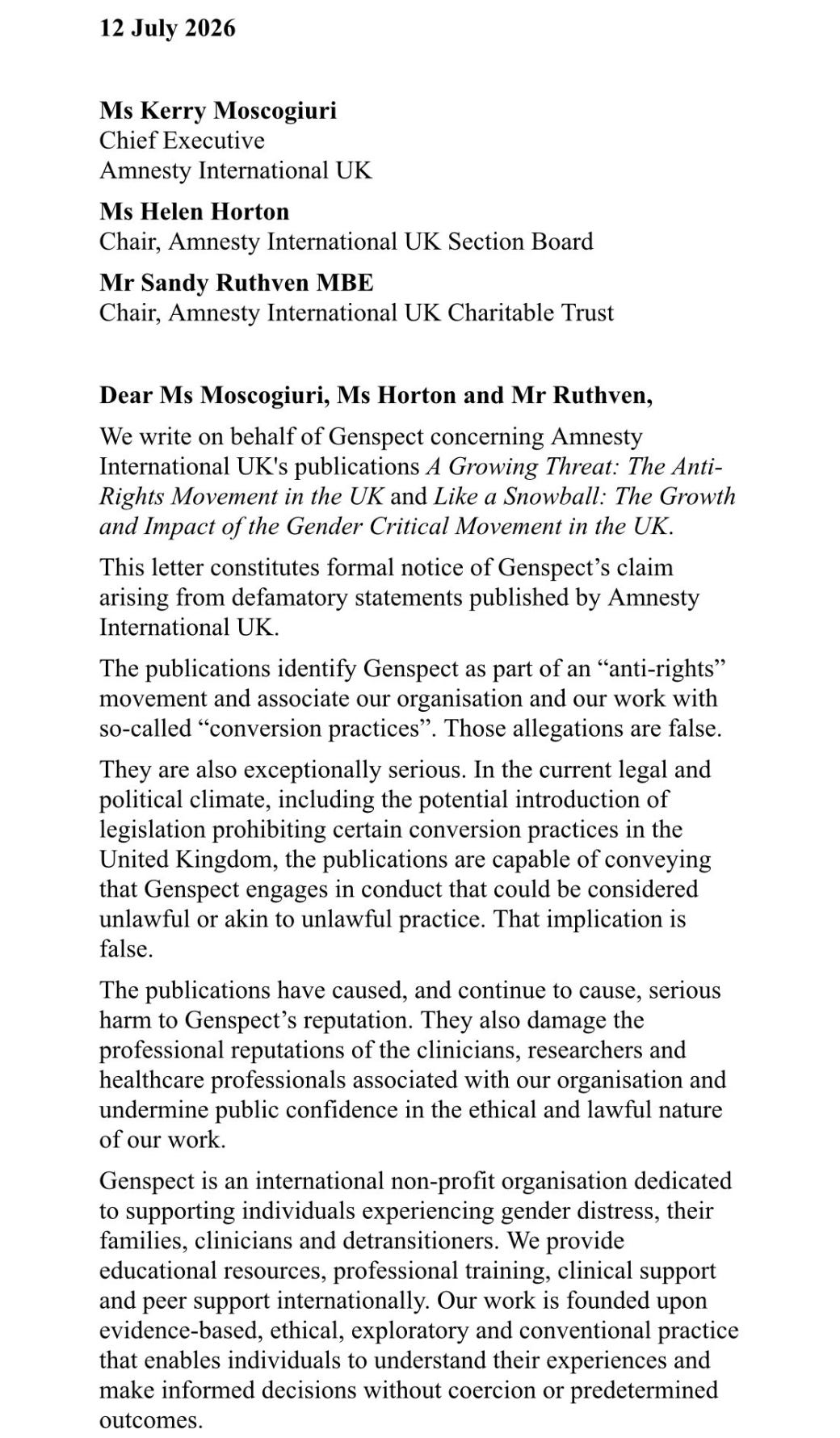
Genspect’s Letter
All the Letters1
- Beira’s Place statement
- Beira’s Place letter
- CAN-SG
- Children of Transitioners and Trans Widows’ Voices
- FiLiA
- For Women Scotland
- Gay Men’s Network
- Keep Prisons Single Sex
- Labour Women’s Declaration
- Legal Feminist
- Lesbian Strength
- LGB Alliance
- LGB Alliance Cymru
- Liberal Voice for Women
- Merched Cymru
- Murray Blackburn Mackenzie
- Protect and Teach
- Safe Schools Alliance
- ScotPAG
- SEEN in Health
- SEEN in Journalism
- SEEN in Publishing
- Sex Matters
- Third Sector SEEN
- Thoughtful Therapists
- Transgender Trend
- Women’s Rights Network
Genspect publishes a variety of authors with different perspectives. Any opinions expressed in this article are the author’s and do not necessarily reflect Genspect’s official position. For more on Genspect, visit our FAQs.