




The Travesty of Amnesty’s “A Growing Threat” Report
By Peter Jenkins
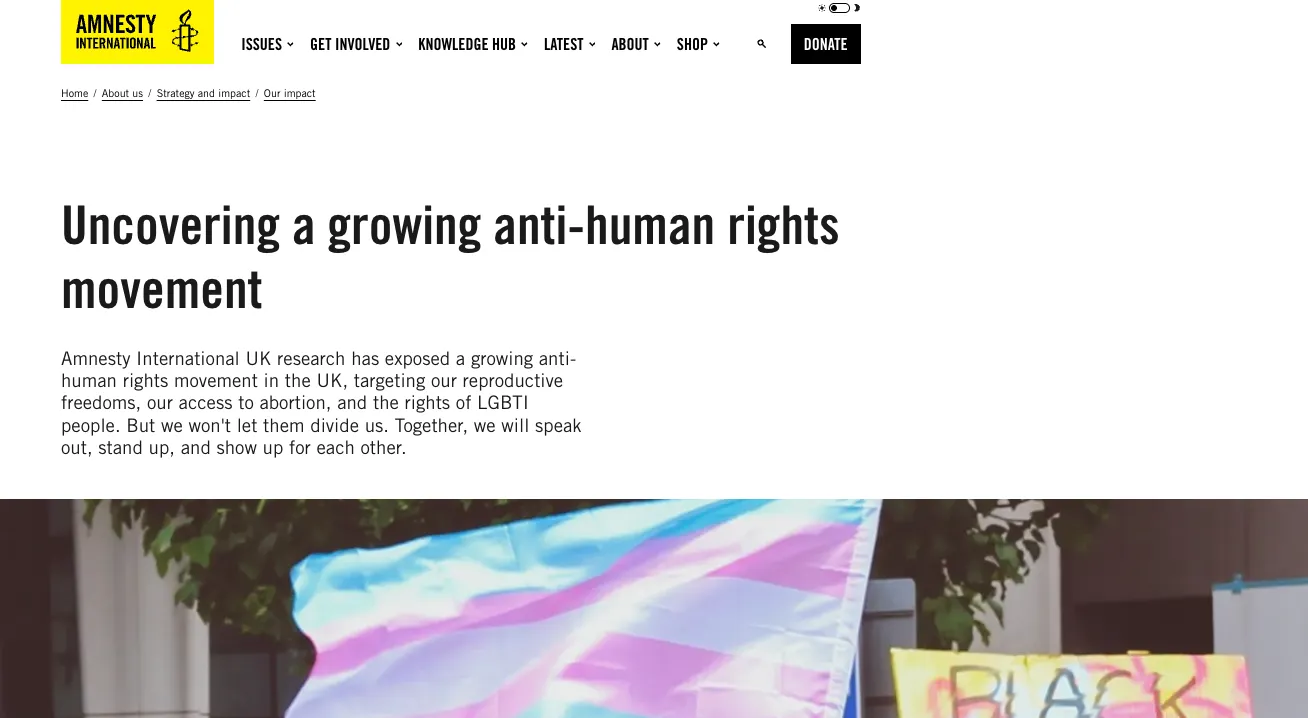
Amnesty International UK’s twisted logic and selective ignorance of human rights law
Peter Jenkins provides the background to the current controversy over Amnesty International (UK)’s report, A growing threat, listing gender critical campaigning and therapy groups as being ‘anti rights’.
Amnesty International was once a highly respected advocate for human rights and defender of civil liberties. It is now a travesty, a shadow of its former self, as an unbridled advocate for the rights of trans-identifying men. It has kicked up a storm of controversy by publishing a report online, which lists organisations in the UK, which it claims, without evidence, pose a ‘growing threat’. To whom, or to what, this threat consists of, is never made clear. No matter, the claims help stoke an atmosphere of well-funded conspiracy against human rights. After all, human rights are, apparently, whatever Amnesty decides they are.
And here the problem starts. Amnesty claims to be analysing “the rise of an anti-rights movement targeting the rights of women and LGBT+ people in the UK” (2026: 1). Yet Amnesty finds it impossible to acknowledge that the rights of women and of trans identifying men could ever be in conflict. Hence the blame is placed on the rise of ‘gender ideology’ (influenced by the Pope). It might help to call things by their right name. The completely legitimate challenge to trans rights is derived from the growth in opposition towards ‘gender identity ideology’, i.e. a belief of an internalised sense of discrepancy with one’s birth sex.
Amnesty’s Failed Intervention at the UK Supreme Court
Amnesty has a good deal of skin in this sordid game. Amnesty was an intervener in the landmark case decided by the UK Supreme Court in April 2025, brought by For Women Scotland. Amnesty argued the classic, if mistaken, case that transitioning males required full legal recognition as women under equality law. Amnesty lost. The UK Supreme Court confirmed that biological sex was of decisive importance in interpreting the Equality Act 2010. This report feels like payback time from Amnesty against, not just Women for Scotland, now on the report’s infamous list of ‘anti-rights’ organisations, but all the other pesky gender critical groups too, like Sex Matters.
Amnesty seems to have serious problems in coming to terms with the law as it is, rather than how they would prefer it to be. So, the report can state, without any obvious sense of irony, that “When the rights of one group are restricted, protections for others can also be weakened…” (2026: 4). This hits the nail on the head. Stonewall’s versions of equality law, seemingly endorsed by Amnesty, would have it that the Equality Act 2010 meant that trans-identifying men were really women in the eyes of the law, and could therefore access women’s legally protected spaces. The UK Supreme Court has ruled that this is not the case in law.
Human Rights = Trans Rights
So, for Amnesty, it seems to have been a very short step indeed from claiming ‘Trans rights are really human rights’ to ‘Human rights are really trans rights’. For an organisation claiming to defend human rights, it is concerning, at least, that Amnesty seems not to recognise the law as it actually is. Specifically, Amnesty also does not appear to acknowledge free speech rights, for example, those held after the Forstater judgement by gender critical so-called ‘anti-rights’ groups. Again, it is not clear at all whether Amnesty has never heard of the Forstater case, or whether it just prefers not to mention it.
Then there is the issue of the list. Amnesty’s report lists 12 organisations allegedly involved in ‘conversion practices’, such as Thoughtful Therapists, Genspect and Therapy First, and 50 organisations described as ‘Gender critical’, including Sex Matters, For Women Scotland and the Lesbian, Gay and Bisexual Alliance. Scandalously, Beira’s Place, a women’s refuge for survivors of sexual assault, is also on this list. The logic underlying the rationale for identifying groups promoting women’s rights, such as Sex Matters, as being somehow ‘anti-rights’ is skewed and defective. It goes something like this:
—Alliance Defending Freedom is a rich, US, far-right opponent of women’s rights, e.g. to abortion.
—Alliance Defending Freedom is a rich, US, far-right opponent of trans rights.
—Organisation X opposes certain trans rights, i.e. the assumed right of trans-identifying males to enter women-only legally protected spaces.
—Organisation X must therefore be an ally of the ADF and of other far-right opponents of women’s rights, e.g. to abortion.
It then follows from this pedantic and illogical reasoning that:
—Organisation X must therefore be very bad indeed and be put on a list, together with all the other bad organisations.
Inspecting Gender is a reader-supported publication. To receive new posts and support our work, consider becoming a free or paid subscriber.
The Contamination Model of Politics
However, this flawed logic is based on a juvenile, unfalsifiable, contamination model of politics. Under this model, no political or social grouping, whether it is Thoughtful Therapists, the Bayswater Group, or Sex Matters, can ever be considered and analysed on its own terms. Every organisation has to be linked to every other organisation, and squeezed into a pie chart, showing substantial overlap and influence. In the end, it appears that all roads inevitably lead back to the US far right. Unfortunately, this model of endless US far-right funding does not address the stubborn lived reality in the UK of the numerous groupuscules on the gender critical spectrum. How come, if all these little groups are so totally aligned ideologically with ultra-rich US benefactors, they never seem to have any money at all? Why are they generally as poor as church mice? It just doesn’t add up.
With this report, already summarily withdrawn for ‘internal review’, Amnesty has abdicated any possible expectation of it being taken seriously as a human rights advocate. It shows every sign of being a vehicle simply for promoting the rights of trans-identifying males, in defiance of the UK Supreme Court ruling and of the extensive rights to free speech consistent with the legitimate expression of gender critical beliefs. The list of ‘conversion practices’ groups and of ‘gender critical’ groups in effect provides an open invitation for trans activist groups to consider challenging these groups’ charitable status where relevant, or to bring future criminal prosecutions under the current Draft Conversion Practices Bill (2026). As proclaimed by the Red Queen in Alice in Wonderland, “Sentence first – verdict afterwards.” This is an indefensible position for any human rights organisation to take.
Update
Amnesty’s report has unleashed a wave of protest by the groups listed as being ‘anti-rights’. A joint letter challenging Amnesty’s unevidenced and damaging assertions has been compiled and will be sent to the Charities Commission, the UK charities regulator. However, this may not be sufficient on its own to bring Amnesty to heel. Amnesty in the UK consists of two separate legal entities – Amnesty International UK Section and Amnesty International UK Section Charitable Trust. Its charitable objectives include educating and promoting awareness of, and support and respect for, human rights. Arguably, its report is not consistent in any way with achieving these admirable goals. However, the Charities Commission has previously been noticeably reluctant to take effective action against organisations over gender critical issues. Mermaids, for example, a highly controversial trans lobby group, was let off by the Charities Commission in 2024 with a mere tap on its wrist.
The second development concerns the realistic threat of legal action against Amnesty. The infamous list included Beira’s Place, a women-only refuge for victims and survivors of assault and abuse. This has now issued a formal legal letter to Amnesty. The potential legal action against Amnesty could well be funded by the author, J.K. Rowling, who has deep pockets, as they say in the legal trade. So Amnesty has clearly overstepped the mark with its report, even if it has now been hastily withdrawn. A human rights group, now apparently rebadged as a trans rights pressure group, giving even the merest hint of appearing to malign a women’s refuge, is not a good look, certainly in the court of public opinion, and even more so in the courts. As for Amnesty, it has issued a bland, multi-purpose statement of ‘regret’, although this may well be a case of ‘too little, too late’, to save it from being properly held to account in the courts.
This is an updated version of this article, which was originally published by Critical Therapy Antidote.
Peter Jenkins is a counsellor, supervisor, trainer and researcher in the UK. He has been a member of both the BACP Professional Conduct Committee and the UKCP Ethics Committee. He has published several books on the legal aspects of therapy, including Professional Practice in Counseling and Psychotherapy: Ethics and the Law (Sage, 2017). He is also a member of Thoughtful Therapists.
Genspect publishes a variety of authors with different perspectives. Any opinions expressed in this article are the author’s and do not necessarily reflect Genspect’s official position. For more on Genspect, visit our FAQs.