



Sex Education Books: Ireland’s Failure to Protect Kids
By Paddy O'Gorman
Paddy O’Gorman’s Letter from Ireland
I was about nine years old when I got what I now consider to have been my first sex education. What happened was this. The nun at school told us to beware of kidnappers who were in our town. These were men, she said, who might try to get us children to get into their cars and take us away. When I got home later that day, I told my mother about the kidnappers. My mum decided to tell me a bit more. It was a particular man in our town, she said, whom the nun was warning us about. My mum told me who that man was, and she further told me that he likes to take little boys away and kiss and cuddle them, which is not a nice thing to do. I thought, yuk! I resolved, there and then, to absolutely never let that man anywhere near me.
Of course, now, many years later, I know that that man wanted to do a lot more than kiss and cuddle little boys like me, but I wouldn’t have understood that at the time. Today, I look back in admiration on how those two women, my mother and the nun, gave me age-appropriate sex education that helped to keep me safe.
See No Evil, Hear No Evil, Speak No Evil
Fast-forward to today, and sex educators are telling schoolchildren how to prepare their anuses for penile penetration: “Trans women’s vaginas do not self-lubricate in a way that a cis woman’s vagina would, so you’ll need LUBRICANT if you’re planning to enter one.” That’s from the publication “What’s the T?”, which is on a list of books recommended for ages 15+ by Children’s Books Ireland as part of their “Read with Pride Guide, 2026” of “100 great LGBTQ+ reads for people age 0 to 18”. CBI describes “What’s the T?” as a “guide written primarily for trans, non-binary, and questioning teens”. The CBI list of books was also featured on the website of Ireland’s state broadcaster, RTÉ, as part of the broadcaster’s Pride Month celebrations in June. It was included in the “RTÉ KIDS Book Club for ages 2–12” section.
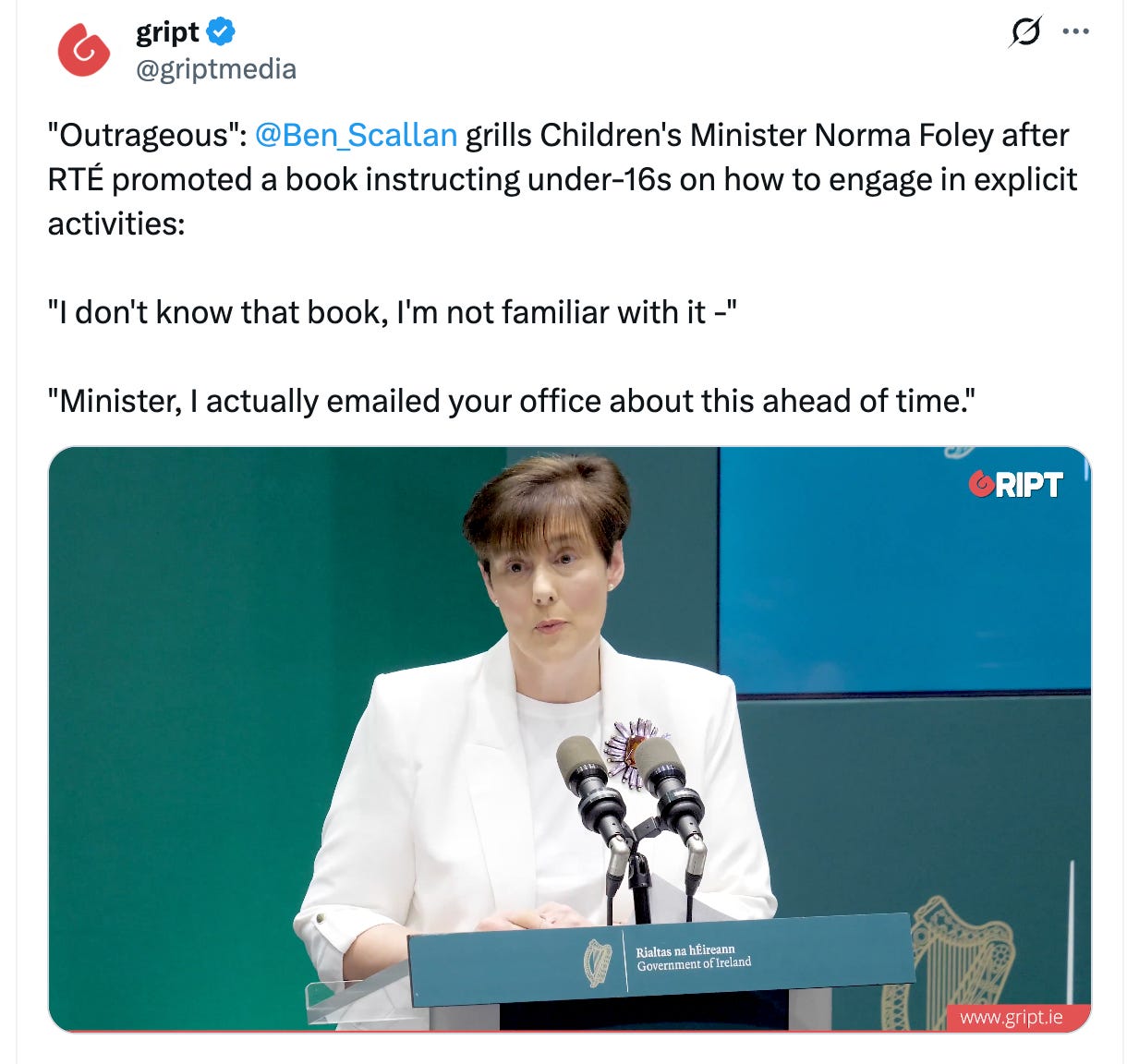
In Ireland, we have a Government Department of Children, Disability and Inequality, which is charged with protecting children. Norma Foley TD is the senior minister in that department. At a recent press conference, worth looking at, Minister Foley was asked by journalist Ben Scallan of Gript Media if she thought it was appropriate that the book “What’s the T?”, which contains sexually explicit material, should be included in a list of books for children aged as young as 15. Scallan further asked the Minister if she thought the state broadcaster, RTE, should be promoting such a book.
Foley responded that she had no knowledge of that particular book, to which Scallan countered that he had given both her office and her department advance notice that he would be raising this matter at the press conference. Foley repeated that she knew nothing about the book, and she then retreated into saying that what a child reads is a matter for parents. “As Minister for Children”, said Foley, “I respect one hundred percent the oversight of parents and guardians”. Which makes you wonder why we have a Minister for Children at all. As the government minister entrusted with guarding the safety of children, is Foley telling us that there is never a circumstance she could envisage in which the oversight of parents or guardians should not be 100% trusted?
Following Minister Foley’s press conference, RTE removed the link it had on its website to the CBI list of books, citing “the age appropriateness of resources for the RTÉ KIDS audience profile of up to 12 years old” for its decision. It’s to the credit of journalist Ben Scallan that RTE made this change after he brought the matter to the broadcaster’s and the public’s attention (which RTE did not acknowledge). Unfortunately, not all journalists are of the same quality as Ben Scallan.
“Wherein Lies the Truth, Minister?” Journalist Cuddihy Cuddles up to Power
Less than two years back, in October of 2024, Norma Foley was Minister for Education in the then-Government when a controversy arose over sex education materials being used in a teacher-training college. These materials included discussion on how to talk to children about “fisting” and “rimming” and on how to get schoolchildren to write about sexual experiences they might like to have. There was also a graphic animation of a woman masturbating, as well as an image that I think is most aptly described as child-orientated pornography: a cartoon-like depiction of lots of happy-looking people frolicking on a hillside, who, on closer inspection, could be seen to be involved in various sexual activities with each other or with themselves. And all of this teaching material took it as a given that a child’s sex is determined by whatever that child says it is. You get the picture.
One trainee teacher on the course, appalled by what she was seeing, turned whistleblower. Education Minister Norma Foley responded by saying there was never any question of any of this sex-education material being used in classrooms. It was all there for the sole benefit of adults taking the course and it was outrageous of anyone to suggest otherwise.
That surely makes you wonder what this material was doing on a teacher-training course in the first place. Why train teachers in how to get kids to write about sexual experiences if there was never any intention of bringing that training into the classroom? And why would you be teaching adult women how to masturbate? Foley’s insistence that none of this sex education stuff was ever to be aimed at kids seemed, to me at least, to be mightily unconvincing. So, to get at the truth, what we, the public, needed was a competent journalist who would ask fair questions of Minister Foley. Instead, we got Kieran Cuddihy.
Foley chose her platform well. She went on Cuddihy’s radio programme on Newstalk where Cuddihy put it to her: “… a former teacher, I’m not even going to say her name and direct people towards the video and get them watching or whatever… but the implication… is that really extreme content is going to be taught to kids in school by this person ‘claiming’ to be a kind of ‘whistleblower’… wherein lies the truth Minister?”
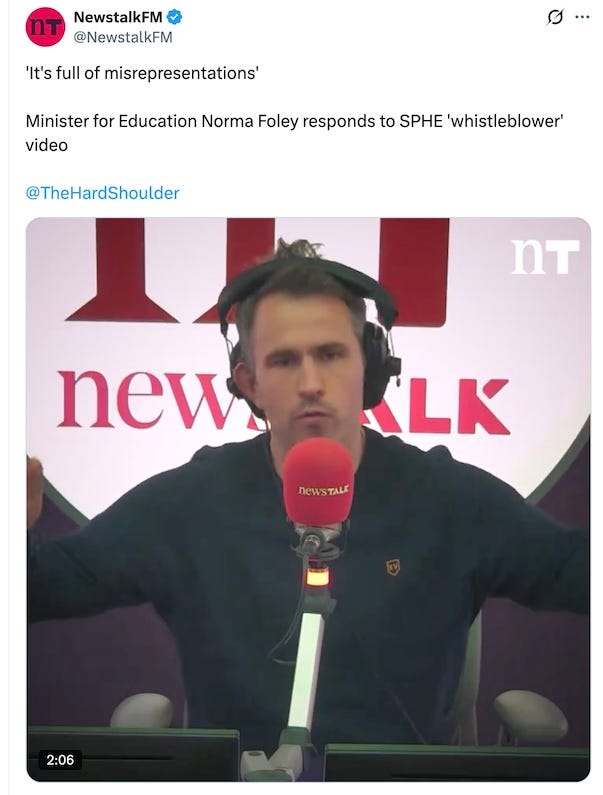
As you will see and hear if you watch the video of that interview, Cuddihy spoke the words “claiming” and “whistleblower” with heavy irony, complete with air quotation marks he made with his hands. And the tone of his question, “Wherein lies the truth, Minister?” was deferential rather than interrogative. Clearly, Foley was being given to understand that no probing or secondary questions would be put to her in the course of her giving her answers, and this turned out to be the case. Cuddihy would go on to be rewarded for his obsequiousness. A year after the Foley interview, he was recruited by the state-funded broadcaster RTE as presenter of the radio phone-in programme Live Line, a role that he still holds.
I’ll explain to readers not familiar with Irish broadcasting that Live Line, for more than forty years, was a great democratic forum on RTE Radio on which ordinary radio listeners got to speak their mind. I’m proud to say I was one of the early producers on the programme in the days when it was presented by the great Marian Finucane, since deceased. In the decades after that, I many times produced Live Line, and, on rare occasions, presented it. For me, one of the joys of being a producer in current affairs broadcasting was that you didn’t have to overthink who was right or wrong about things. If there was a public controversy about something that people cared about, you aired that controversy.
When Journalists Take the Knee to Politicians
But that’s all changed now. Even before Cuddihy took the helm, Live Line had already abdicated its responsibility to the public. It’s been four years since the programme dealt with transgenderism for the first and last time. Over three days, callers spoke for or against the trans policies being introduced in our laws, our schools, our healthcare, and our sports. The politicians’ reaction to this outbreak of free speech on RTE was one of fury. Taoiseach (Prime Minister) Micheal Martin said, “We don’t need that kind of debate in Ireland”. Politicians of all the major parties banded together to demand that RTE be called before an Oireachtas (parliamentary) committee to answer for what it had done. The rest of the legacy media, almost without exception, rounded on RTE and sided with the politicians. In response, RTE, instead of calling the politicians’ bluff and standing up to its critics, bottled it and tacitly agreed to never offend the trans lobby again. With hindsight, I now think that RTE’s shocking decision to take the knee to the politicians at that time marked the beginning of the end of a once-great radio station.
RTE will go on losing public respect so long as it continues to run away from issues that people care about. How about opening up the phone lines for discussion on some of these questions: Were the British police right or wrong to arrest Irish comedy legend Graham Linehan over a tweet that some trans activists found offensive? Should our libraries be hosting Drag Queen story events for children? Does Irish pop star Roisin Murphy deserve the abuse and industry cancellations she has been getting because she says it’s wrong to give puberty-blocking drugs to teenagers? Are we doing the right thing in putting sex offender men into women’s prisons and violent men, or any men for that matter, into women’s domestic violence refuges? Are our secondary schools right or wrong to be getting rid of separate boys’ and girls’ toilets? And, most recently, is it right to be giving schoolchildren books on how to do anal sex?
But none of that will happen because RTE doesn’t want debate. It will allow only one view on trans to be heard. The author of the anal sex guide for kids is a trans-identified man by the name of Juno Dawson. Following the publication of his last book, an equally sexually explicit one for kids who think they may be transgender, Dawson was a guest on RTE Television’s Late Late Show, where he was allowed to put forward his views unchallenged. Irish author Helen Joyce, who has written a best-selling book critical of the trans agenda, has never been a guest on The Late Late Show, nor on any other RTE programme, to my knowledge.
So as our mainstream media opts out of public debate, the role of the online media becomes more important than ever. Just because RTE won’t talk about the books it has been recommending for children doesn’t mean that the rest of us can’t talk about them. And the intrusion of the transgender movement into childhood culture is a particularly sinister development that needs to be scrutinised.
Public Vigilance Protects Children
I expect I’m not the only person who, for decades, was vaguely aware that there are groups of men who like to dress up in women’s underwear and prance around in front of each other. Who cares? Then those men started to involve kids in what they do in an activity they call Drag Queen Story Time. Now I care. Once you involve children, your fetish becomes everyone’s business.
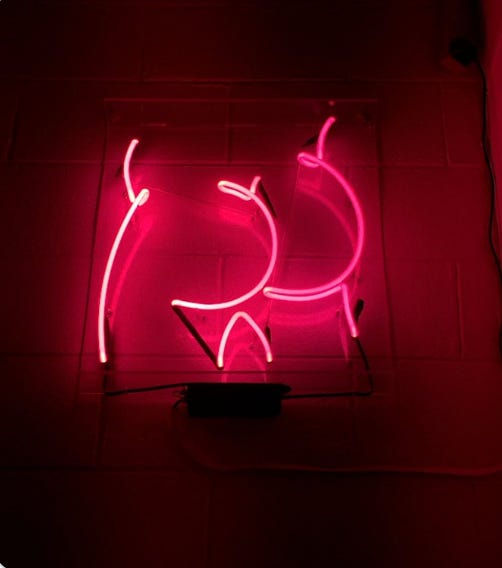
And public vigilance is paying off in protecting children. A few years back, in Dun Laoghaire, County Dublin, the public library there booked a drag act called “Glitter Hole” and billed this as an event to entertain children. The group’s logo showed a line drawing of a pair of buttocks alongside the group’s name. The juxtaposition of the buttocks and the word “hole” made for an anal allusion obvious to everyone except confirmed trans “allies” and unfit parents. But there were enough parents who knew a threat to their children when they saw one. Dun Laoghaire Library eventually cancelled the event, citing threats to its staff as the reason, but I think it was public concern for the protection of children that finally brought the Library authority to its senses.
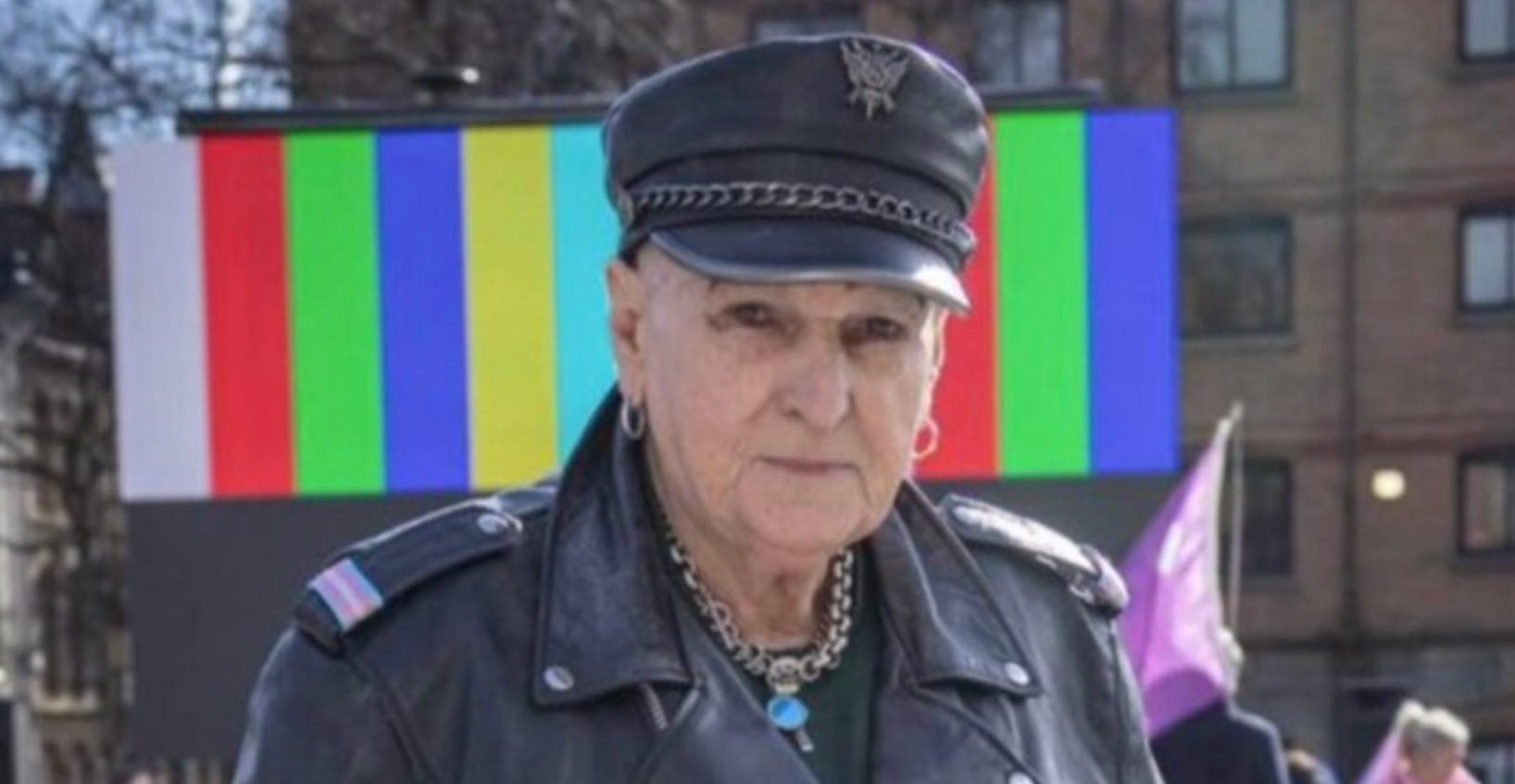
But the danger is far from over. We continue to see ample evidence of child abusers putting on dresses and using transgenderism to gain access to kids. Recently, an elderly trans-identified man, who went by the name of Tina McCombe, died. McCombe had been a prominent person in Belfast Pride, and “her” death brought gushing tributes from fellow Pride activists. Then, post-mortem, a disturbing picture of McCombe emerged of him as a serial sex predator who had, among other things, pimped out a schoolgirl and had habitually indecently exposed himself to children. That’s something that parents in Belfast might have been warned about before they were encouraged to march their children along with McCombe at Pride events. Clearly, McCombe had been able to use his trans status as a means of gaining access to victims while staying above reproach because, seemingly, nobody had the courage or moral compass to challenge this trans-identified icon when he was alive.
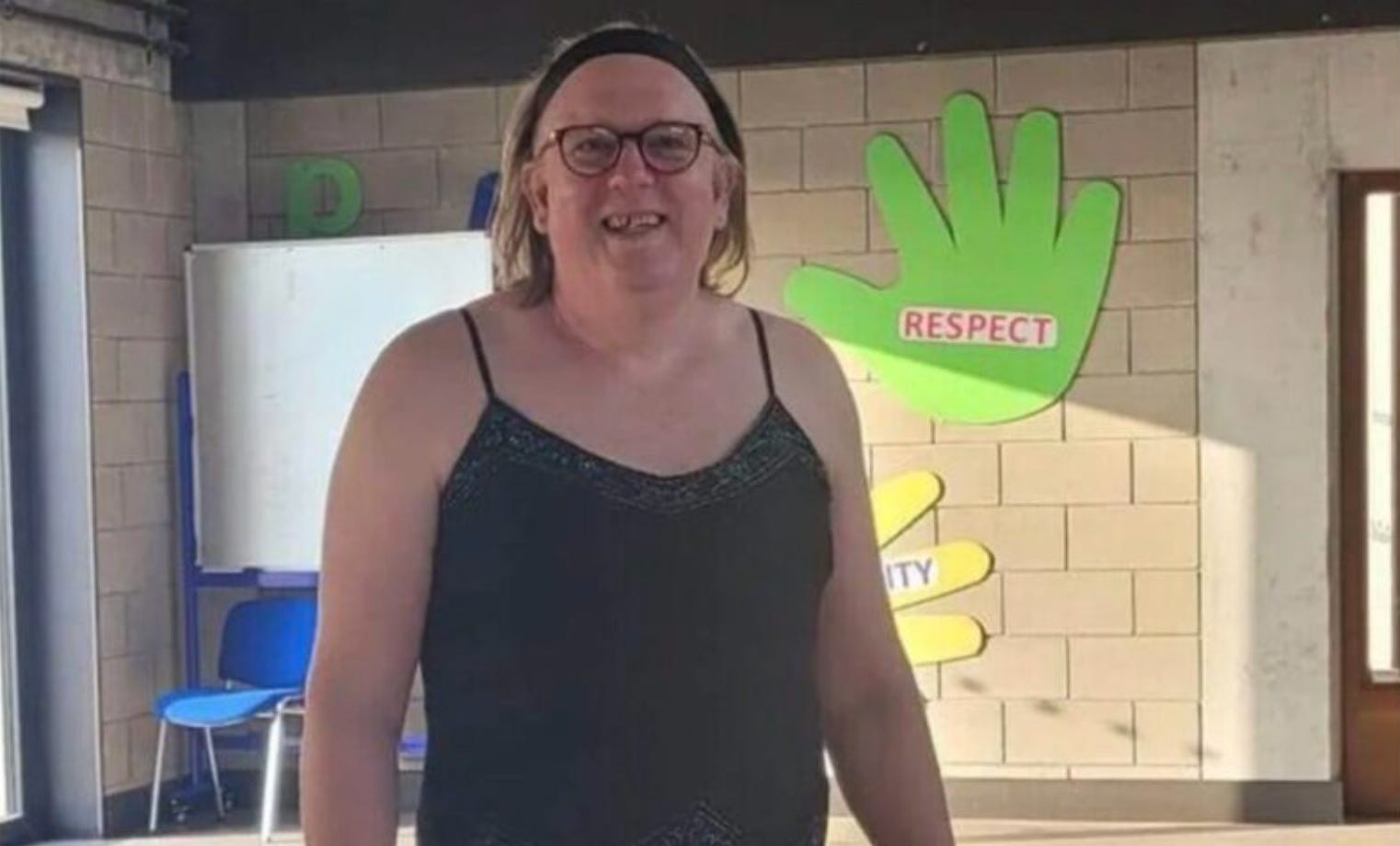
Also recently, we saw a case of a trans-identified man in a dress who goes by the name of Aleena Starshine being recruited to work in a creche in Letterkenny, Co Donegal, where he soon started trying to get the children there to kiss him. Starshine was swiftly sacked. We only heard about all this because Starshine took a case to the Workplace Relations Commission, where he claimed his sacking was unlawful. (He lost his case at the WRC.) Unlike McComb, who lived in Belfast in the United Kingdom, Starshine is a citizen of the Irish Republic, which means he was able to obtain a Gender Recognition Certificate, making him legally a woman. As a result, the WRC case report refers to him as a woman throughout, although pictures that have emerged of Starshine make it obvious that he is a man who likes to wear a wig and a dress. In the Starshine case, we saw a trans-identified man posing as a woman to get a job before going on to prove himself to be a threat to children’s safety, who should never have been hired in the first place.
Predators in Unicorn Outfits
But it is in the area of sex education that, it seems to me, predators pose the greatest threat to children, which brings us back to the Children’s Books Ireland list of “Pride” publications that we talked about at the start of this article. If a stranger were to try to engage your child in a conversation on sex, anal, or otherwise, you would break that person’s nose. And for times when you are not there to do the warranted nose-breaking, you can warn your children to run away from, or give a kick in the balls to, any such person trying to talk to them like that. And you can do your best to warn your kids about online predators and to protect them from the same. But the predator as sex educator brings the threat to your child to a new level, far beyond that of the street or online pervert, because the sex educator comes with the imprimatur and authority of the school, or library, or other institution that your child is expected to respect. Your child might tell a stranger wanting to talk about sex to fuck off, but your child is unlikely to have the confidence to do that if the person making that approach is a school-approved educator with the latest CBI-recommended book in his hand.
So, Pride is the way for child predators to go. There was a time when wolves donned priests’ garb to give themselves their sheep’s clothing. Now, after decades of child sex-abuse revelations, the priest’s garb doesn’t work like that anymore. These days, a unicorn outfit is much more likely to serve purpose.
But the fight-back is happening. It was, I believe, a significant victory in that fight-back that RTE was forced to remove its endorsement of the Children’s Books Ireland list of “Pride” publications. Now, hopefully, RTE and others will be more aware of, to use their own term, “age-appropriateness” before they foist stuff like that on children again.
Now we all need to learn to look beyond the rainbow colours that Pride comes packaged in and look out for the threats to our children that may be hidden within. Let’s stay vigilant in protecting our kids.
Genspect publishes a variety of authors with different perspectives. Any opinions expressed in this article are the author’s and do not necessarily reflect Genspect’s official position. For more on Genspect, visit our FAQs.