




The Philosophers Have Weighed In — and It’s Glorious!
By Nancy McDermott

Volume 6 of the Journal of Controversial Ideas is a win for logic and clarity
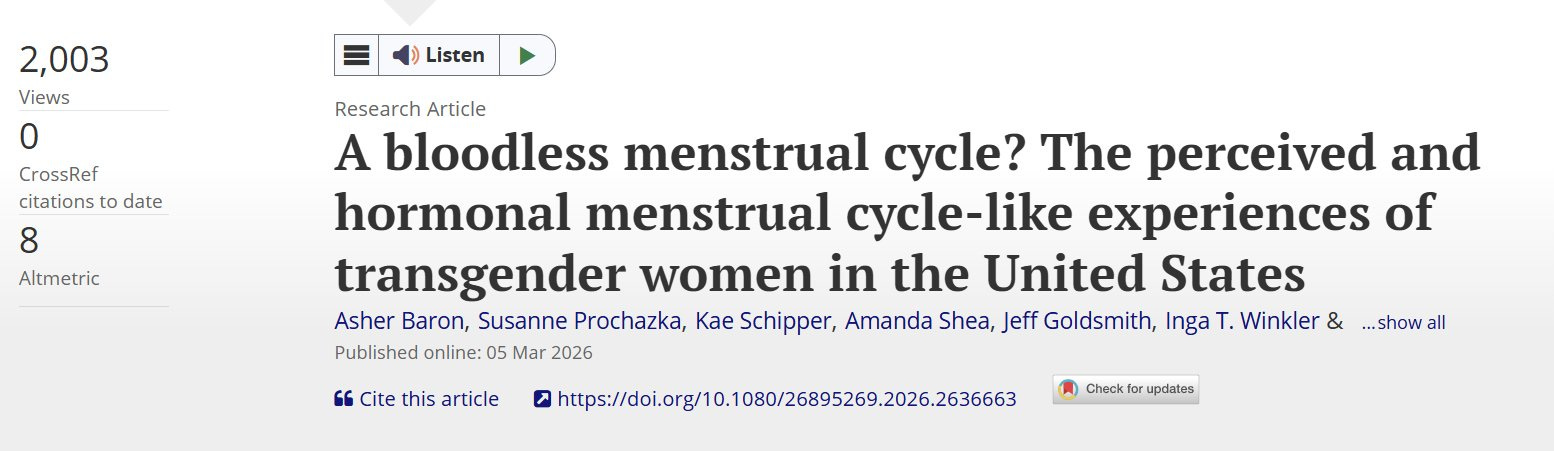
It’s called “gaslighting”: a form of relentless psychological manipulation that deliberately distorts shared reality.” An article from WPATH’s journal, recently highlighted on X by Leor Sapir, springs to mind. “Menstruation,” it begins, “is typically constructed as a biological hallmark of cisgender womanhood, excluding transgender women from menstrual cycle-related experiences.”
Really?!
We know it’s wrong, but untangling its twisted logic, which is itself grounded in even more twisted logic, makes most of us feel like throwing up our hands. It’s a dirty job and yet we know, deep down, that someone must do it. That’s where the philosophers and other academics come in.
The Journal of Controversial Ideas was founded in April of 2021 by philosophers Jeff McMahan, Francesca Minerva, and Peter Singer to serve as a forum for philosophers and academics from other disciplines to continue doing what they are supposed to do: engage in the battle of ideas in pursuit of the truth. It was a desperate measure because so many universities and academic journals had become unwilling to uphold academic freedom, and those who dared to deviate from the new orthodoxy faced cancellation by mobs of self-righteous students and their enablers in university administrations.
For five years now, the journal has covered a wide range of topics but Volume 6, published this month, is a “must read” for anyone engaged in untangling the knot of trans ideology – even if you aren’t in the least bit academic, just for the utility and pleasure of watching the masters demolish the deeply distorted claims about gender we have all come to know and despise.
Published this month, it includes seven (!) papers directly related to gender, and the rest are good too —especially the standout piece by Alan Sokal (of the famous Sokal hoax) responding to a paper by Simpson and Srinivasan defending certain forms of no-platforming at universities.
All the volumes of the journals can be downloaded for free and, unlike many academic publications, are readable and mercifully devoid of jargon. We’ve included a synopsis of each paper in Volume 6 below:
Gender-related Papers
Is It Morally Wrong for Transwomen to Claim to Be Women?
Holly Lawford-Smith, a political philosopher and associate professor at the University of Melbourne, examines how gender-critical feminists resist trans women’s claims to be women. She compares this resistance to the pushback against Rachel Dolezal’s claim to be Black. The paper directly addresses the normative question of whether it is morally wrong for men to claim to be women, and whether the critics of this view are correct.
PDF
Feminism and Trans-Inclusionism: Enemies, Not Friends
Kate M. Phelan, a lecturer at RMIT University and author of Feminism, Defeated, argues that feminism and trans-inclusionism are not allies but opposing movements. Feminism works to protect the sex class of women from men, while trans-inclusionism advocates for gender nonconformists against the sex/gender binary. Because the two movements have different analyses, goals, enemies, and allies, trans women’s demand to be recognized as women puts them in direct conflict with core feminist aims.
PDF
Should Sports Be Organized on the Basis of Sex?
Daniel Kodsi, a philosopher with a DPhil from Oxford and editor of The Philosophers’ Magazine, and John Maier, a philosopher and psychotherapist who teaches at Lesley and Simmons Universities, argue for excluding males from female sports categories. They contend that sports should be organized on the basis of biological sex because the female category has greater comparative naturalness. Their paper draws on the philosophy of categories and was developed from an amicus brief on Title IX that they submitted to the Supreme Court.
PDF
Treatment for Gender Transition & Parental Obligations
Emmanuel Smith and Andre Leo Rusavuk, philosophers working in ethics, challenge the assumption that parents must affirm and support medical transition for their children or adolescents. Drawing on analogous cases, they argue that parents instead have a moral obligation to oppose it and that no relevant moral asymmetry justifies treating this issue differently.
PDF
Trans Kids and “Making Up People”
Alex Byrne, professor of philosophy at MIT, and Moti Gorin, associate professor of philosophy and bioethicist at Colorado State University, examine different ways of understanding “trans kids.” They consider three views: that trans kids do not really exist (fiction), that they are a naturally discovered kind, or that they are “made up people” in the sense described by philosopher Ian Hacking. The authors defend the third view—that trans kids are brought into existence through social classification and processes rather than simply discovered.
PDF
Why the Transgender–Transracial Analogy Holds Up
James Dyer, a philosopher at the University of York who researches gender identity, defends the transgender–transracial analogy originally put forward by Rebecca Tuvel. He shows that common objections to transracial identity apply equally or similarly to transgender identity, and that no clear asymmetry exists between the two without stronger arguments.
PDF
Other Notable Papers
Academic Freedom, No-Platforming, and Appeals to “Disciplinary Competence”: A Critical Analysis of Simpson–Srinivasan’s Arguments
Alan Sokal, a professor of mathematics at University College London and professor emeritus of physics at New York University, critically assesses Simpson and Srinivasan’s defense of certain no-platforming practices. What does it mean for an issue to be “settled?” How should disagreements between disciplines be handled? What counts as a genuine academic discipline? Sokal argues that epistemic criteria must take priority over sociological ones, and that appeals to “disciplinary competence” or “settled science” are sometimes used to suppress dissenting views on ideological grounds.
Organized Dogmatism Controls the Message about Gender Bias in the Academy
Stephen J. Ceci, a professor of developmental psychology at Cornell University, and Wendy M. Williams, a professor of psychology also at Cornell University, argue that the current dominant narrative in science claims pervasive bias against women in every academic domain. Though larger, stronger studies and meta-analyses have repeatedly nullified many of these claims, weaker studies supporting the narrative receive more attention. As a result, many faculty overestimate the extent of bias. The paper focuses especially on tenure-track hiring, where evidence shows women are often preferred over equally qualified men.
Neoliberalism and the COVID-19 Pandemic: The Enigma of Lockdown
Christian Joppke, a professor of sociology at the University of Bern, examines the widespread lockdowns during the COVID-19 pandemic. Many on the political left saw lockdowns as the end of neoliberalism. Joppke argues instead that lockdowns carried clear neoliberal hallmarks—authoritarianism, technocracy, elements of global governance, and an emphasis on security—alongside the precautionary principle in conditions of uncertainty.
The Equality Paradox
Shuichi Tezuka (pseudonym) addresses group differences in average cognitive ability, a highly controversial topic often suppressed on the grounds that such research is socially harmful. The paper contends that the assumption of equal average ability across groups has itself led to forms of racial discrimination in the United States, including against high-achieving groups and in criminal justice decisions about the death penalty. To support a non-discriminatory liberal society, research on group differences should proceed and be used responsibly rather than suppressed.
All Signal, No Virtue: How Trigger Warnings and Other Ineffective Pedagogical Practices Spread
Renaud-Philippe Garner, a philosopher and assistant professor at the University of Toronto, and Nazaneen E. Jamil examine the rise of trigger warnings and similar practices in education. Despite limited or no empirical support for their effectiveness, these practices have become widespread. The authors argue that their persistence stems from failures of intellectual virtue—particularly a lack of prudence—driven by character weaknesses (such as reluctance to speak up when it is costly) and institutional incentives that do not reward genuine teaching excellence.
The Justice of Punitive Wars
Benjamin Robert Koons argues that punishment can be a just cause for war, contrary to the recent consensus in just war theory. Drawing on work in social ontology, he defends the idea that an international organization may wage war against a member state to punish it. He shows how punitive terms can serve retribution, deterrence, and reform, and responds to common objections.
Nancy McDermott is the director of Genspect USA