




The Dutch Protocol Re-Examined
By Hermes Postma
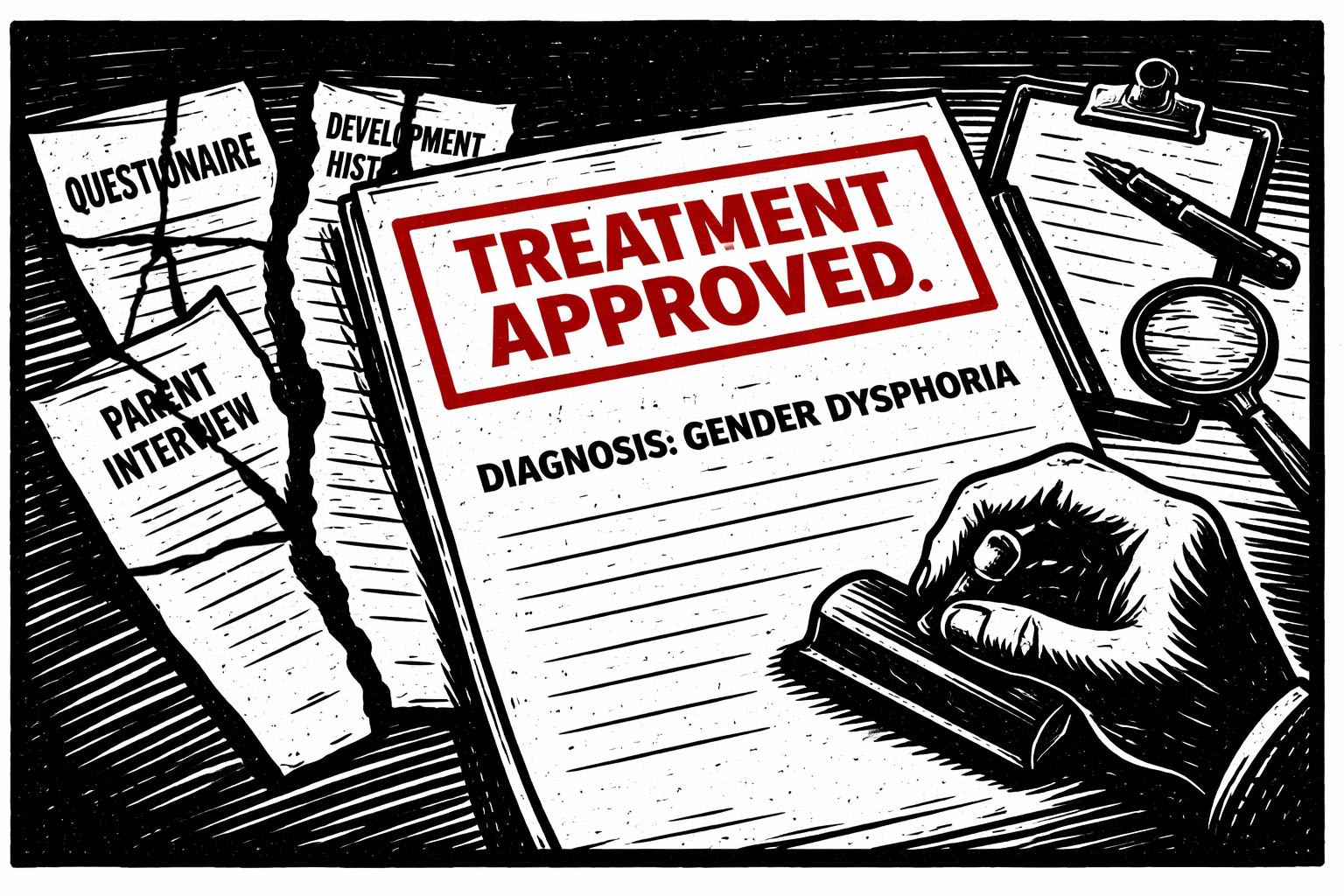
Inconsistencies Revealed in a New Amsterdam Cohort Study, by Hermes Postma
The Amsterdam University Medical Centre (Amsterdam UMC) has long stood as the undisputed global standard-bearer for paediatric gender medicine. It was here, in the 1990s and early 2000s, that the Dutch Protocol was developed and refined – the model that introduced puberty suppression with GnRH analogues (GnRHa), followed by cross-sex hormones and, later, surgery. Key figures in this framework include clinicians such as Annelou L.C. de Vries (child and adolescent psychiatrist) and Thomas D. Steensma (developmental psychologist and researcher on the desistance and persistence of gender dysphoria). Their publications shaped not only Dutch practice but also international guidelines, including early Endocrine Society recommendations and WPATH Standards of Care. For two decades, the Amsterdam clinic has been cited worldwide as the most cautious, evidence-based, and thoroughly evaluated centre for youth gender dysphoria.
A new retrospective study from this very institution, therefore, carries particular weight. Published online on 9 March 2026 in the Journal of Sex & Marital Therapy, “Characteristics of Dutch Gender Clinic-Referred Adolescents Who Did Not Pursue Gender-Affirming Medical Treatment” (De Rooy, Dekkers, Steensma et al.) examines 1,470 consecutively referred adolescents (2009–2019). The paper’s authors include De Vries and Steensma themselves, as well as affiliated colleagues. While the clinic’s defenders may point to the reported 18% non-pursuit rate as evidence of careful gatekeeping, a closer reading reveals several structural inconsistencies that merit serious scrutiny.
Medical Treatment Without Formal Diagnoses
In six cases, gender-affirming medical treatment (GAMT) was started although “the adolescents had not yet received a GD diagnosis.” The explicit rationale given is “creating (head)space for further exploration.” This is not a peripheral footnote; it represents a deliberate clinical decision to use puberty blockers or hormones as a diagnostic or exploratory tool rather than as treatment for a confirmed condition. Given the well-documented potential effects on fertility, bone density, and sexual development, this practice challenges the foundational requirement for a DSM-5-TR diagnosis prior to irreversible intervention – a requirement repeatedly emphasised in the very Dutch Protocol that de Vries and Steensma wrote themselves.
Extremely Low Diagnostic Attrition After Intake
Ultimately, only 18% (264 adolescents) did not pursue GAMT. Of these, 38.3% received no GD diagnosis after the full trajectory, and 27.7% had dysphoric feelings, but the trajectory was deemed unfeasible due to mental-health or developmental issues. This implies that approximately 82% of referred adolescents who passed the intake phase proceeded to medical treatment. The non-pursuers already showed significantly lower gender dysphoria scores and more psychological problems at baseline. The study describes a “comprehensive diagnostic exploratory trajectory,” yet reports no meaningful late-stage attrition among those with higher initial dysphoria scores. In any robust differential diagnosis – incorporating comorbidity (autism, trauma, depression), sexual orientation, and identity development – one would expect far higher rates of exclusion after the initial screening. The data suggest that the intake functions as the diagnosis itself and that subsequent exploration never reverses an initial positive trajectory.
Striking Omission of Hetero-Anamnesis
The Dutch Protocol and earlier Amsterdam publications have consistently stressed the importance of detailed hetero-anamnesis (parental reports on sexual orientation and psychosexual development) to distinguish gender dysphoria from other developmental pathways. Yet in the 38.3% of cases where no GD diagnosis was ultimately made, hetero-anamnesis is not mentioned once as a contributing factor. This omission is striking. If parental and developmental history truly forms a core element of differential diagnosis, its absence from reported reasons for non-diagnosis raises questions about the actual weight given to this component in practice.
Re-Application in Adulthood
Of the 264 non-pursuers, 28.8% (n = 76) later reapplied for GAMT as adults at the same clinic. The paper provides no information on whether a new diagnostic process was required or whether adult-informed-consent pathways were used. This pattern suggests that a negative or inconclusive outcome in adolescence may simply be circumvented by waiting until the individual reaches legal majority, at which point the safeguards that were already largely absent in adolescence no longer apply. Such a pathway undermines the purported protective function of the extended exploratory phase emphasised by the Dutch model.
Circular Logic
The study implicitly presents both natural puberty (in non-pursuers) and puberty suppression (in those who started GAMT, including the six without a diagnosis) as mechanisms that provide “time to think” or “headspace” for identity exploration. Traditional Dutch Protocol literature positions GnRHa as essential precisely because natural puberty would interfere with careful decision-making. Yet here the authors note the importance of assessing “whether adolescence is the right timing,” while simultaneously reporting that many who experienced full natural puberty still later sought treatment. The same medication used without a formal diagnosis to create an exploratory space is elsewhere described as medically necessary care within the basic health-insurance package. This circular logic – natural puberty gives space, blocked puberty gives space, and blockers are also given when no diagnosis exists – reveals a fundamental incoherence at the heart of the protocol’s rationale.
Implications for the Field
Amsterdam UMC remains the clinic whose protocols, outcome data, and clinical philosophy have influenced gender services from London to Boston to Melbourne. When even this centre’s own retrospective analysis documents treatment without diagnosis, minimal late-stage diagnostic attrition, omitted hetero-anamnesis, adult re-applications, and contradictory conceptualisations of exploratory “headspace,” the international community cannot dismiss these findings as mere anomalies. The Dutch Protocol was never intended as a flexible informed-consent model; it was presented as a cautious, gate-kept pathway grounded in thorough differential diagnosis.
The publication of this study by the very team that built the protocol offers an opportunity – perhaps the last clear opportunity – for genuine self-examination. Independent, external audit of Amsterdam’s diagnostic and treatment trajectories (2009–present), transparent reporting of late attrition rates, and explicit documentation of how hetero-anamnesis and comorbidity influence decision-making are now essential. Until these inconsistencies are addressed with the same scientific rigour that the clinic has long claimed, global reliance on the Dutch model rests on increasingly shaky foundations.
Genspect continues to advocate for evidence-based, non-medical-first approaches to youth gender distress. This latest paper from Amsterdam does not undermine that position; it strengthens the case for it.
Genspect publishes a variety of authors with different perspectives. Any opinions expressed in this article are the author’s and do not necessarily reflect Genspect’s official position. For more on Genspect, visit our FAQs.