




The Desistance Series – Cathy’s Story
By Stella O'Malley
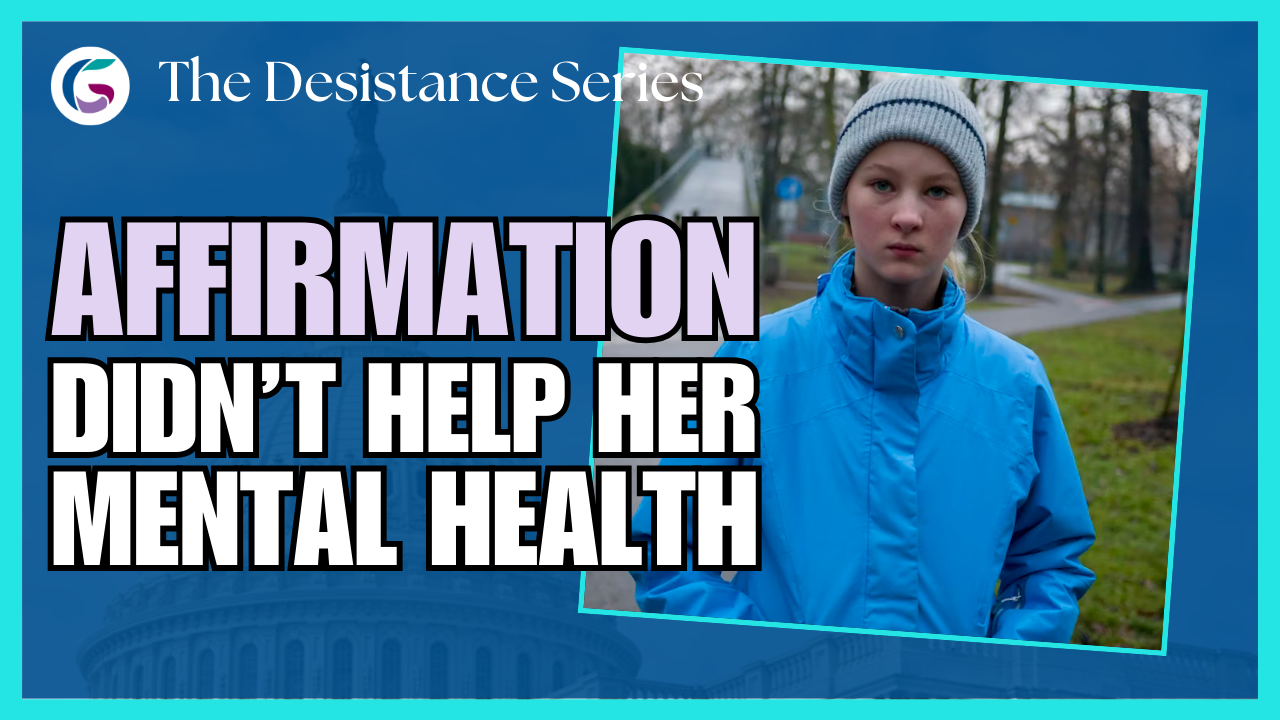
Cathy’s story traces a family’s path from crisis to stability as they held the line, rebuilt their bond, and somehow stepped back from the brink.
Cathy’s daughter was eleven when she announced that she was non-binary. It was 2020, in the middle of lockdown, and Cathy and her husband had never encountered anything like it. The idea seemed to have come from school and from a friendship group who were playing around with identities. Later, Cathy discovered it had in fact come from an old childhood friend who had spent long hours online and introduced her daughter to these concepts.
At first, the parents assumed it was a phase. It did not feel like a crisis. Their daughter began asking to be called by a new name and wanted they/them pronouns. Cathy did not fully understand what was happening, but she and her husband responded by giving her more attention. They took her out for breakfast, brought her shopping, and made a concerted effort to reconnect. They wondered if they had been too focused on their sporty son. But their efforts did not change the trajectory.
By seventh grade, her daughter was anxious, and by eighth grade her mental health had worsened considerably. She became depressed, intensely perfectionistic, and overwhelmed by ordinary demands. Cathy and her husband sought help and arranged therapy, and for a full year their daughter attended sessions. Cathy believed they were addressing the anxiety that had begun to dominate her life.
They were not.
At the end of that period, her daughter came downstairs and, with a smile, announced that she was transgender and really a boy. The conversation was brief and disorienting. Cathy and her husband were alarmed. Their daughter seemed oddly light, almost detached, while they were confronted with the full weight of what was being said.
The following day they met the therapist and discovered that, over the previous year, the therapeutic process had centred on affirming her transgender identity.
Cathy’s daughter’s mental health continued to decline. She was diagnosed with ADHD, OCD, anxiety, and suicidal depression, and was eventually hospitalised as an inpatient. Cathy and her husband were deeply reluctant to use medication, but after careful consideration they agreed to it in response to how serious things had become.
At the same time, the pressure to affirm intensified. The therapist affirmed. The psychiatrist affirmed. The schools affirmed. Cathy allowed her daughter to have a binder, as she anticipated that her preference for loose-fitting clothes would make it unbearable – she was right. Her daughter also asked to see an endocrinologist and Cathy chose not to make the appointment.
The parents were in full agreement with one another and worked together to make careful adjustments. Their daughter cycled through name changes and they avoided using the new name, using terms of endearment instead. Sometimes they used they/them to reduce conflict. They tried to widen her social world and to build their connection with her.
Cathy read Gordon Neufeld and Gabor Maté’s Hold on to Your Kids: Why Parents Need to Matter More Than Peers and shifted her focus so that her priority became the relationship.“I started to work on my reactivity, our relationship… I stopped trying to push myself on her, just let her be and just listen. Honestly, that, in our case, made the biggest difference.” She stopped arguing and listened more, staying present even when her daughter said things that felt irrational or frightening. She made herself the central relationship in her daughter’s life again.
Cathy came to realise that the broader environment was reinforcing the problem and pulling her daughter further away. Schools, clinicians, and local policies were all gender-affirmative. She decided to leave Washington State, leaving her husband and son behind temporarily. She and her daughter moved to a different state, closer to extended family and to a community that was less affirming. They began homeschooling and, gradually, things began to shift.
As time went by, her daughter began to settle. The anxiety eased, gradually her medication was reduced, and she finally stopped attending therapy. She started to make friends again and, with that, the intensity around the identity softened. She no longer insisted she was a boy and instead reverted to a non-binary identity, she even softened her name into something more neutral.
Most importantly for Cathy and her husband, the immediate threat of medicalisation receded. They were no longer living with the fear that their daughter would be pushed toward life-changing, irreversible interventions. The sense of crisis that had dominated their lives began, at last, to lift.
Her daughter is now almost eighteen. She still identifies as non-binary. She has not declared a full desistance. But she is not interested in medical transition. The family relationship has been restored, and with it everyone feels on steadier ground.
Why do some young people step back while others continue down a medicalised path? Why do some identities loosen their grip while others harden? There are no simple answers. Human development is not linear, and identity is often more changeable and influenced by circumstances than it first appears.
With this Desistance Series, we aim to cast some light on these stories, so others can spot patterns that might help, and parents trying to reach their children might find a few helpful tips along the way.
Watch here
If you find this series helpful, please consider supporting our Beyond Trans programme, where we provide support to parents of trans-identified children, to detransitioners, to regretters, and to people who identify as trans: https://gofund.me/2b20d15db