




Germany’s 2025 Year in Review: Pride, Joy and German Angst
By David Allison

I often hear the question, “Have we finally reached peak trans?” Well, in Germany the answer is a resounding “Nein”.
That said, there may be some consolation in the fact that the country tends to lag behind trends in the rest of the Western world. Germany is frequently associated with the stodgy and downright conservative: from mechanical engineering to Lederhosen. Yet the nation also has a long history of political and cultural radicalism, and these elements have now seeped into the mainstream in particularly rotten forms.
Transgenderism has a long history in Germany, dating back, as Helen Joyce explained in her book Trans, to the early 20th century and the work of Magnus Hirschfeld. Maybe this explains why most of its psychotherapists and psychiatrists are so beholden to WPATH today, and why gender ideology has so rapidly integrated into German clinical culture.
Germany was once the land of poets and thinkers, but you don’t get many of the former anymore, and critical thinking is definitely verboten. Take, for instance, the new German-language guideline on Gender Incongruence and Gender Dysphoria in Childhood and Adolescence, published in March. The guideline effectively deems watchful waiting with exploratory therapy as unethical, paving the way for the swift prescription of puberty blockers, cross-sex hormones, and surgery. It creates a one-track path to medical transition with no age limits for medical interventions, as if it were the most natural thing in the world. The guidelines were rolled out with great fanfare as part of a massive campaign. Social workers and therapists eagerly attended seminars, webinars, and conferences hosted by professional psychotherapy associations where they learned about multiple genders and best practices for affirming transgender identities in minors, and how best to support their access to medical transition. Most of these events took place behind closed doors, excluding critical voices.
Passing the Buck
Mandatory contributions to the German healthcare system are set to rise again in 2026. This is a political hot potato for the government. The previous government’s promise to provide all affirmative medical interventions free of charge has not been implemented. Health insurance companies continue to fund hormonal treatment and surgery on an ad-hoc basis, but policy decisions are notable for their absence. It looks as if no one wants to be caught red-handed. This nervousness may also explain the lack of coverage of trans-related political issues in the German press. The Federal President, Frank-Walter Steinmeier, took the opportunity of an address to Germany’s most significant LGBTQ+ movement in April to attack Donald Trump’s stunning discovery that there are only two sexes as a symptom of rising populist demagoguery across the globe. But his speech – unparalleled in its stupidity – was not reported in the press.
Much like Britain’s BBC, German public broadcasting has been the target of much criticism. Meanwhile, the rest of the press appears to be keeping its head down on transgender issues. For instance, only one major national newspaper reported on a case in which a court threatened to remove a mother and father’s parental rights because they refused to endorse hormone treatment for their 17-year-old daughter. There has been no coverage of recent developments in the UK, such as the NHS ban on puberty blockers or the public outcry against the questionable Pathways Study. Nor has there been any mention of the HHS reports on gender dysphoria in minors released by the US administration in May and November. The US Supreme Court’s landmark ruling in Skrmetti was ignored, and the UK Supreme Court’s judgment on the biological meaning of sex was reported with the truly Orwellian headline, “UK Supreme Court Denies Transwomen Women’s Rights”.
There was some coverage of attempts to intimidate participants at the SEGEM conference in Berlin in September, an excellent conference, which the President of the German Medical Association addressed. But the threat of violence from trans activists, underscored by the assassination of Charlie Kirk, was real. Equally concerning are the more subtle attempts at bullying by government-sponsored NGOs, which politely inform those advocating for sex realist positions that they are being monitored!
I had the opportunity to question Jochen Bittner, a journalist with the liberal-left national newspaper Die Zeit, on the behavior of the press at a Battle of the Ideas event in London in September. Bittner conceded that the German media has indeed erected an “intellectual firewall” around an array of political issues, which he argued is becoming harder to sustain, as public trust in the established media continues to dwindle.
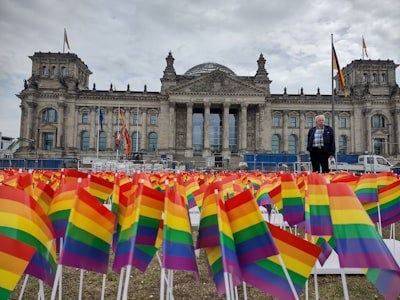
A blanket of uneasy silence has descended on Germany. Public celebration of transgender politics has become somewhat more muted. Germany’s parliamentary president, Julia Klöckner, refused to allow the rainbow flag to be hoisted on the parliament building for this year’s Berlin Pride. There is a pervasive sense of anxiety in the country about the threat of right-wing populism, fueled by fear of political failure. Trans advocates have not given up, but stealth has become their preferred strategy, which means smuggling transgender ideology into existing law. Hence, Germany’s Social Code now promotes the concept of multiple sexes and commits social work agencies to trans-affirmative approaches to minors in care, with corresponding training and pressure on parents. They enforce these initiatives by threatening to cut funding to non-compliant voluntary service organizations. Money from Federal Ministries flows freely to agencies that – as is true of most of them – are more than happy to comply.
Terf is the New Punk
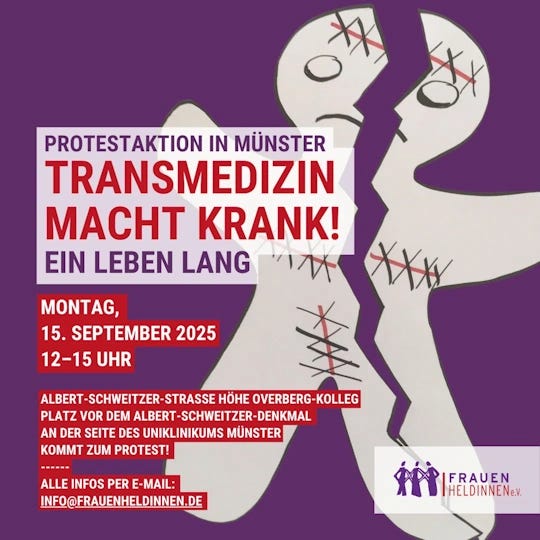
There is some resistance. I spoke (surrounded by a baying crowd of masked antifa) on behalf of parents at a demonstration in front of Germany’s biggest gender clinic in Münster in September. The demo, with banners pronouncing “No child is born in the wrong body” and “It’s OK to be gay”, was organized by the feminist initiative Frauenheldinnen, which staged an identical event before a conference of transaffirmative physicians in Berlin a few days later. There has also been some progress internationally with German parents at the forefront of establishing a new network of critical European groups.
Germany, like other Western countries, is experiencing an epidemic of mental health issues among its youth. Unfortunately, with a few notable exceptions, the issue of overdiagnosis has not garnered much attention. Instead, there has been a massive expansion of the number of newly accredited psychotherapists, but not people, I’d argue, you’d really want your children to see. Mental health disorders are becoming badges of identity which these therapists are only too happy to grant. Here, too, normal life circumstances and challenges are being pathologized, with resources being monopolized by those – often more privileged recipients – who need them least. This has paralleled the massive increase in sex-rejecting self-diagnoses.
Normality has become taboo — lederhosen look more suspicious than ever, and the voices of ordinary Germans are missing from the conversation. Diversity (the official credo) is harder and harder to distinguish from perversity and even the most critical voices, many of them are friends of mine —I was once a member of Germany’s Green Party, after all — emphasize the role of feminist and gay activists in combatting queer politics. This is great, but where are the voices of ordinary families to be heard? I suspect they are not only deemed too heteronormative, but also frankly too normal to be taken seriously.
No Joy in Anxiety
Meanwhile, a new parliamentary initiative is underway to incorporate “sexual identity” as a protected characteristic in Germany’s constitution. This is regarded as a nice thing to do but it will be anything but for women and girls. Valiant women’s and LGB groups are at the forefront of opposition to this, which is especially important given the German left’s historical links to organized paedophilia, but the fact that it has become an issue at all tells us something about Germany today.
Listening to a recent podcast with Stella O’Malley on the Kinsey Report inspired me to re-read a 1951 essay by the liberal critic Lionel Trilling. “The Kinsey Report,” he wrote back then, “directs the harshest language toward the idea of the normal”, while simultaneously and contradictorily proclaiming its message, “anything goes” because – well, it’s all perfectly normal.
Trilling questioned the report’s endorsement of any and all forms of sexual and identity expression, and castigated its failure to recognize how extreme forms of behavior may be “ridden by anxiety”, compulsive and inimical to joy. Making such distinctions between the healthy and the unhealthy, Trilling argued, has become tantamount to social discrimination: no judgement must be passed and any conclusion drawn because that “which perceives values and consequences will turn out to be ‘undemocratic’”
That’s Germany in 2025. In the country’s new age of anxiety using your critical faculties is deemed offensively anti-democratic.
David Allison is a former member of the German Green Party and speaker for Transteens-Sorge-Berechtigt (TTSB). TTSB is a parents’ initiative in Germany that opposes the unnecessary medicalisation of adolescents and young adults who question their gender and/or do not conform to gender stereotypes.
Image: Pride badge. Photo: Marek Studzinsk
Genspect publishes a variety of authors with different perspectives. Any opinions expressed in this article are the author’s and do not necessarily reflect Genspect’s official position. For more on Genspect, visit our FAQs.