




Bí Cineálta – Be Kind Part 2
By Catherine Monaghan
In Bí Cineálta, Part 1, we contemplated the message that schools are sending to the community when they fly the progress pride flag. In Part 2 we’ll look at the ways in which school policy can be used to further embed contested ideology into children’s lives.
Then and Now
A lot has changed in Ireland since I was in primary school. It was the 80s and the fight for gay rights was in its infancy. Homosexuality was illegal and same-sex marriage was a pipe dream in a country that was dominated by the Catholic Church. Trans or gender ideology – the notion that one could be born in the wrong body and have a ‘gender identity’ that is incompatible with one’s male or female body – was something nobody had heard of.
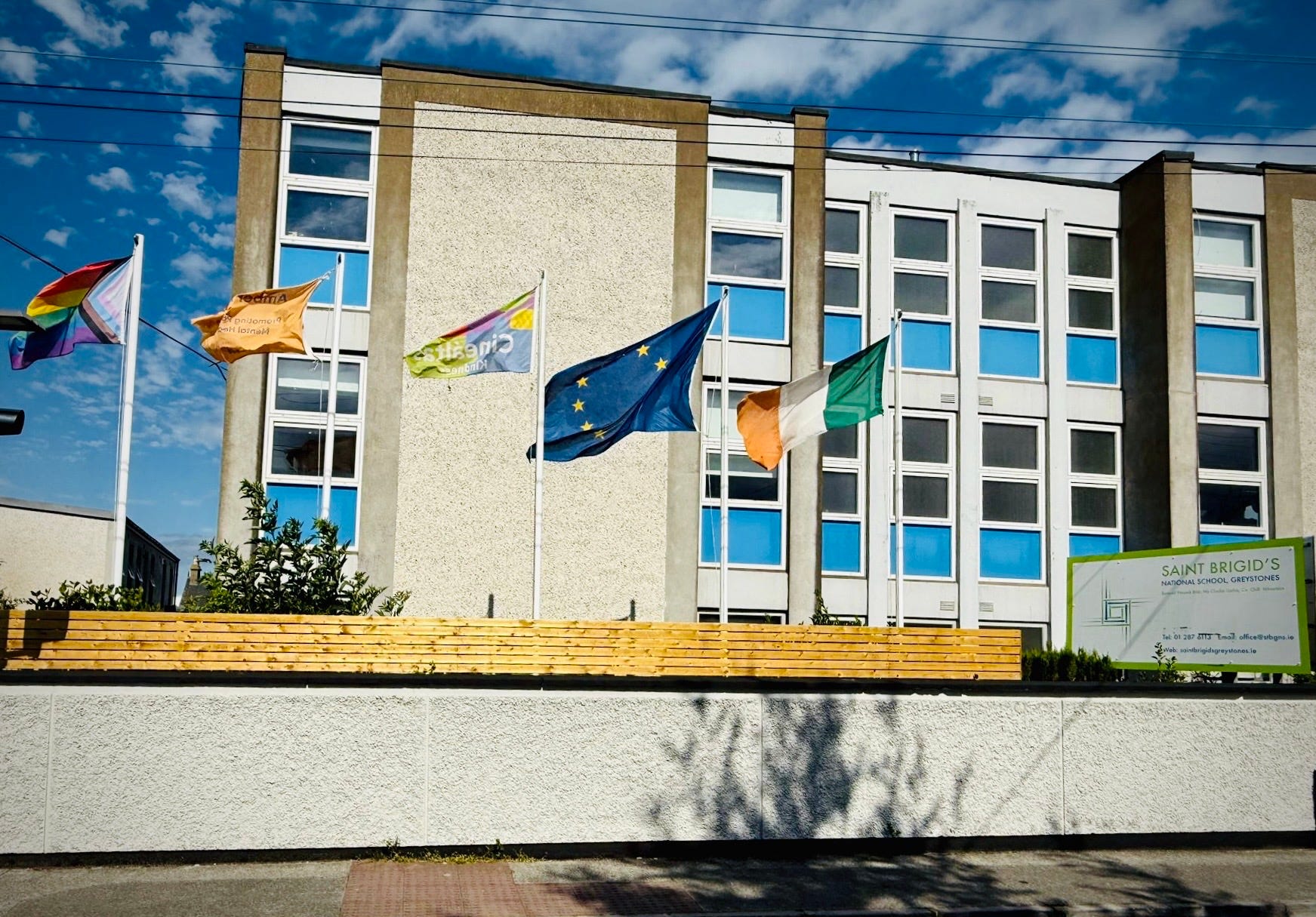
Fast forward forty years and Ireland has moved on. Homosexuality was decriminalised in 1993. Same sex marriage was voted in by a significant majority in 2015. We have well-established rights and recognitions for lesbian, gay, and bisexual people – all the same rights as straight people. We’re considered one of the most progressive countries in the world. My old school is now flying the progress pride flag, displaying it’s belief in, and support for, gender ideology.
Gender Recognition
Less widely celebrated in Ireland, because few are actually aware of its existence, is our legislation that enables anybody over 18 to legally change their sex simply by filling out a form online. The Gender Recognition Act 2015 (GRA) was surreptitiously slipped in alongside the same-sex marriage legislation, with none of the debate, consultation, or fanfare that the latter involved. Most Irish people were happily celebrating marriage equality, oblivious to the other new legislation that meant the protections afforded to women by our Equal Status Act are now meaningless. Any man can declare himself to be a woman and then legally enter women’s spaces including prisons, refuges, changing rooms. He can claim women’s seats on boards, win women’s awards, and play women’s sport. Single sex spaces and services, necessary for the safety and dignity of women and children, are no longer guaranteed.
The lack of consultation and engagement with the public about the GRA was not a simple oversight. It has since become apparent that it was part of a strategy, clearly documented in the Dentons Report. The strategic advice for advancing gender recognition legislation (including to minors) includes recommendations for activists to: lobby quietly and behind the scenes; tie a campaign to more publicly acceptable reform (e.g. same-sex marriage); and limit media exposure so as to avoid public backlash. The reason such secrecy and underhand tactics were necessary is because the general public would not automatically be onboard with gender recognition and especially self ID.
Be Kind
In the same way that endorsement of trans ideology snuck into our legal system, it has snuck into the policies and frameworks upholding many of our other institutions, including our education system. Bí Cineálta, the new anti-bullying policy about to be rolled out in all Irish primary and post primary schools is an example of this.
In June 2024 the Irish Department of Education published Bí Cineálta: Procedures to Prevent and Address Bullying Behaviour for Primary and Post-Primary Schools, replacing the 2013 Anti‑Bullying Procedures. The Department of Education claims the initiative promotes a culture of respect and inclusiveness across primary and secondary schools. Its intentions are laudable – everybody knows it’s good to be kind, after all – but its expanded scope, specifically its emphasis on identity-based bullying, has sparked concern.
Each school drafts their own Bí Cineálta policy, based on training provided by Oide, but the policy must include reference to particular types of bullying including identity-based bullying such as transphobic, racist, and sexist bullying.
This seems reflective of the growing influence of critical theory and critical social justice frameworks on school curriculum and policy. These ideologies view society through the lens of power, privilege, and identity, dividing people into categories of oppressed and oppressor. The purported aim is to challenge inequality, but this way of viewing the world can inadvertently promote conformity of thought and suppress dissent. It encourages prejudgement of people and situations according to where they sit on an imagined social hierarchy.
Sticks & Stones
When I was at school the general dogma was that we must treat others as we would like to be treated ourselves regardless of how they looked, what they could or couldn’t do, where they came from, where they lived, and so on. Of course, this didn’t prevent all bullying; nothing will. Children can be cruel to each other for all kinds of reasons: the wrong haircut, the wrong shoes, the wrong hobby, the wrong address, the wrong use of a word, a lisp or stutter, for being too clever or not clever enough – the list is endless. Is it worse to be bullied because of your skin colour, or because you’re always top of the class? Is it worse to be bullied because you bring unusual food for lunch every day, or because you’re a boy who likes to play with dolls? Is it necessary or helpful to elevate certain types of bullying, particularly identity-based bullying, above other types of bullying?

According to Stella O’Malley, psychotherapist and author of the book Bully-Proof Kids: Practical Tools to Help Your Child to Grow Up Confident, Resilient and Strong:
“When we start ranking children’s suffering based on identity, we send the message that some pain matters more than others. That’s not helpful—it creates a hierarchy of suffering. When we focus too much on the identity of the child being bullied, we risk giving some children the impression that they are more special or more protected, while others feel invisible, as though their pain doesn’t count.”
Contested Ideas
With its particular mention of transphobic bullying, the Bí Cineálta framework pushes contested ideas about gender identity to children and encourages, or even insists upon, affirmation of trans identities in school.
This is in direct contravention of the most up-to-date and comprehensive advice available on the issue. The Cass Review (2024), a landmark report on gender identity services in the UK, concluded that even social transition (e.g. changing names and pronouns) is not a neutral act and may contribute to long-term psychological and developmental consequences. The report recommends a cautious, evidence-based approach to gender distress in children, centred on safeguarding and clinical oversight rather than affirmation. The Health Service Executive (HSE) in Ireland is currently aligning its gender healthcare services with the Cass Review, and the most recent Programme for Government also reflects this shift. Both emphasize the need for clinical evidence, child safeguarding, and restraint in the social or medical transitioning of children.
In contrast, the Bí Cineálta policy appears to be based on a different philosophy, one that assumes support and affirmation of trans identities is inherently kind and unproblematic, and that treats the notion of gender identity as a fixed and unquestionable truth. This divergence from international best practice should be of serious concern to parents and teachers.
Personal Beliefs
Most people do not believe that it’s possible to be born in the wrong body or to change sex. The expectation that all students must affirm a peer’s self-declared gender identity, lest they be considered guilty of transphobic bullying, will result in children being compelled to speak and behave in ways that contradict their own beliefs or family values. There have been several high profile court cases in the UK where people have won the right to hold gender critical beliefs, that is, to not be compelled to go along with someone’s belief that they are the opposite sex.
Where Were the Parents?
Parents have questioned the influences behind the Bí Cineálta policy. LGBTQ+ youth organisation Belong To was involved in shaping the policy while many parents felt largely excluded from the conversation. Belong To is an organisation that openly promotes the controversial and discredited affirmative model of care for children. They have supported medical transition for minors, the promotion of breast binders to girls (a binder is a garment worn to compress and flatten the breasts which can restrict breathing, cause pain, and lead to tissue damage, including potential rib fractures or permanent chest deformation), and the withholding of information from parents (you can read more about their activities here).
The National Parents Council was involved and is cited as representing parental views, yet parents report being unaware of the policy’s deeper ideological components until after its adoption. Vague surveys and surface-level engagement do not constitute meaningful consultation.
A mother from Co. Meath said:
“The ratification of the Bí Cineálta policy in our school has shattered my trust in the Irish education system. There was no meaningful consultation. The concerns brought to our school were never raised with the Department, and full ratification went ahead — placing every child, including mine, under this policy, whether we agreed with it or not.
Another mother, from Co. Carlow, explains:
“There is a fear of saying anything and then being seen as a ‘pariah’. Everyone goes along and nods their heads in agreement. Everyone buys into the ‘kindness’ narrative of Cineáltas. I could not think of a better word to be used to hoodwink parents”
Some similarities could be drawn with the Dentons strategy used to introduce the Gender Recognition Act under the radar, for example: work behind the scenes to get the concept in place, avoid public or media exposure, and tie the idea to something very palatable to the average person. Who would say no to an anti-bullying policy? Any parent who didn’t delve into the policy in detail, or one who didn’t understand the issues or the latest research on the dangers of attempting to transition children, would likely see no problem with a policy labelled “Be Kind”.
A Useful Tool
If there was any doubt that school policies are being used as a tool to ingrain trans ideology into children’s lives, the fact that the Bí Cineálta policy is directly linked in Ireland’s recently published National LGBTQ+ Inclusion Strategy should expel it. The explicit aim of that strategy is to embed LGBTQ+ inclusion into public policy, education, healthcare, and community life through targeted actions and government-wide coordination. The strategy lists Bí Cineálta as the means for implementation in schools. Again, parents were not informed, with one mother from Co. Dublin saying:
“I was astonished. That strategy had clearly been in development during the ratification process, and it openly states that Cineáltas is the mechanism through which schools will implement it. This was never disclosed to parents.”
Given that Ireland has already demonstrated its commitment to equality for people who are LGB, these policies are really about the TQ+. People who identify as trans, nonbinary, and so on have beliefs about themselves and perhaps the world – just like religious beliefs – that many others do not share. In the same way that we don’t expect non-Catholics to comply with Catholic traditions or practices, we cannot expect or compel people – adults or children – to comply with trans ideology.
Children ≠ Adults
It’s notable that the policy’s sample framework in Appendix A references Ireland’s equality legislation and the nine protected grounds for discrimination. This legal framework plays an important role in adult employment and public life, but is it really applicable in the context of primary education? Is it developmentally appropriate to treat young children as if they are participants in adult identity politics? Can children truly understand the legal and social implications of gender identity labels? And is it fair or reasonable to expect children from families with varying beliefs to participate in practices such as pronoun changes that contradict what they see and know?
Questions Remain…
There are many questions to be asked and answered regarding the Bí Cineálta policy. Parents who have raised objections to it say they have been dismissed, ignored, and told that it’s simply about “being kind”, but kindness should not come at the cost of personal integrity or child safeguarding.
The aspiration to create respectful school environments is one we can all get behind, but using an anti-bullying policy as a means to introduce and normalize trans ideology is underhand and unethical. Children deserve to be protected not only from bullying but also from being placed at the centre of adult ideological debates. Education should be guided by clear evidence, developmental appropriateness, and a duty of care toward all children, including those from families that do not subscribe to trans ideology.
It remains to be seen if the parents who have been insistent in their objection to aspects of Bí Cineálta will be heeded. They would like to see the Department of Education revisit the Bí Cineálta framework with input from a broad cross-section of society, including parents with diverse views, child development experts, and school patrons, as well as regard for the most up-to-date research. In doing so, the Department of Education could fulfil its duty to safeguard all children and uphold parental rights, while ensuring that Irish schools remain places of learning, not ideological indoctrination.
Catherine Monaghan is an Irish women’s rights activist and founding member of Wicklow Women 4 Women.
Genspect publishes a variety of authors with different perspectives. Any opinions expressed in this article are the author’s and do not necessarily reflect Genspect’s official position. For more on Genspect, visit our FAQs.