




Attention Insurers: False Diagnostics in Gender Healthcare Exposed
By Hermes Postma
Diagnosis in Medicine: From Knee Injuries to Headaches
In medicine, diagnoses rely on objective facts. Consider a patient with knee pain: a doctor examines the knee and, if needed, orders an X-ray. The image might reveal a cartilage tear—a clear, observable abnormality. This fact supports a diagnostic code and guides treatment. But some conditions lack direct evidence. For example, no X-ray detects a headache. In these cases, doctors use differential diagnosis (DD), listing potential causes like head trauma, alcohol abuse, migraines, or stress, then systematically ruling them out through investigation and clinical judgment.
In short:
- Measurable conditions yield certain diagnoses based on hard facts.
- Non-measurable complaints require a logical DD process and careful evaluation for a provisional diagnosis.
In both cases, two principles guide care: “Do no harm” and “In dubio abstine” (when in doubt, refrain from intervention).
The Special Case of Gender Dysphoria
In 1980, the DSM-III classified Gender Identity Disorder (GID) as a psychiatric condition under ‘psychosexual disorders.’ GID described a severe disconnect between a person’s birth sex and their experienced gender role. Some psychiatrists viewed the belief “I am the opposite sex” as delusional since it contradicted biological reality, but GID was not formally labeled a psychotic disorder like schizophrenia. Still, it remained a recognized mental health condition.
The DSM-IV shifted focus to the distress caused by this disconnect rather than the disorder itself. By the DSM-5, activism drove the adoption of the term Gender Dysphoria, pushing to depathologize trans identity.
This shift had consequences:
- The emphasis moved from “disorder” to “identity.”
- Gender identity became viewed as neutral or normal.
- Only the distress from incongruence remained diagnosable.
This created a problem: identity alone isn’t a medical condition and doesn’t justify treatment. To address this, clinicians developed criteria combining trans identity experiences with reported suffering. These criteria gave the appearance of medical necessity for treatments like hormones or surgeries.
Circular Reasoning in Diagnostics
Gender clinics often follow a flawed process: patients complete standardized questionnaires that simply confirm the initial referral’s assumptions. A patient identifying as trans answers affirmatively, and the outcome labels them as trans. This circular reasoning—“You’re trans because you say you’re trans”—lacks independent observation or critical differential diagnosis. The questionnaire acts as a bureaucratic cover, making paperwork appear thorough while failing to explore whether trans identification stems from other issues.
Clinical Practice: How Clinicians Bypass Differential Diagnosis
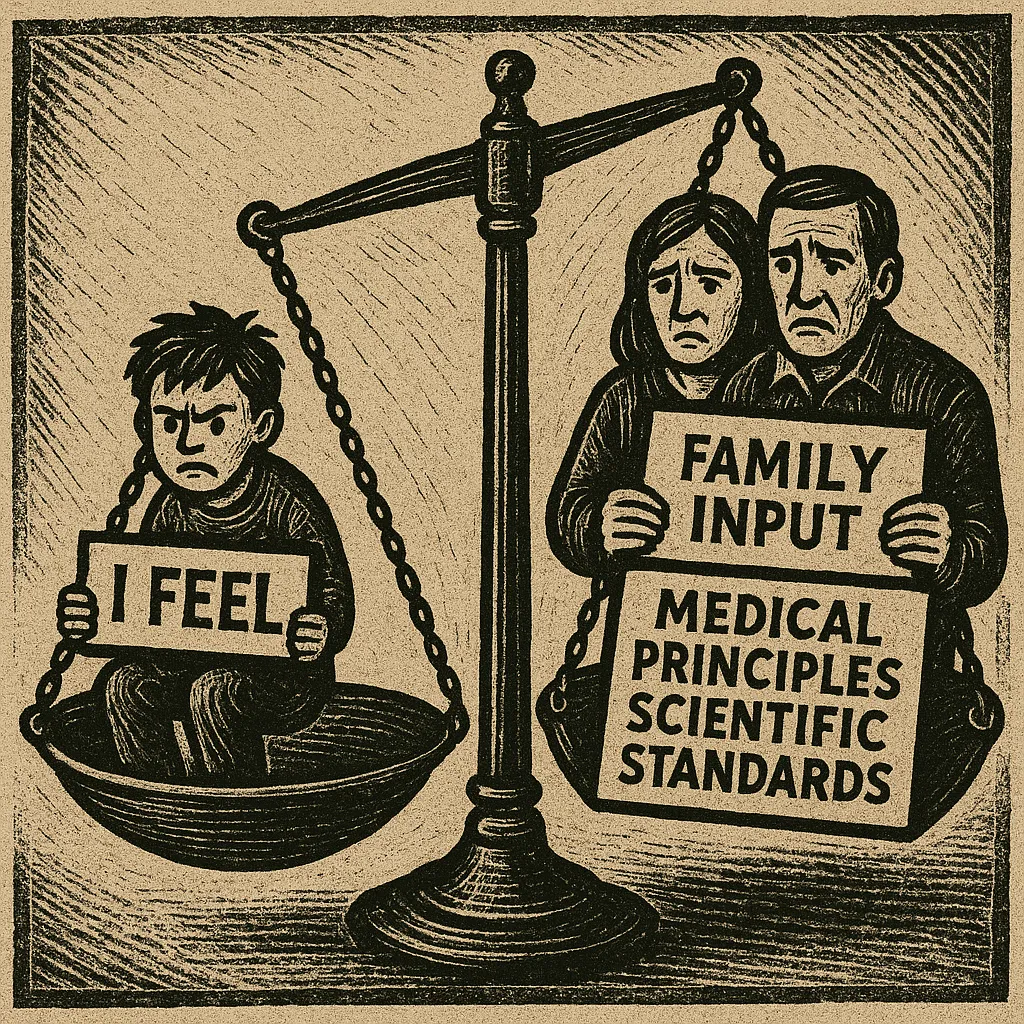
Differential diagnosis, critical for psychological complaints, is formally conducted but effectively ignored in gender clinics. Clinicians perform DD to claim they investigated, but they never issue a negative diagnosis (i.e., not trans). They document input from parents or family but rarely treat it as a reason to pause. Specialists prioritize self-reports, minimizing legal liability by claiming they “heard everyone.”
This creates a superficial diagnosis:
- It appears thorough.
- It lacks factual testing.
- It ignores alternative explanations.
Consequences: Major Risks for Patients, Families, and Healthcare
This flawed diagnostic model poses serious risks:
- Patients face permanent harm from inappropriate treatments.
- Families suffer emotional devastation when clinicians dismiss their concerns.
- The healthcare system loses public trust.
Typically, risky treatments demand rigorous diagnostics and informed consent. In gender healthcare, clinicians apply these standards with alarming laxity.
Responsibility of Insurers: No More Ignoring the Problem
This raises a critical legal and financial issue:
Reclaiming Payments for Invalid Diagnoses
Insurers reimburse treatments based on diagnostic codes, like 302.6x for Gender Dysphoria. If these diagnoses prove systematically flawed, legal consequences follow:
- Insurers can demand refunds from providers for improper payments.
- Patients and families can sue for negligence or malpractice.
- In extreme cases, this could constitute healthcare fraud.
Now that this analysis is public, insurers cannot claim ignorance. Continuing to blindly fund these treatments makes them complicit in potential medical misconduct.
A Concrete Example
A young person receives gender-affirming treatment based on a questionnaire, without thorough DD or consideration of family input. Years later, they face severe physical and psychological consequences. Their parents learn the diagnostic process fell short of medical standards. They hold the clinic liable for malpractice and the insurer liable for negligence in funding substandard care.
Conclusion
Current gender diagnostic practices fail to meet medical standards:
- They lack objective measurability.
- They rely on circular reasoning around self-identification.
- They dismiss family input.
- They undermine differential diagnostics.
- They risk irreversible harm.
Healthcare providers, insurers, and policymakers must act. Medical ethics demand: Do no harm. In dubio abstine.
A Call to Action
Are you a concerned parent or citizen critical of gender healthcare practices? Share this article with your health insurer.
Genspect publishes a variety of authors with different perspectives. Any opinions expressed in this article are the author’s and do not necessarily reflect Genspect’s official position. For more on Genspect, visit our FAQs.
Check out Genspect’s Gender Dysphoria Support Tool