




Arrayed in the Trappings of the Feminine
By D. Delaney

The man’s face is contorted, flushed red, eyes darting about. His teeth flash as he forces out words through a clenched jaw. He is deeply upset, betrayed. Fury seeps from him. He is denouncing a charity for using his music in a film. He accuses them of hate speech. He offers no evidence. The charity, LGB Alliance, is trying to disentangle gay, lesbian, and bi issues from trans issues. There is no hate speech on the LGB Alliance website. The alleged crime is one of omission, a failure to include references to trans people. It remains a puzzle as to why some gay men denounce such efforts. Puberty blockers, cross-sex hormones, and cosmetic surgery were historically used to control and punish gay men.
Giovanni’s Room (1956) by James Baldwin, Queer (written in 1952, but not published until 1985) by William Burroughs, and The Fall of Valor (1946) by Charles Jackson are significant novels of the 20th century written by gay men. All three novels centre a man in the grip of a crisis of reckoning with his sexuality in the context of homophobic societies. In all three novels, the crisis is symbolised by the appearance of a man arrayed in the trappings of the feminine. In Giovanni’s Room, it is a nameless man, a “flaming princess.” Queer has Bobo, a “wise old queen,” and a reference to “female impersonators.” The Fall of Valor has Arne Ekland, who has painted nails. However, they are not depicted as positive role models. They are ambivalent figures, described with various degrees of horror and disgust. They are depicted as effeminate, effete, uncanny, and abject.
Feminine, Effete, Effeminate
Although the etymological root of “feminine” is “woman,” its associations are more to do with manners—for example, “feminine products” as a synonym for toiletries only used by women, or a description of a way of being in the world that is seen as right and proper for females in society; for example, people would say, “That is a very feminine dress.” Recently, it is more likely that men are described as “feminine,” and this is usually in the context of discussing gender and trans issues, whether that is a trans-identified male claiming an identity, or people trying to use a word to discuss a set of behaviours that are stereotypically associated with females, such as kindness or gentleness.
Effeminate comes from a Latin root meaning “made feminine.” The meaning is “not masculine.” Thesauruses give a list of insults as synonyms. You would rarely describe a woman as effeminate, but certain people describe men as effeminate or effete, a word which is often used incorrectly as a synonym for effeminate. The original meaning of “effete” was “fertility exhausted by having too many babies.” It means ineffectual, and the implication is castration.
Giovanni’s Room
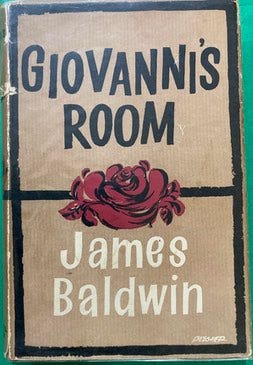
In Giovanni’s Room, James Baldwin portrays David—known to his father as “Butch”—a gay man in a state of deep denial. He is living in Paris, in a two-way parasitic relationship with an older gay man, upon whom he projects all his internalised homophobia, describing him as “disgusting.” He is in a relationship with a girl, whom he idolises, even as he hangs around with gay men in the gay bars of Paris.
One day, he encounters Giovanni, with whom he falls in love at first sight. At that moment, a figure, the “flaming princess,” appears from nowhere and advances towards him: “It glittered in the dim light; the thin, black hair was violent with oil, combed forward, hanging in bangs; the eyelids gleamed with mascara, the mouth raged with lipstick. The face was white and thoroughly bloodless with some kind of foundation cream; it stank of powder and a gardenia-like perfume[…].”
The image is repellent: the man’s breath smells of garlic, and he has bad teeth. He moves with a “horrifying lasciviousness.” He walks like a “mummy or a zombie.” The man is dehumanised. He is both a physical threat and has the quality of an apparition. David is startled at the size and strength of the hands, but at the same time feels that the man might, “at any moment, disappear in flame.” He is suddenly aware of “my awakening, my insistent possibilities.” The “flaming princess” is depicted as both abject and uncanny.
The Uncanny
Freud’s essay on the concept of the unheimlich (translated as “uncanny” in English) was first published in 1919. Freud writes that the uncanny is the realm of the frightening with roots in the hidden: the eerie, horror, mist, haze, and veil, revenants, dolls, and doppelgangers. He suggests that the causes of an uncanny effect all return to the root of something that has been repressed. He lists the uncanny as things from some circumstance that causes us to activate discarded beliefs such as the omnipotence of thoughts, instantaneous wish fulfilment, secret harmful forces, or the return of the dead—or a repressed complex.
Freud offers an analysis of the story of The Sandman by Hoffman as a superlative example of the uncanny in literature. The Sandman rips out children’s eyes. He argues this symbolises a childhood fear of castration in its psychoanalytic sense: the ability to touch and take part in the world. Freud writes that we have an uncanny experience “when we are faced with the reality of something we thought was imaginary: when a symbol takes on full function and significance of what it symbolises.”
The Abject
Published in 1980, Julia Kristeva, a French psychologist, wrote of the abject, which is in some ways an extension of Freud’s concept of the uncanny, and also its own thing. Abjection is a state of alienation related to disgust. She lists things that can be experienced as abject: the “improper” and “unclean”—loathing, food, filth, dung, and the way it is experienced in the body. It produces spasms, vomiting, repugnance, and retching.
She writes that the abject is a function of the part of the psyche associated with morality and society, the superego. It is associated at its most archaic with loathsome food—she gives the example of the skin on boiled milk—with faeces, corpses, cesspools, and death. It can also be associated with actions: she lists the liars, criminals, hypocrites, and cold-blooded murder. But she notes it is not the lack of cleanliness or health that gives rise to an abject effect but “…what disturbs system, identity, order. What does not respect borders, positions, rules. The in-between, the ambiguous, the composite.”
The abject and abjection are, according to Kristeva, a boundary that protects the self. The abject effect safeguards against a reality that, “if I acknowledge it, annihilates me.” “A massive and sudden emergence of uncanniness which, familiar as it might have been in an opaque and forgotten life, now harries me as radically separate, loathsome. Not me, not that. But not nothing either.”
That which is abject is something that must not be integrated into the self. Even as we reject it, that which is experienced as abject is fascinating even as it is repulsive.
Baldwin’s figure of the “flaming princess” is uncanny in that he seems to appear from nowhere, having the quality of the undead. He is abject: a rotting corpse, smelling of dying flowers, a stinking subhuman revenant, and is experienced by David with visceral revulsion. He is arrayed in symbols of the effeminate, the not-masculine, and is at once a herald of David’s own repressed desire and a projection of his internalised homophobia.
Queer
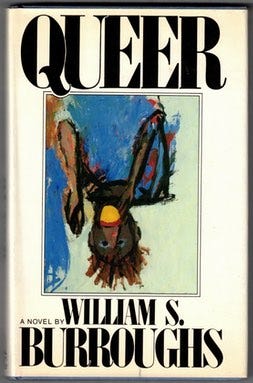
There is a rhyming set of associations in the novel Queer by William Burroughs. The story is about Lee, an American living in South America, who is beset with desire for Allerton, a younger man. When Lee admits to Allerton that he is gay, he recalls his “unspeakable horror,” “grotesque misery and humiliation.” He associates being gay with being a “female impersonator,” “subhuman,” a “sex monster”; he recalls the “…painted simpering female impersonators I had seen in a Baltimore nightclub. Could it be possible that I was one of these subhuman things?… Nobler, I thought, to die a man than live on, a sex monster…”
He goes into what he describes as “the routine,” a habit (shared by Burroughs) in which he tells exquisitely grotesque stories to entertain—and in this case seduce—his audience. Lee says, “It was a wise old queen—Bobo, we called her—who taught me that I had a duty to live and to bear my burden proudly for all to see, to conquer prejudice and ignorance and hate with knowledge and sincerity and love […] Poor Bobo came to a sticky end. He was riding in the Duc de Ventre’s Hispano-Suiza when his falling piles blew out of the car and wrapped around the rear wheel. He was completely gutted, leaving an empty shell sitting there on the giraffe-skin upholstery. Even the eyes and the brain went with a horrible shlupping sound.”
Like the “flaming princess” of Giovanni’s Room, Lee’s acknowledgement of his homosexuality is accompanied by the conjuring up of a figure that is at once regressive, uncanny, and viscerally disgusting. Lee/Burroughs subjects Bobo to a violent and revolting symbolic castration. Bobo—in Spanish for “foolish” or “silly”—furnishes the character with a sense of regression to childhood. “Ventre” is Spanish for “stomach,” a recurring motif in Burroughs’ work, always associated with symbolic castration.
Some writers interpret Bobo and his advice as a dig at an advocate for gay rights, Donald Webster Cory, who had published The Homosexual in America (1951). Burroughs wrote that Cory’s writing was “…enough to turn a man’s gut. This citizen says a queer learns humility, learns to turn the other cheek, and returns love for hate.”
An alternative interpretation of the character of Bobo is that Burroughs is actually sending himself up even as he advocates for gay men. The fate that Lee/Burroughs inflicts upon Bobo is a travesty of the 1927 death of the dancer Isadora Duncan, whose scarf got caught in the wheels of an expensive car (Hispano-Suiza is a manufacturer of luxury cars). Contemporaries unfairly attributed the accident as some kind of divine retribution for Duncan’s presumed vanity as a performer, an uncanny echo of her famous act, which made much use of scarves. In the act of writing the novel, which faithfully portrays a man overtaken by a fever of desire, Burroughs is setting himself up on a stage not unlike the grand proscenium of Bobo’s luxury car. The novel was not published until the 1980s, and this is considered to be due to institutionalised homophobia due to its depiction of sex between two men.
Cory published writing and campaigned for the word “homosexuality” to be used rather than Hirschfield’s term “invert” or contemporary insults such as “fairy”: there was no consensus at the time. Burroughs preferred the term “queer,” also an insult. The word’s guttural prosody goes better with his carefully considered public persona, that of the Southern Gentleman crossed with the hard-bitten Private Detective. The word “queer” better fits the natural metre of plain-spoken English, in contrast to the sing-song Latin flourish of “homosexual,” with its connotations of medical taxonomies.
Queer, as Burroughs wrote later, is not simply a story of lost love. It is a semi-autobiographical work about “withdrawal,” often understood as Burroughs’ own withdrawal from heroin use. It was written in the aftermath of a horrific accident where Burroughs had killed his wife playing a foolish game. It is there in the text: Lee mentions that someone has shot their wife as a passing comment, and no further mention is made of it, but it haunts the narrative. The novel depicts South America as a place of filth, peopled by grotesque, toothless female figures and idealised beautiful young men. A superficial reading might charge Burroughs with a colonial mindset, misogyny, and cultural superiority. However, a reading where South America is symbolic of a state of mind and the figures in the novel are aspects of Lee’s self yields depths of meaning. In this reading of the novel, the title is not only a description of sexuality, but also a state of sickness, guilt, and alienation, symbolised by “South America,” a state of withdrawal from society.
In this more complex reading, the figure of Allerton could be interpreted as not just a love interest, but also a symbol of an aspect of Lee/Burroughs’ self: an idealised image of himself which he cannot recover. Allerton, too, is on the run from something (we never find out what it is); he has debts somewhere, he is lazy, insubstantial to the point of transparence, ambivalent towards Lee, brushing him off but returning repeatedly. When Lee seduces Allerton, it is an oddly downbeat scene in an untidy room with a pair of “disembowelled trousers” carelessly discarded. Note that Burroughs again uses the malfunctioning or injured gut as a symbol of castration. Afterwards, Allerton lies in the bed and vomits, and Lee gives him money. It’s not much of a love story. Allerton (spoiler alert) eventually disappears from the narrative. The novel ends with Lee looking for a mythical psychedelic drug in a remote rainforest, living with a strange toothless couple, abject and uncanny, who are like grotesque, effete parent figures. In this land, the earth lacks a key nutrient, so people become weakened, sick, and their bones and teeth decay. The last image of the novel is of toothless, mask-like, pale faces in an isolated and remote forest, a “dead-end.” It is a superlative image of alienation, loss, and despair.
The Fall of Valor
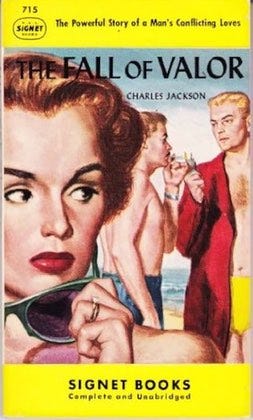
Charles Jackson’s The Fall of Valor is a different kind of book. It was one of the first popular novels to feature a homosexual story and was published whilst homosexuality was still illegal in the US. Whilst Burroughs and Baldwin are self-consciously writing in a literary tradition, The Fall of Valor is a popular novel, a melodrama, which uses the broad-brush symbolism of the movies. It is set during World War II in the US and tells the story of John Grandin, a middle-aged academic. Grandin and his wife are on holiday when Grandin meets and falls in love with Cliff Hauman, forcing him to reckon with his sexuality and the failure of the marriage.
As in Queer and Giovanni’s Room, the admission of desire is accompanied by the appearance in the narrative of a man arrayed in the trappings of the feminine. As in Giovanni’s Room, this ostentatiously gay man is a kind of herald of desire, and with his effeminate ways, he encapsulates Grandin’s internalised homophobia. As in the other two novels, the man that the main character falls in love with is archetypically masculine. In contrast, Arne Ekland is portrayed as a gay man who flaunts his sexuality. He has “highly lacquered nails,” conducts himself with a “perverse good humour, as if any moment he would go into a broad burlesque of himself,” and has “a strangely singing quality” to his voice. Grandin’s party immediately deride Ekland with contempt, using the innuendo “4F,” i.e., homosexual. (“4F” was a US army categorisation that defined men as unfit for military service on physical, mental, or “moral” reasons and is still used colloquially.) Ekland is portrayed as both glitteringly numinous and mildly uncanny. Grandin is deeply ambivalent. He is disgusted by Ekland’s unashamed exhibition of his sexuality, but also seems to admire him, describing him as a decent and intelligent young man.
It seems that Ekland has spotted that Grandin is a fellow traveller. He presents Grandin with a photograph of a soldier in a magazine and remarks on his attractiveness. This infuriates Grandin, who, like Lee in Queer and David in Giovanni’s Room, reacts with disgust and anger. “He felt an impulse to turn savagely and say: ‘Look here, Eklund—if people dislike you and your kind, it’s your own damned fault!'” Grandin’s response is hypocritical as he has a fixation on newspaper images of young men killed in service. For Grandin, fear of homosexuality is also wrapped in the uncanny quality of photographs or the abject quality of the cadaver, and how this represents desire and fear about Grandin’s own sexuality could be the subject of an extended essay. He gloomily ponders images of the dead in absolute fascination and fantasises about Hauman’s death. It has to be said that Ekland is not a frightening figure: at the end of the novel, when Grandin has accepted the fact of his homosexuality, he seems to regret the missed opportunity to make friends.
The association of homosexual desire with death and disease is also present in films. For example, in Death in Venice (1971) by Luchino Visconti, Aschenbach, a man in late middle age, becomes overtaken with desire for a youth. At the beginning of the film, the man is conservatively dressed. As the man becomes more fixated on the young boy, his moustache is trimmed to a kind of affected style, a barber paints his face, dyes his hair, applies lipstick and eye make-up. A flower is placed upon his breast. As he becomes engulfed in desire, so he becomes engulfed in the trappings of the feminine. Venice operates as a kind of dreamscape, symbolic of his inner psychic state; as the man becomes more fixated, and yet also in denial, workmen begin sluicing the fountains and drains with disinfectant—it seems that there is a sickness, an epidemic of cholera in the city, but the officials deny it. Distressed, Aschenbach’s feverish sweat dissolves the black hair dye, and it runs down his face as he dies. Again, sexual desire is associated with the abject, in this case an unseen disease. It is a devastating film, reflecting the devastated lives of gay men in the late 19th and early 20th centuries.
Conclusion
During the course of the 20th century, the symbol of the homosexual man arrayed in the trappings of the feminine has been repurposed on an individual and collective level by gay rights activists as a provocative protest against those who seek to police sexuality, and as an image of defiance and radical self-acceptance. Yet the same set of symbols are also deeply ambivalent. On a recent TV programme in the UK, Stuart Feather, a veteran gay rights campaigner, explained that he and his friend dressed “as your worst nightmare,” dressing up in drag to protest for gay rights. Drag is here nothing to do with “authenticity,” but a provocation aimed at people who are hostile, reflecting back prejudices and images of homophobic beliefs. He was literally dressing up as a homophobic idea.
Quentin Crisp’s autobiography, The Naked Civil Servant (1968), is the memoir of a gay man who grew up in England in the 20th century. Crisp felt that he was so obviously gay that he decided to flaunt his homosexuality by wearing make-up and women’s clothes in an act of defiance, provocation, and self-acceptance. Interestingly, he describes “walking like a mummy” about the streets of London. He describes the great animosity between those men who wanted to be discreet and those, like Crisp, who flaunted their sexuality. Crisp was ostracised by gay men and refused entry to gay venues for being too flamboyant, which speaks to long-established tensions within and between groups of gay men.
The visual cultures associated with gay men were deliberately co-opted by trans campaigners. In addition, aspects of gay men’s culture—such as drag or camp modes of dress, or certain codes of speech—were deliberately subsumed into the trans umbrella. The symbols are superficially very similar. There is the same use of signs that produce uncanny and abject effects employed for protest. Yet there is a qualitative difference between gay men dressed up in camp style, gay men who present in women’s clothes and make-up, gay men who believe themselves to be women, straight men who cross-dress, and straight men who actually believe themselves to be female, let alone women who believe themselves to be men. Yet some gay men seem to be unable to acknowledge this. It seems that the emotional content is overwhelming, thought-stopping. For these individuals, even to consider the effect of men in women’s spaces, women’s sports, or the terrible consequences of surgical and hormonal interventions upon children and vulnerable people seems to be some kind of emotional betrayal.
The novels and films discussed are accounts of individuals confronting the fact of their homosexuality. They indicate that in the 20th century, to be gay was experienced by gay men as to be somehow symbolically arrayed in the trappings of the feminine, or more exactly in the effeminate, the effete, the not-male, the castrated (in its psychic sense). At the same time, dressing in women’s clothes and make-up has become an equally powerful symbol of defiance and self-acceptance. It is a potent confusion of positive and negative symbols that speak to distant times and places, and yet still resonate with gay men today. It is perhaps easier to see why gay men felt an obligation to accept trans into the LGB campaigns, and why stripping out this set of symbols may excite such deep anguish.
Genspect publishes a variety of authors with different perspectives. Any opinions expressed in this article are the author’s and do not necessarily reflect Genspect’s official position. For more on Genspect, visit our FAQs.