




The Bigger Picture in Lisbon
By Stella O'Malley

When Genspect first conceived the idea of countering WPATH’s fascist diktat of #NoDebate with a counter-conference in the same town and at the same time as the WPATH conferences, we had no idea that, just one year later, WPATH would resemble Fannie Mae in the wake of the housing crisis, living on borrowed time.
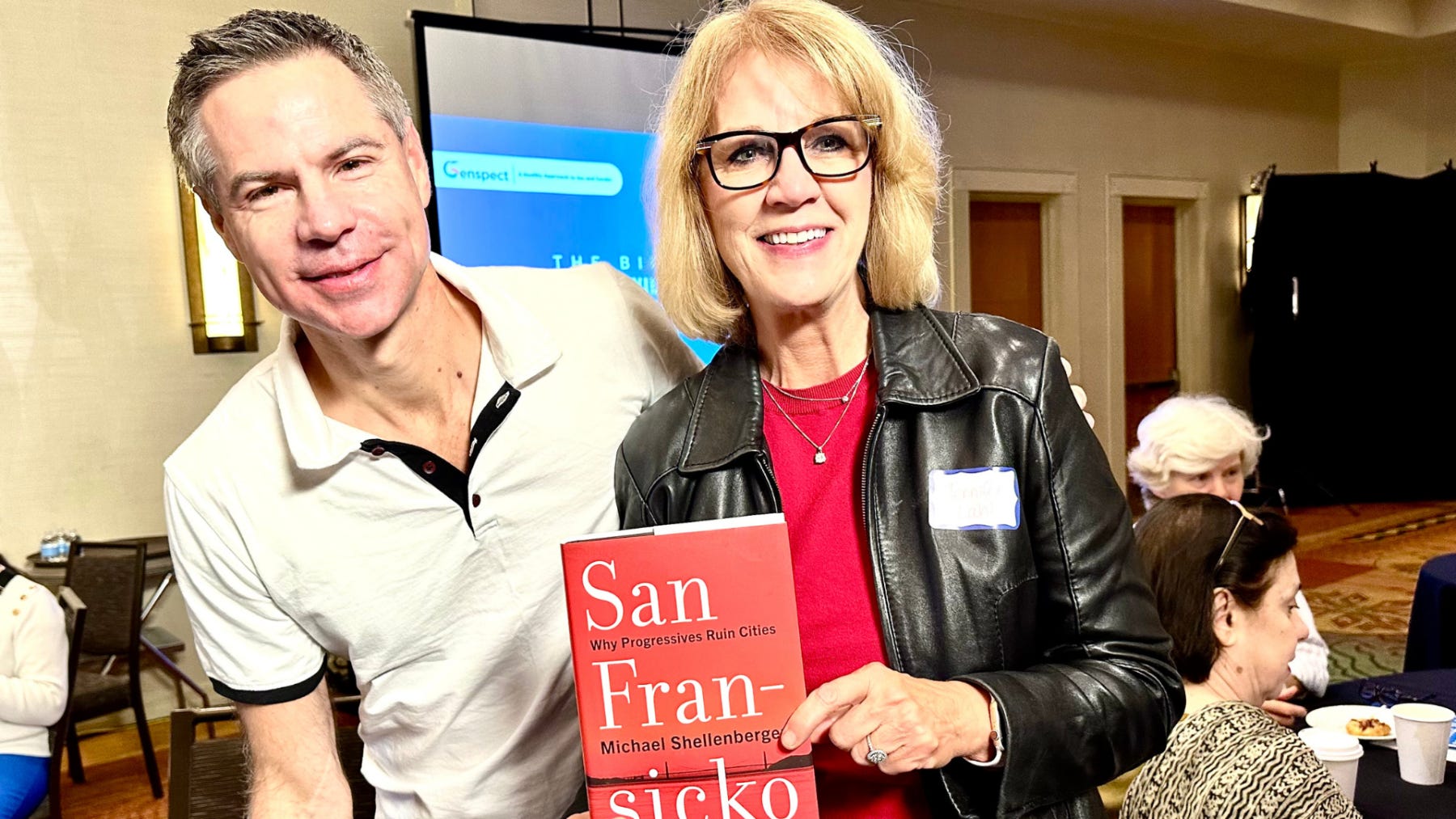
WPATH were rattled by our presence first in Killarney, Ireland and again in Denver, Colorado. Legal letters were exchanged during both conferences. Invitations to private meetings were issued. At our conference in Denver, Michael Shellenberger gave an electric speech with a thrilling opener “The name of my speech is ‘How WPATH ends.’” We worked extensively with Michael to help launch the WPATH Files a few months later. WPATH responded with an off-the-wall statement that chose to assert that “gender, like genitalia, is represented by diversity .” The Cass Review, released soon after, intensified the challenges for child sex-change lobbyists. Dr Hilary Cass’s team provided comprehensive research showing that there is no quality evidence to support radical and irreversible medical interventions for individuals seeking to express their personal sense of identity.

Although we live in a world where there is very little consensus, we can all probably agree now that WPATH will never regain the credibility it once had. Membership of WPATH is down roughly 25%, from 4119 in January 2023 to 3225 members today, and there isn’t a bookie on this planet who would offer odds on their numbers recovering. But we can’t be complacent as we still have a lot of work to do. The past MO of the trans industry suggests that other organisations will soon spring up in a bid to continue the project to promote the medicalisation of people’s identities. We’re looking forward to our conference in Lisbon, Portugal perhaps being even bigger than the WPATH conference as this will highlight the fact that most people agree that a non-medicalised approach to gender nonconformity is more helpful than enabling mentally ill people to deny the bitter reality of life. All we’ve ever needed was to get this message out into the open, and finally, we’re succeeding in this.
As the gender wars became increasingly vicious in the 2020s, it quickly emerged that this was a massively under-researched issue and researchers scrambled to catch up. Thankfully the Cass report has sorted this out and we now have the research. The jury is very much in. The range of systematic reviews and research from England, Sweden, Denmark, Finland, France and the Netherlands shows us clearly that there is insufficient evidence to promote medical transition as a healthy option for vulnerable people with gender dysphoria. Conventional least-invasive-first treatments such as psychotherapy and other social supports make much more sense than the scalpel and/or a lifelong prescription for body-altering hormones.
We call our conference series The Bigger Picture as we believe it is imperative to move far beyond a medical understanding of gender dysphoria. This is not only a psychological issue, but a political, sociological and legal issue. There is no point in academics remaining in their silos discussing the minor details of little-known research. Nor do we need to hold secret meetings any more. That day is over. Our job now is to pivot and instead publicly and loudly address the wider issues that prevent the natural evolution of a healthier way forward.
Here’s the thing, a significant impediment to the development of a healthy society has recently arisen. The sharp rise in rapid-onset gender dysphoria (ROGD) among young people does not exist in a vacuum. These often gay and/or neurodiverse kids live in a world where the majority of institutions, organisations and political parties have been captured by the billion-dollar trans industry. Schools and colleges also tend to favour a narrow view on this issue, and many are complicit in indoctrination. Continuing to view medical transition solely as a psychological/medical issue is massively missing the point by now.
Queer theory and the rise of identity politics means that vulnerable and often extremely mentally ill people are led to believe that it is healthy to identify as identities that are, as WPATH described, “not known in nature”. In the olden days we identified with people to demonstrate a connection with another person, today we identify as another persona in a way that disconnects us from ourselves. This needs a good deal of analysis, from many different disciplines.
Input from experienced doctors and psychologists is essential and so the Genspect conference in Lisbon offers presentations from Dr Carrie Mendoza (Genspect USA); Dr Louise Irvine (Can-SG); Dr Stephen Levine and Dr Kris Kaliebe among many others. Marcus Evans will give a presentation about psychoanalysis for trans-identified males, while Sue Evans will discuss her acclaimed family model. Bob Withers (Thoughtful Therapists) will delve into the body-mind connection, and Jaco Van Zyl (Critical Therapy Antidote) will examine the psychological drive to transition. Fellow podcaster and world expert on ROGD youth, Sasha Ayad, will share insights from her work with ROGD youth.
Our work has shown that, if this conference is to provide valuable insights into the challenges faced by many young people and parents today, it is also essential that we avoid leading individuals towards false hope by implying that the “right diagnosis” or “right treatment path” will somehow provide a panacea. For this reason, we will include a panel discussion exploring The Limits of Psychotherapy.
It is no longer appropriate for clinicians to fall ever-deeper down the rabbit hole of in-depth research, diagnoses and treatment pathways—this is an issue that has moved far beyond this and we now need to understand the trans issue within a much wider context. It is arguable that Professor Mattias Desmet, famous for his theories on mass formation hypnosis and the rise of technocratic totalitarianism, may give more insight into what’s really going on for the ROGD kids than diagnostic clinicians. Andrew Gold has studied the way that cults work for some years now and the insight he will provide into who joins cults, who remains in a cult, and why and how do some leave, will be very helpful for some parents. As always, until we have a more complete understanding of this issue, we must remain open to the broader perspectives.
Over the years both parents and detransitioners have provided insight into the extraordinary intensity that is overwhelming many young neuro-diverse people today. They are led to believe that they can become a different person and this will lead them to a much better life. It is a beguiling promise and it can lead to wretched disappointment and great physical harm. This premise is propped up by a very vocal online community and zealous trans-positivity in schools, universities and other institutions. Despite this, desistance is a better option for a trans-identified young person as medical transition carries an unbearably heavy burden on the body. Alex Capo, clinical director of the Charlton School, will speak in Lisbon about how a culture of desistance was cultivated in his therapeutic boarding school through utilising a compassionate and careful approach that can be replicated in schools anywhere. Experts in other fields will examine wider, but equally important issues, such as family law barrister Sarah Phillimore (We are Fair Cop) explaining children’s capacity to consent and sociologist Frank Furedi’s (MCC Brussels) account of how the LGBTQ lobby took over the EU.
We have noticed the impact on loved ones when a family member transitions so there will be a panel discussion from Emma Thomas, whose father transitioned when she was a child, Shannon Thrace, whose ex-partner transitioned, and Jude Hunter, whose child transitioned. Lynn Chadwick will offer her valuable insight into how she moved on from the pain of family estrangement while Julie Bindel will present her research on the trauma that parents are experiencing.
Any conference about trans issues needs to highlight the issue of lesbian, gay and bisexual people fleeing their sexual orientation and seeking to somehow “trans the gay away.” Bev Jackson (LGB Alliance) will speak about The Good, the Bad and the Diabolical within the gay rights movement while Kathleen Stock (The Lesbian Project) will undoubtedly provoke heated discussion when she explores whether lesbianism is an identity. Autism is another essential factor in understanding trans-identification and Christina Buttons’s research and conclusions in her Autism Report will give a much-needed understanding of the vulnerabilities of autistic young people.
Detransition is yet another issue that needs to be considered. Tove Solander’s research from Sweden is an extremely important and helpful addition to the literature while Emelie Kohler’s presentation, called If True Trans Were a Thing, That Would Be Me, addresses the issue of “true trans” head-on. Those of us who hang out on Twitter/X will know and love Funk God Laura Becker and her presentation on the psychology of detransition will provide a deeper understanding of this complex and brutally harrowing experience.
But, as with all Genspect conferences, there will be lighter moments too! Peter Boghossian will speak about how to have difficult conversations—a skill many of us in the trans trenches need to learn. Graham Linehan will give his thoughts on the trans predicament and Andrew Doyle will speak about the new puritanical shift in the discourse. Colin Wright will explain the implications of the expanding definition of transgender. It’s an embarrassment of riches, however, I think I’m personally most looking forward to Rosie Kay’s presentation, which is called The Body is the Frontline: Trans, the Military, the Body, and Dance. We also can’t wait to interview Billboard Chris for our Gender: A Wider Lens podcast which will be filmed before a live audience. The interview with Lionel Shriver about the larger civilisational implications of the trans phenomenon will undoubtedly be thought-provoking and entertaining. Jennifer Lahl’s film The Lost Boys will be a social occasion with a panel discussion afterwards featuring Andrew Doyle and Graham Linehan.
Truly the trans phenomenon has now bled into almost every aspect of society. For this reason, our conference seeks to provide deeper insight into what is happening by highlighting the different issues. By now most of us know about the problems and most of us know about the research. What we don’t know is a way forward out of this mess so Helen Joyce, the world-leading thinker on trans issues, will give a presentation called What Will it Take to Return to Reality?
The current Zeitgeist is frightening. The polarisation is woeful. The politicians aren’t offering much hope so instead we need to work together to seek some sort of resolution, a way forward, so that we can one day move beyond trans. As another Helen (Keller) once said, “Alone we can do so little; together we can do so much.”
To view the conference programme: https://genspect.org/wp-content/uploads/2024/06/Lisbon-Program.pdf
To buy in-person or online tickets: https://genspect.org/the-bigger-picture-lisbon/
25% discount available to Friends of Genspect
If you find it challenging to cover the cost of attending this event but are eager to participate, please don’t hesitate to reach out to us: info@genspect.org. We’re committed to making accommodations to ensure everyone can join.