



Two Ways to Be Wrong
By Tom Sherry
Twenty years ago, I went with a friend to see Touching the Void, a 2003 documentary about a mountain climber who falls into a crevasse, breaks his leg, and through grit and determination manages to survive. Exiting the theater, I said to my friend, “Why the hell didn’t the helicopter guys just rescue him?” My companion looked at me in amusement and disbelief, unable to comprehend how foolish I was. “Tom, those were reenactments.” In my brain, I was watching a film crew documenting a climbing expedition. It was a documentary after all. But this preconceived notion, a prejudice of sorts, fixated my thinking and prevented me from noticing something plainly obvious for nearly two full hours. Suddenly my brain flipped a switch and immediately I wondered how I could be so clueless.
This would just be a funny story about how irrational I can be, except for the fact that this happens to all of us all the time. Most people recognize it as “confirmation bias.” In medicine it is referred to as “cognitive overshadowing” or “diagnostic overshadowing” and can have serious implications. But most of us go about our daily lives having no idea how much our mindset informs our perceptions. For example, if I were in bed and I felt an animal jump up on the mattress, I’d freak out—if I was not fully aware that I have a dog. Identical physical stimuli can be interpreted with opposing psychological experiences. Our cognitive frame is the foundation of how we experience the world.
That foundation is under perpetual construction and revision by personal experience, parents, faith leaders, teachers, and the media. Those in authority hold a peculiar sway in our effort to understand the world. Like most people, I can’t personally verify authoritative statements about how tides work, what medications to take, or even the existence of germs. I also know some plainly intuitive understandings can, with deep examination, be shown to be false. Other things are plain as day and scientifically established facts. So, every time a respected thinker, writer, or scientist claims there are more than two sexes, I’m left scratching my head in abject confusion. These people are not charlatans talking to crystals or selling quantum energy air filtration systems. To the contrary, they are prominent scientists saying things that, to my mind, sound like flat-earth poppycock.
How is this possible? Every time it happens, I wonder, “Maybe I’m the guy in the tinfoil hat.” I’m confident I am not that guy. But how can I be sure?
Remembering that moment, exiting the theater, helps me stay vigilant to the fact that sometimes my cognitive frame is misguided. I watched the same documentary as my friend. My perceptions were the same as his, but my interpretation was obviously wrong. Overcome with embarrassment, I did not argue my position, nor I did I try to find some loophole to steelman my claim. There was simply no explanation that could alter the truth. Most of the time, I appreciate hearing a perspective that turns my world upside down. This time, I felt hoodwinked by my own brain. It was easy to acknowledge, “Of course, they were recreations, Jeez how could I be so stupid?”
So, I have a hard time understanding people who argue against the obvious. Maybe they are suffering from strong cognitive bias, maybe I am, or (gasp) maybe I’m wrong.
There is, however, another option. We are both right.
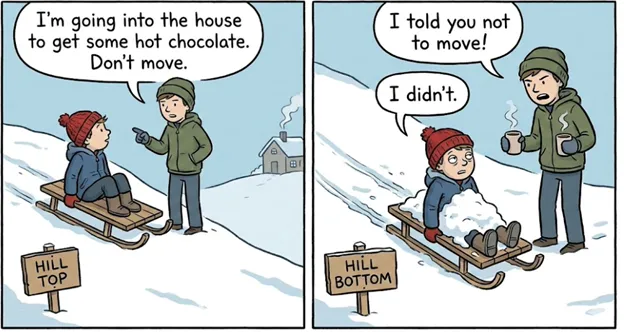
The most potent lesson I ever learned flashed before me in 5th grade science class. I once opened to a page in our textbook displaying a two-panel cartoon. The first panel has a boy sitting on a snow sled at the top of a hill. His brother stands beside him and says, “I’m going into the house to get some hot chocolate. Don’t move.” The next frame has the boy sitting on the sled at the bottom of the hill. The brother has returned and says, “I told you not to move!” The kid on the sled replies, “I didn’t.” The caption below simply explained, relative to the sled the boy did not move, but relative to the ground he did. I remember that moment vividly. With the same set of facts two opposing positions can be true. I think about this nearly every time I feel adamant about any topic. Can I be sure this person is wrong or am I just thinking about the problem in a different way?
If one determines sex as simply a matter of gamete size, (eggs or sperm), there are only two sexes: female or male. Many impassioned gender activists will assent to this fact. Problem solved—right? So here we have a fact and a frame of reference. For many of us sex is defined by the anatomy and secondary sex characteristics that are organized around this simple gamete binary. For others, it is those physical characteristics, how one looks, that define male or female, man or woman. They highlight biological variations and the ability to change them, while we scream “Gamete size—large and small.” “You moved.” “No, I didn’t.” “Yes, you did.” Our differing perspectives make productive conversations virtually impossible.
This is not a frame of reference problem
It is worth questioning what motivates any party to choose one of those two frames of reference. Why am I in the gamete size camp while most of my peers are in the sex characteristics and gender identity camp? When public awareness of trans identification flourished, as a lifelong liberal, I was happy to place pronouns in my bio. But working with adolescents for over thirty years, the concept of a “trans child” and the “affirmative” medical model did not sit well with me. When most professional organizations and all of my peers were fully on board, I figured I must be trapped in a misguided frame of reference or hold some strange bias. I read everything I could in an effort to discover what was wrong with my thinking. I was hoping, “Can we both be right?”
No. This is not a frame of reference problem. This is a cognitive bias contagion.
For years, the letters LGBT have been a part of our lexicon. Most of us understand lesbian, gay, and bisexuality because we all experience an innate sexuality. It does not take much to convince people they also have a gender identity. I “feel” like a man. But is that a “gender identity” or the simple recognition I inhabit a male body? For decades everyone has been primed to associate sexuality and trans identities as basically one thing. In this frame of reference questioning someone’s gender identity carries the same social stigma as challenging their sexual orientation. As a therapist, even working with a client to explore trans identification is considered the same as gay conversion therapy. If gender identity transcends anatomy and is as innate as sexuality, doing the right thing means supporting everything that flows from that core belief. This is where it gets interesting—and for some of us infuriating.
Contorting evidence to satisfy cognitive bias
From my vantage point, trans identified individuals engendered little public scrutiny until activists claimed “trans” was merely an adjective for a certain kind of man or woman, no different than being tall or having red hair. This novel idea runs counter to one of the most obvious facts of mammalian biology.
A large segment of society and many major medical and political institutions now operate under a belief that all people have a gender identity, some have a gender identity that does not match their biology, and that the moniker “man” or “woman” is a derivative of one’s stated identity not their observable biology. Following this assumption, we now sanction placing males in women’s prisons, halt the natural puberty of distressed children, deny the physical advantages of male anatomy in women’s sports, and claim adolescents have the maturity to forgo fertility and sexual function for the rest of their lives. Given the seriousness of the stakes, one would think most people would pause and reconsider their priors like I did when my friend pointed out my error: “Oh my God, how stupid could I be, of course that was a reenactment!” But even good people contort evidence to meet their cognitive bias. Truth is, we all do.
When “identity” is aligned with an idea we tend to resist any challenge to it. Those with deep religious faith hold a specific worldview that informs their perception of the world. I understand how a fundamentalist Christian would reinterpret facts of evolution to maintain their foundational viewpoint. We tend to accept this kind of epistemology when it comes to religion. But what do we do when this kind of willful ignorance invades foundational scientific, educational, and political organizations?
Those of us who question the existence of gender identities are disparaged as “biological essentialists.” Because trans activists can’t argue the basics of sexual dimorphism, they say we want females to behave “like women” and males to behave like “men.” Most of us are simply saying there is a difference between what you are (your sex) and who you are (however you choose to express yourself.) Masculinity and femininity are merely behavioral traits that fall on a spectrum between both sexes. When it comes to supporting gender expression, gender critical influencers and trans activists are in agreement. Everyone I know on both sides of this debate supports unbridled self-expression. But, you can’t claim water is wine by adding grain alcohol to grape juice. Altering secondary sex characteristics does not change one’s biology. This is not a matter of semantics or frame of reference.
We are all blind to our blind spots. For over 90 minutes in a dark theater I was thoroughly blinded by my own misperceptions. But stepping into the light and being unwilling to see, that is a different kind of problem.
Tom Sherry is a child and family therapist who has focused on adolescents and parents for the past 25 years. He lives with his wife and son in Asheville, North Carolina. When inspired, he posts to his Substack Chill the F Out (https://chillthefout.substack.com/)
Genspect publishes a variety of authors with different perspectives. Any opinions expressed in this article are the author’s and do not necessarily reflect Genspect’s official position. For more on Genspect, visit our FAQs.