




The Deification of the Transgender Child
By Daniel Howard James
If you’re new to this series, please visit Genspect on Substack to read my previous articles about Gnostics, Jungian alchemists, castration cults, and the rock ‘n roll gender outlaws.
Everything I know about the proselytization of Buddhism, I learned from watching ‘Monkey’ on TV. This Japanese series, produced from 1978 to 1980, based on Wu Cheng’en’s 16th-century novel, was shown on British television with dubbed dialogue while I was in primary school. Other than the titular magical simian in somewhat human form, his water-monster sidekick Sandy, the ever-hungry, lecherous Pigsy, and their talking horse, the central character was boy-priest Tripitaka. Just like Moses, this young mystic had been found as a baby floating in a stream, and had been given the special mission of receiving, guarding and spreading the divine word.
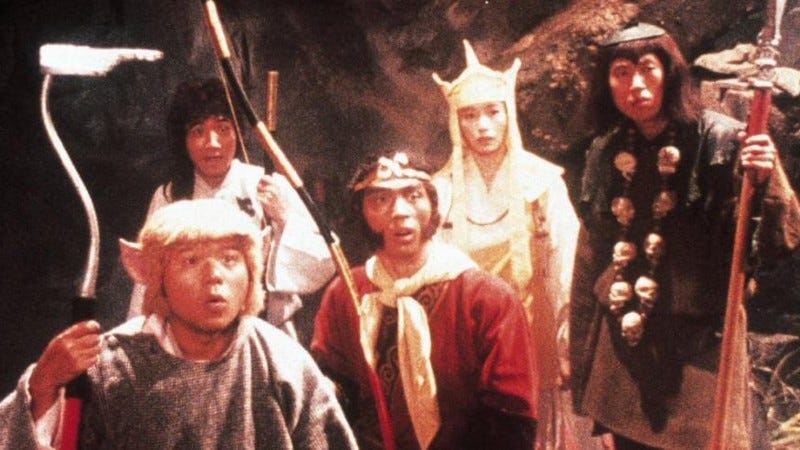
On an epic journey to India with the imperative of retrieving the three sacred texts he was named after, Tripitaka was given anthropomorphic animal companions by the Buddha to defend him from cannibals. Because he was considered the reincarnation of a holy being, a belief had spread that consuming the flesh of this boy-priest would confer eternal life on whoever ate him. My favourite character was Sandy, who wrestled with the moral dilemma of having to defend Tripitaka despite his fondness for snacking on humans, as demonstrated by his skull necklace. You can take the water-monster out of the swamp, but can you take the swamp out of the water-monster?
Even as a child, I noticed that the holy charge of the spirit animals was not at all masculine. In fact, Tripitaka was played by actress Masako Natsume in the 1970s version of ‘Monkey’, the boy-priest being rather girly as a consequence. This was not the only reference to gender ambiguity in the series. In one memorable episode, a defiant Monkey attempted to fly beyond the end of the world on his pink cloud, only to discover that he remained within the Buddha’s hand. Giant columns, which our staff-wielding, kung-fu fighting hero imagined were pillars marking the end of the heavens, were in fact manicured fingers attached to the divine palm. The Buddha had confused Monkey that day by appearing in his/her female form.
Bissu Gender
I remembered this early education in Eastern mysticism while learning about the Bissu gender of indigenous priests who live among the Bugis people in South Sulawesi, part of modern Indonesia.
The Bissu have their own written ‘language of the heavens’, studied from a young age and supposedly unintelligible to other Bugis, in which the same characters can be transcribed as matelo (to die) or mattelo (to make love). This literary ambiguity emphasises the cycle of life leading to new life, which Sabina Spielrein made the core of her theory of primary masochism, or ‘Thanatos’, as the death drive.
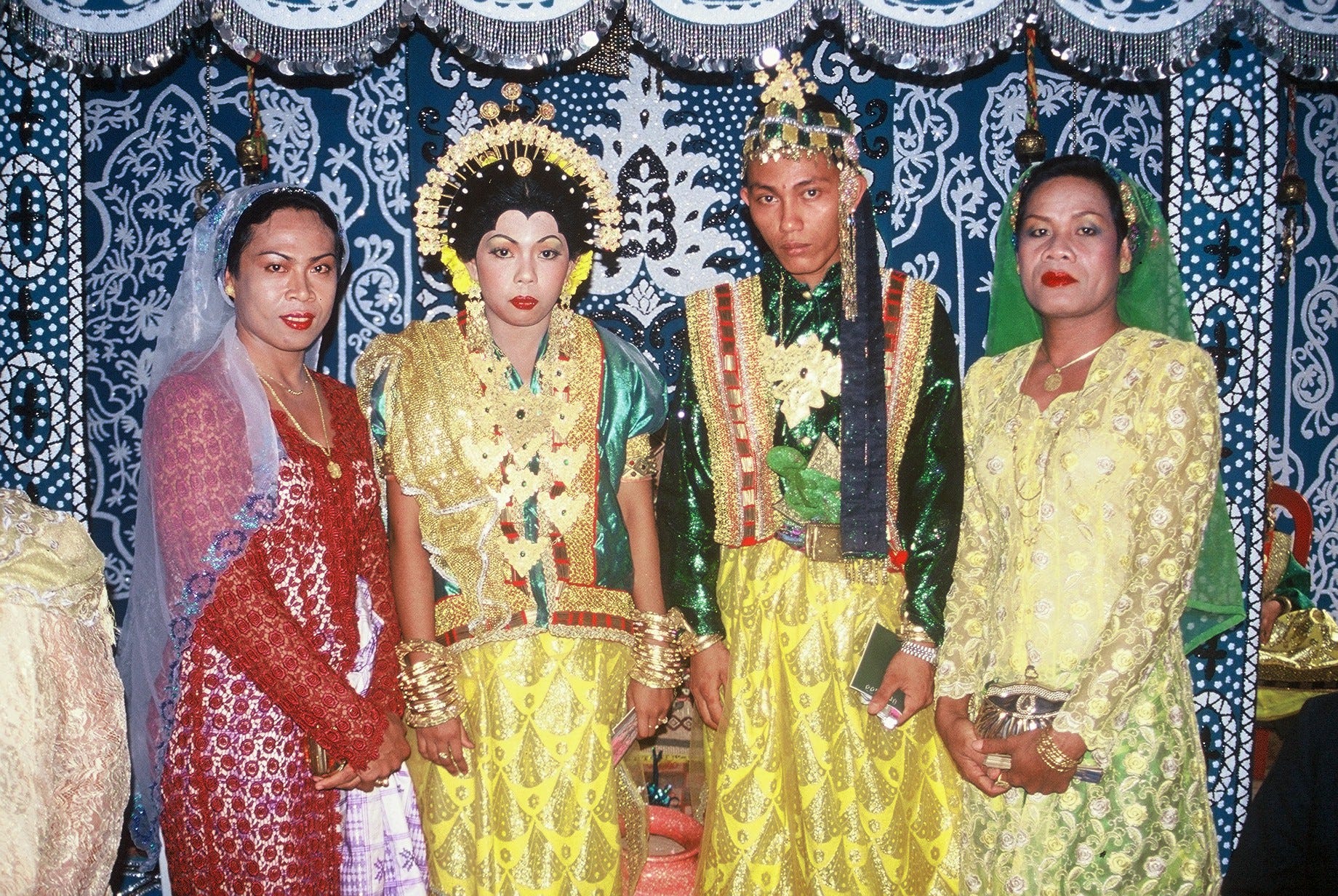
Young Bissu must undergo a potentially dangerous initiation ritual, involving an elder member of the sect holding a dagger against their throat while readings are made from sacred, esoteric texts.
The success of Islam in the region has marginalised the indigenous religion to the point where this gender non-conforming priest caste might disappear altogether. The ‘trans genocide’ wasn’t caused by Western feminists or Baroness Cass. Under the long dictatorship of Suharto, a military general from Yogyakarta, which lasted from 1967 to 1998, Bissu were forced to renounce the religion of the Bugis. Some Bissu were tortured or murdered in the preceding Islamic rebellion led by Abdul Kahar Muzakkar.
It was, of course, a 2006 meeting of academics and human rights professionals at Gadjah Mada University in Yogyakarta that devised a framework that codified gender identity beliefs into international law. Of the 29 signatories to the original Yogyakarta Principles, only one represented Indonesia, while the majority were Westerners.
Attempts to claim the supposedly celibate Bissu and other indigenous gender identities for the Western LGBT movement may not be helping to save them from radical Islamist oppression. Recently, Bissu had found a unique niche in a syncretic blend of traditional religion and Islam, blessing events such as Hajj pilgrimages, but they remain under threat from a new generation of anti-LGBT Muslims.
There is now academic interest in the Bugis people and their traditions because of their five traditional gender identities: oroani, makkunrai, calalai, calabai and bissu, roughly corresponding to masculine, feminine, transmasculine, transfeminine and either ‘intersex’ or ‘non-binary’ respectively. Other than the Bissu priests, transfeminine Bugis work as makeup artists, wedding planners and caterers, while some transmasculine members of their society provide physical labour.
As Leonard Andaya, former professor of Southeast Asian history at the University of Hawaiʻi, relates, the Bissu have a higher status in Bugis society than cross-dressers who perform opposite-sex roles, because it is believed they have the unique ability to understand both heaven, which is coded as male, and earth, which is coded as female. The Bissu are considered divine because of their ability to manifest both masculine and feminine genders, like the Buddha who entrapped a foolish Monkey in her manicured fingertips.
Other than blessings, Bissu carry out religious duties for their communities including rituals, and in the past, the crowning of kings, but their identity does not map exactly onto Western understandings of gender or differences of sex development. While some Bissu are believed to have been marked by the gods with unusual bodies, like the sacred, feminine bayasa of central Sulawesi reported to have very small penises, other Bissu, known as mau jangkka, are feminine men who have wives and children. To complicate matters, calalai and calabai sometimes have to step in to perform Bissu rituals because the latter group is now so small in number.
Much like the Western priest class in their frocks, who at once provide their congregations with masculine discipline and a sympathetic, listening ear coded as feminine, the Bissu have a formal social role which accommodates, rather than pathologises, their distinct appearance and gendered behaviours.
The tragedy of Western transgenderism is that the modern, secular world has no reserved place for cross-dressing eccentrics with esoteric ideas and beliefs about the universe and their place in it, except in light entertainment, academia, software engineering, Olympic sports or political lobbying. And so, we medicalise and surgically alter these benighted individuals, in a misguided attempt to help them fit our godless times. A man being made ‘Woman of the Year’ neatly encapsulates this exaltation without purpose.
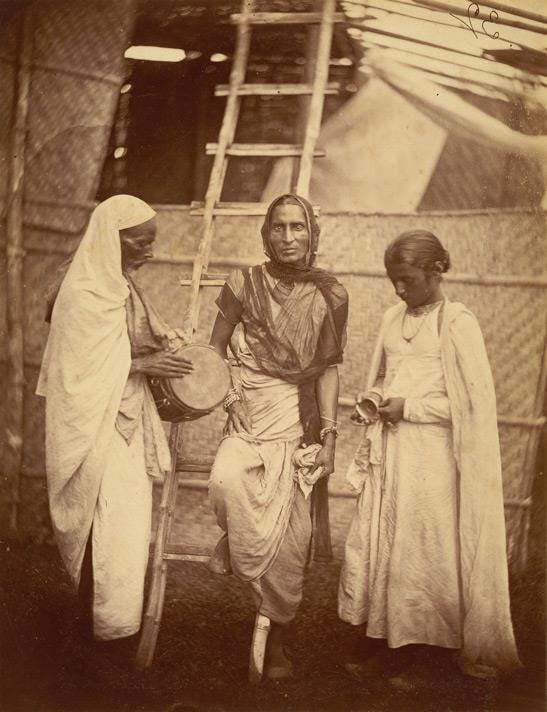
The idea that the transgender or gender non-conforming individual has unique access to the divine is by no means limited to Indonesia, and appears common to several societies in Asia. This makes transgenderism ultra-conservative, rather than progressive. The anti-scientific notion that the way a person has sex or dresses makes them neither male nor female, or somehow the opposite sex, appears in pre-Abrahamic traditional religions which have a very different understanding of the human body.
Andaya reports that among the Iban people of Borneo, the manangbali healer wears female clothing “in obedience to sacred commands conveyed through dreams. However, it was necessary for him to be ‘sexually disabled’ before doing so”, in a manner similar to that of the boy singer with the voice of an angel given the snip to become a castrato. The hijra, despite living on the margins of society across the Indian subcontinent, often with no other work available than prostitution, have been considered magical for centuries.
Eastern Imports
In addition to the influence of Germanic pseudoscientific ‘sexology’ on notions of gender, Westerners have witnessed the wholesale importation of Eastern religion by the counterculture from the 1960s onward, by pop stars and phony gurus alike. It is cultural appropriation to imagine ourselves part of a multi-gendered, pre-modern society like the Bugis or the Iban. And there was no facial feminisation surgery, for which the appropriate abbreviation is ‘FFS’, in Tripitaka’s time.
As Matt Osborne wrote in 2023, and I have covered in part one of this series, the more radical factions of contemporary Protestantism are waving the Progress Pride flag, their belief predicated on the Gnostic heresy of the gendered soul. This belief may have been reincarnated in our times from Buddhist missionary influence on the early Christians.
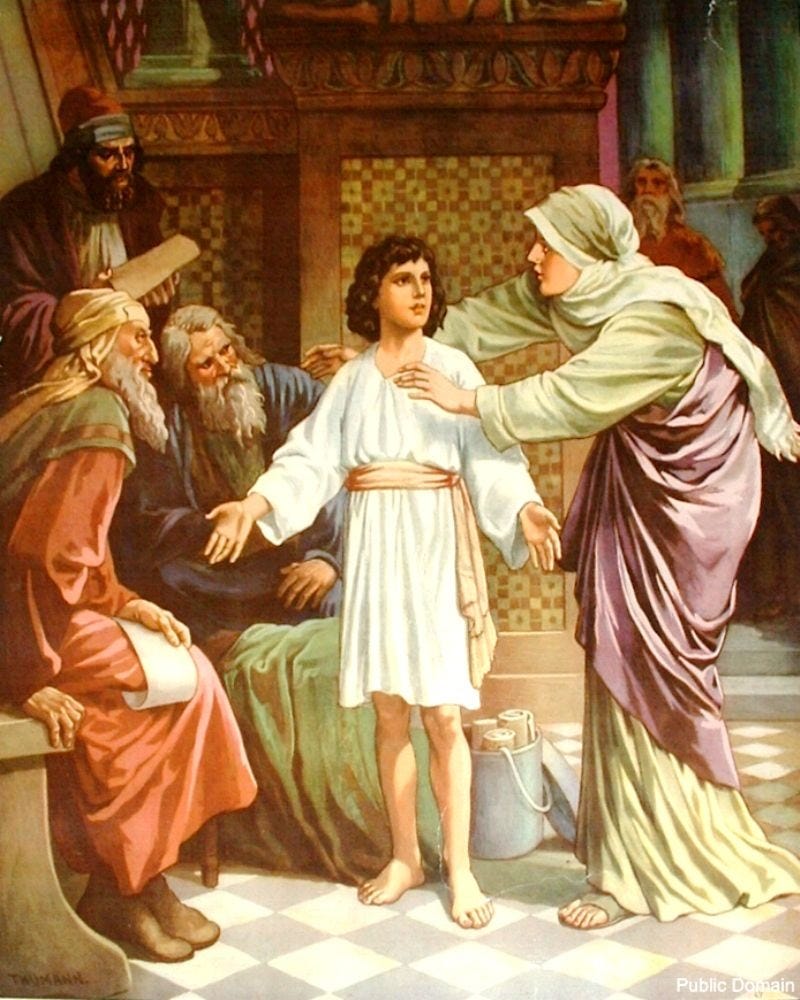
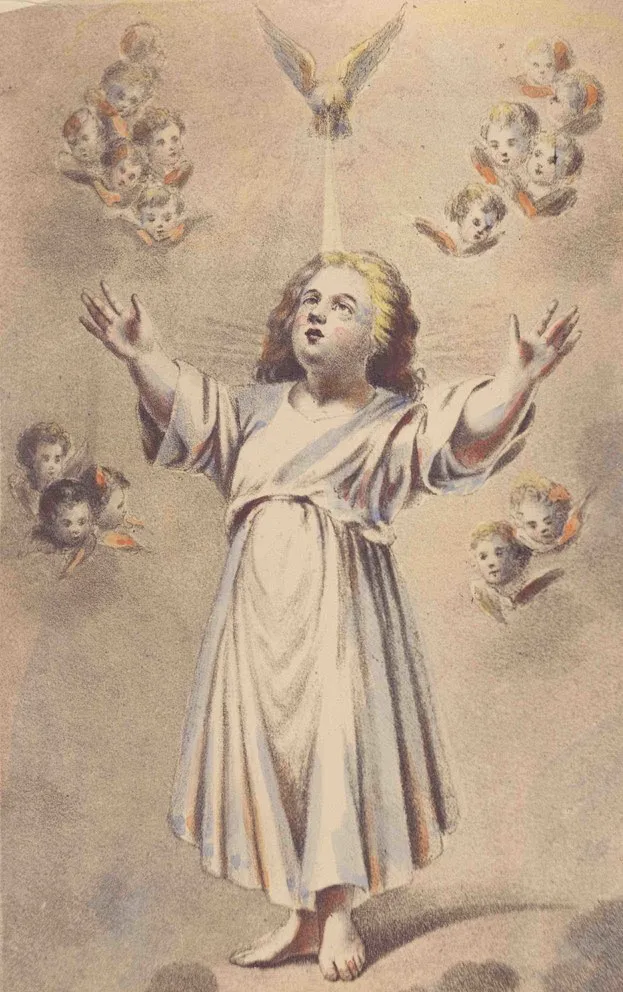
Inverting the principle of ‘lived experience’, the holy child knows more than we adults do precisely because they have a direct line to the divine. The search for a new Dalai Lama among children of the Tibetan villages, the lost boy Jesus found in the Jerusalem temple dispensing wisdom to his elders, or the ‘transgender child’ who knows their sex better than any biologist: all embody the idea of a precocious supernatural authority. “They know who they are!” shout the devouring mothers who transport their children to the gender clinic for chemical castration, and the surgical table for removal of sexed body parts.
J.R.R. Tolkien used the term ‘mythopoeia’ to describe the process of legend creation, which he had dedicated himself to by writing the epic Lord of the Rings cycle over seventeen years. Psychoanalytic alchemist Carl Gustav Jung, whom we met earlier in this series, fully leaned into the value of myth-making to humans. Robert Bly and others would later draw on the Jungian method to create the ‘mythopoetic’ men’s movement in the 1980s.
The Harry Potter universe, the Narnia stories of C.S. Lewis, or even the Star Wars franchise could be considered mythopoeic; they are not mere allegories for the eventual triumph of good over evil, but complete subcultures which attract obsessive fandoms. The young Potter himself is a magical messiah, the divine child who arrives at our time of need to save the world from evil. He receives the grimoire, a mystical text, but he is found in the cupboard under the stairs rather than in a floating basket.
Art and Life
As life imitates art, Greta Thunberg, who arrived telling the adults they are wrong and wicked, never grows up, cursed to remain all-knowing while trapped in the body of a child. Like Oskar, the protagonist of Die Blechtrommel by Günter Grass, her piercing scream is heard from afar. To ‘beat the tin drum’ is a German idiom meaning ‘to gain attention for a cause’.
Perhaps the reason why self-identified ‘transgender rights activists’ hate J.K. Rowling so thoroughly is that having created their magical world, with the story of a hidden child inheriting supernatural powers from heavenly parents, she is their Gnostic demiurge: the jealous god of Moses’ second commandment. Helen Joyce defined gender identity as “a thing that the individual in question can utter into being by stating it”.
Alchemy uses magical words in an attempt to control the material world, and so gender woo is not merely an abstract, inconsequential performance; it is semantic witchcraft. Someone who grew up believing in ‘Harry Potter and the Philosopher’s Stone’ might imagine that words of self-declaration spoken out loud could turn a man into a woman, as he grasps his wand tightly.
The extreme privation of the spiritual ascetic is no longer Harry Potter’s cupboard, or being walled into a convent cell like 15th-century syphilitic anchoress Lady Isabel German, it is being imprisoned in the family basement by depression and an addiction to Reddit, or worse still, being the subject of a reality TV show on ‘the transgender child’.
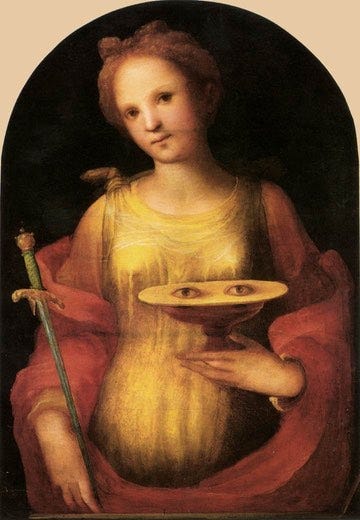
In Exulansic’s re-telling of the ‘Melody’ Dawson case, a teenage boy suffering the delusion that he is female managed to shoot out both of his eyes and part of his brain with a single bullet. This is not only a tragedy which Sigmund Freud might have considered validating of his Oedipus Rex fixation, but an act of religious extremism comparable to the eyeballs on a dish of third-century Christian martyr Saint Lucy. ‘Melody’s’ survival of this alleged self-harm could be considered miraculous, on the path to sainthood.
The deification of the transgender child is only possible within the belief system of a child abuse cult like the Skoptsy, because this holy status comes with costs attached. In Western culture, with our history of using psychiatry to control difference, cross-sex identity is not merely symbolic. Veneration requires sacrifice. As Abraham discovered in the Book of Genesis, being willing to destroy your own child is the ultimate test of faith. Nor is transgender ideation merely a performance à la Judith Butler. Instead of on the altar for burnt offerings, the knife is now wielded above the surgeon’s table, somewhere in Thailand where ladyboy transitions are routine.
The transgender child is venerated because he/she/they has achieved gnosis at a prodigious age, and is therefore the most special child of all. What takes some autogynephilic men until middle age to realise, they discover in school. Just as the young Jesus was found conversing knowledgeably with the elders in the temple, inspired by the divine power of the Gnostic goddess Wisdom, so the child is allowed to lead the adults because they are the shepherd and we are the sheep.
So-called ‘gender-affirming care’, which involves castrating and mutilating young people in a secular context of ‘informed consent’, is not progressive. It merely replicates ancient religious traditions of ritual and sacrifice. It is a regression to myth-making, which is why evidence-based medicine was always incompatible with the gender industry. Now, after multiple systematic reviews, ritual body modification has retreated to the consumer principle that the customer is always right, even if mental and physical health outcomes are not improved by these drastic interventions.
We need a new honesty that transgender medical and surgical procedures have nothing to do with ‘healthcare’ and everything to do with a reversion to pre-modern superstition, in which gender non-conforming people pay a high price for being different. On this basis, the special exceptions in legislation which allow physical harm to transgender people, forbidden for anyone else, need to be repealed immediately.
Female genital mutilation law also needs updating to address the phenomenon of male children being flown across borders for devastating surgeries, which would be illegal in their own territories. This urgently-needed political intervention would confirm that neither boys nor girls should be enabled to suffer life-limiting procedures which they cannot possibly consent to. And as those children grow into adults, they need the support to understand that self-harm is never a rational choice.
Genspect publishes a variety of authors with different perspectives. Any opinions expressed in this article are the author’s and do not necessarily reflect Genspect’s official position. For more on Genspect, visit our FAQs.