




The Colonisation of the Irish Curriculum: Part I
By Colette Colfer
Ireland is no stranger to colonisation. The arrival of the Vikings, Anglo-Normans, and subsequently the English, changed the trajectory of Irish culture, society, and people. Today, rather than raiders stealing silver chalices from monasteries, plundering resources and grabbing land, a soft colonisation is underway involving the implantation of gender identity theory throughout the Irish education system.
Explaining to students that a small number of people suffer from the debilitating condition of gender dysphoria is very different to statements now included in educational resources such as ‘everyone has a gender identity’. It is also taught that gender is ‘given’ at birth and that sex is ‘assigned’. Advice in resources for teachers includes: ‘When you greet your students for the first time, announce your name and pronouns (e.g. “My name is Ms Murphy and my pronouns are ‘she/her’).’
What started off as a noble aim to alleviate challenges faced by children suffering from homophobic bullying and gender-related distress has mutated into the wholescale uncritical adoption of a contested theory. The inclusion of gender ideology in Irish classrooms is linked to the evolution of lesbian and gay organisations, national government strategies, and the inclusion of activists on curriculum development groups.
The addition of transgender concerns to gay and lesbian organisations can be dated to the mid 1990s. The Second Annual International Conference on Transgender Law and Employment Policy took place in America in 1994. Some of the roughly 65 people (mostly male-to-female transsexuals) attending that conference wanted to shift the language about transgender people from the medical establishment to that of human rights. That shift in focus opened doors.
In 1996, an American magazine for gays and lesbians called ‘The Advocate’ ran a story called The Transgender Revolution. The article began: ‘A newly determined, in-your-face transgender rights movement sends ripples through the gay and lesbian establishment’. The trans community was described as ‘courageous, media-savvy, politically astute, and on the Internet’ and these qualities were seen as a potent political force that could benefit the gay and lesbian movement. At the time, however, there was also resistance from many gays and lesbians.
Many or even most gay and lesbian organisations that had been founded around the 1970s evolved between the 1990s and 2010s to include bisexual and transgender people. The National Gay Federation, for example, that was founded in Ireland in 1979, became the National Lesbian and Gay Federation in 1990 and then the National LGBT Federation (NXF) in 2014. Once sexual orientation and gender identity were conflated in the LGBT acronym, they also started to be conflated in law, in people’s minds, and in government policies.
The 2000s saw the birth of brand new organisations in Ireland such as BeLonG To Youth Services, established in 2003 to work with LGBT young people, and Transgender Equality Network Ireland (TENI), founded in 2005.
Between 2006 and 2016, advocacy groups such as BeLonG To, NXF, TENI, and the Gay and Lesbian Equality Network (GLEN) published a raft of reports about LGBT issues in Ireland. The problem of bullying in schools was a recurring issue.
One publication, the LGBTIreland Report, was published in March 2016 by GLEN and BeLonG To and was funded by the Health Service Executive (HSE) National Office for Suicide Prevention (NOSP).
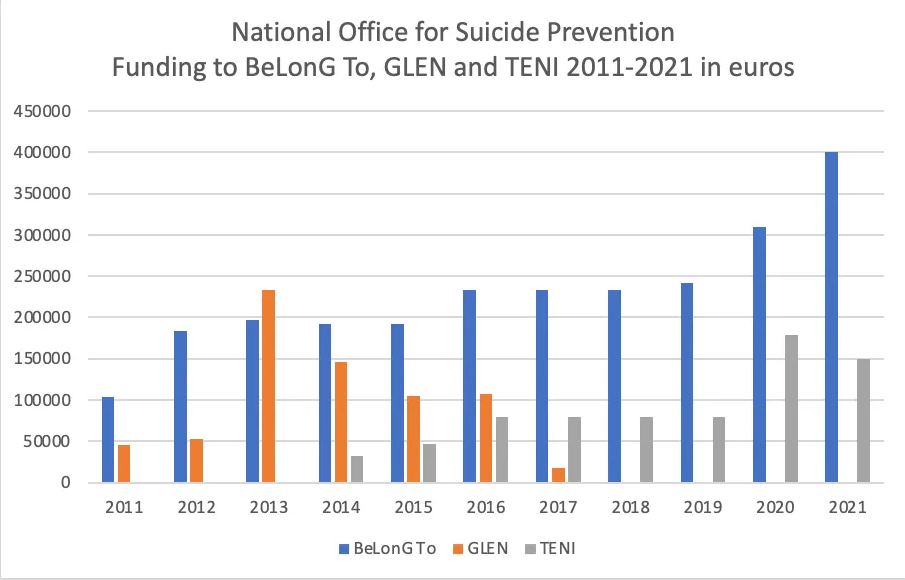
[Above: Figures from the NOSP show funding allocated to various LGBT groups between 2011 and 2021. Note that GLEN closed down in 2017 following allegations of financial mismanagement.]
The 2016 LGBTIreland Report had as one of its concluding recommendations: ‘The curriculum on LGBTI issues is expanded to address both sexual orientation and gender identity beyond what is included in Relationships and Sexuality Education (RSE) or Social Personal Health Education (SPHE) classes’.
Katherine Zappone was one of the people who attended the launch of the LGBTIreland Report in March 2016. She had just been elected in the previous month’s General Election when she took the final seat in the Dublin South West constituency after two days of recounts. Zappone had been a public advocate for LGB and transgender issues for many years, and was herself a lesbian who also had experience working on children’s issues.
Zappone skipped into a senior ministerial role in Government after getting the seat by the skin of her teeth and became part of the 2016 Partnership Government whose Programme for Government included a commitment to develop an LGBT Youth Strategy. On the 25th June that year, Zappone announced that her Department of Children and Youth Affairs would lead the LGBTI+ Youth Strategy and later that year she secured €400,000 in the budget to underpin it.
Many issues highlighted in the NGO publications by NXF, BeLonG To, GLEN, and TENI became translated into Government-led ‘actions’. The LGBTI+ National Youth Strategy 2018-2020 was quickly followed by the National LGBTI+ Inclusion Strategy 2019-2021, which is ongoing and due to conclude in the summer of 2023. NXF, BeLonG To, and TENI all have members on the National LGBTI+ Inclusion Strategy Committee. Both strategies called for the inclusion of LGBTI issues in the curriculum.
The crucial difference between the various NGO reports and the Government strategies is that the NGOs had no authority to instruct on mandatory actions in Government departments or public institutions whilst the National Strategies were Government-led, involved all Government departments as well as many public bodies, and outlined a comprehensive list of actions to be taken across the arc of Irish society. Their recommendations became mandates in areas including health, trade unions, business, libraries, the judiciary, broadcasting, education, business groups, An Garda Síochána (police service), public transport, tourism, prisons, and sports.
It is only relatively recently that the wide-reaching ramifications of these Government-led strategies is coming to light in policing, prisons, libraries, and sports. The colonisation of the curriculum with gender ideology is arguably the most important area, as this is where the minds of those who will decide policies of the future are being shaped today.
The next article in this three-part series will look in more detail at how gender identity theory came to be presented as fact in curriculum resources. It will also look at some of the material being used by teachers and in classrooms.
Header image by Gautam Arora on Unsplash