




Suggestion, Appropriation, and Straight-Out Theft
By Eliza Mondegreen

In my recent conversation with Benjamin Boyce, we covered a lot of ground, including suggestion and the belief that many ‘gender-affirming’ providers (not to mention gender-affirming parents, teachers, and social workers) hold: the belief that you can’t ‘make’ somebody trans.
Take Johanna Olson-Kennedy’s parable of the cinnamon and strawberry Pop Tarts. You can read the full rundown at 4thWaveNow, but here are the highlights:
An eight-year-old kid comes into my practice, and this is the story with this kid. Assigned female at birth, eight years old, was completely presenting male, whatever that means—short haircut, boy’s clothes. But what was happening, is, this kid went to a very religious school and in the girls’ bathroom, which is where this kid was going, people are like, “why is there a boy in the girl’s bathroom? That’s a real problem.” And so this kid was, like, so that’s not super working for me, so I think that I wanna maybe enroll in school as a boy. This kid had come up with this entirely on their own.
When the kid came in, mom was like, “oh, we don’t know what to do, so please help us,” and so we started talking about it and what was interesting is that, you know, some kids come in and they have great clarity and great articulation [sic] about their gender. They are just endorsing it: “This is who I am, and yes, there’s gender confusion but it’s all of you who are confused.” So, there are those kids. So, this kid had not really organized or thought about all these different possibilities.
You know the mom had shared this whole history, and said, when the kid was three, the kid said, “Could you stroll me back up to God so I can come back down as a boy” and the kid’s like, “Ah, I didn’t say that.” You know, 8-year-olds, so I’m like, “I don’t think your mom made that up, that’s crazy.”
So, at one point, I said to the kid, “So, do you think that you’re a girl or a boy?” And this kid was like, I could just see there was, like, this confusion on the kid’s face. Like, “Actually, I never really thought about that.” And so this kid said, “well, I’m a girl ‘cause I have this body.”
Right? This is how this kid had learned to talk about their gender, that it’s based on their body.
And I said, “oh, so—and I completely made this up on the spot, by the way, but—I said, “Do you ever eat Pop Tarts?” And the kid was like, oh, of course. And I said, “well, you know how they come in that foil packet?” Yes. “Well, what if there was a strawberry Pop Tart in a foil packet, in a box that said ‘Cinnamon Pop Tarts.’? Is it a strawberry Pop Tart, or a cinnamon Pop Tart?”
The kid’s like, “Duh! A strawberry Pop Tart.” And I was like, “So…” And the kid turned to the mom and said, “I think I’m a boy and the girl’s covering me up.”
And the best thing was that the mom was, like, [squeals] and she goes and gives the kid a big hug and it was an amazing experience. But I worry about when we say things like “I am a…” vs “I wish I were…” because I think there are so many things that contextually happen for people in [sic] around the way they understand and language [sic] gender.
So, I don’t think I made this kid a boy.
I don’t THINK so.
Olson-Kennedy plays this line for laughs and the audience obliges.
So, here we have a little girl who does not believe she is a boy (“Well, I’m a girl ‘cause I have this body”) but whose gender-nonconformity is making other people uncomfortable and causing them to make her feel uncomfortable. She doesn’t say she wants to be a boy. It sounds like the problem here is a problem involving other people: she’s tired of people asking what a ‘boy’ is doing in the girl’s restroom so maybe she should enroll in school as a boy. Maybe the questions would stop and she could get on with being an eight-year-old.
What Johanna Olson-Kennedy sees the moment this girl steps into the room is an elementary schooler who is “completely presenting male, whatever that means.” And Olson-Kennedy sets out to awaken this child to ‘his’ true self through the medium of Pop Tarts.
I’d be horrified to suggest such an idea to a child because—to me—that’s telling a child that there’s something wrong with the way she is. It’s planting an idea in a child’s head, pushing her toward a medical pathway, and setting her up for a lifetime where the world will constantly abrade her fragile (because false) sense of self. Besides, the alternative seems so simple and obvious. All you have to say is: Yeah, you’re an unconventional girl—and that’s not a big deal! There’s no right or wrong way to be a girl. There’s nothing wrong with you just the way that you are. I’m sorry other people are making you feel like there’s something wrong with you—what can we do about that?
If someone believes that trans identification is not an idea that can be planted in somebody’s head—that trans is not a belief about the self—they won’t understand what they’re doing when they suggest such an idea to a child. So if a therapist or a doctor or a teacher or a peer or a stranger on the Internet suggests the idea to you, it will have no effect on you unless you are ‘really trans.’ It doesn’t matter what condition you’re in when you encounter the idea. It doesn’t matter how often or how insistently you’re prompted to consider it. If you are not transgender, then this idea will not speak to you because being trans is not a belief about the self.
This is where people whose hearts are in the right place make a terrible mistake. They think raising awareness around trans is just like increasing visibility and representation for kids who are different in other ways, where visibility and representation help these kids accept themselves as they are and imagine themselves into adulthood.
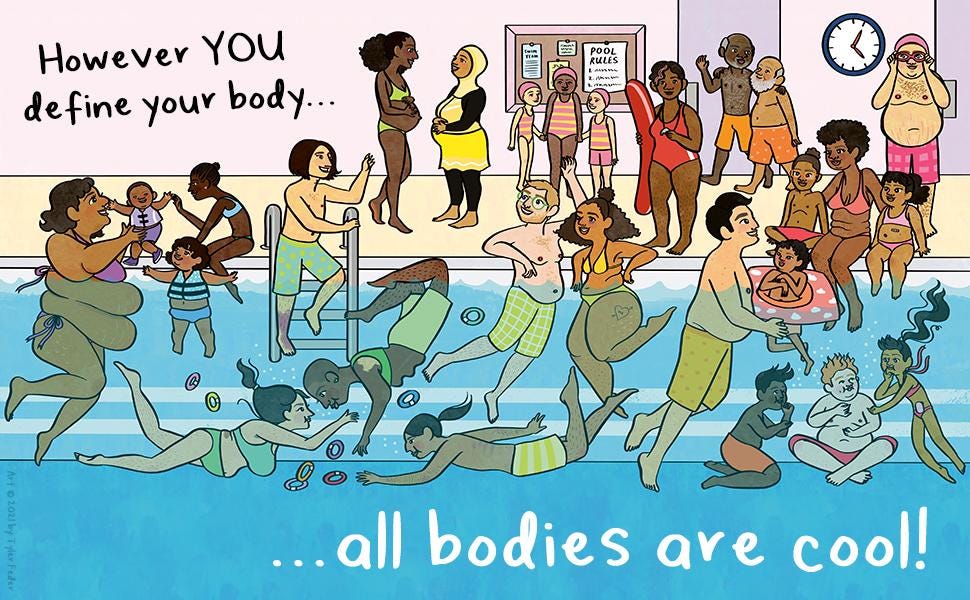
Feder’s All Bodies Are Cool
Under this way of thinking, we need to teach all kids about what it means to be trans—and how you’d know if you were trans—so that the few ‘trans’ kids in the mix will know they’re not alone in the world, so that they will look out at the world and see themselves reflected back. This is what many adults think they’re providing to ‘trans’ kids. And if ‘trans’ kids were like kids with disabilities or kids with incarcerated parents or refugee kids or kids whose names nobody can pronounce or kids who will grow up to be gay, they’d be right. You don’t turn a child into a refugee by reading children a book about refugees.
But ‘trans’ is a belief about the self. Of course it can spread. Of course it can fall apart. Of course we shouldn’t inscribe it on children’s flesh.
When something is a belief about the self, raising awareness operates rather differently. Exposing kids to the concept of transgender identity creates ‘trans’ kids through suggestion.
And that’s not all. In the process of boosting representation for quote-unquote ‘trans’ kids, they are actively stripping representation and role models from girls and gender-nonconforming kids. Remarkable women are being transed—on the grounds that they were remarkable and thus could not have been women at all!
Since ‘trans people’ did not exist until queer theory and medical technology created this new way of being human in the mid-20th century, every attempt to extend trans representation backwards in time is in fact a theft from girls and women and gender-nonconforming people. Which means every attempt to expand trans representation leaves girls and gender-nonconforming kids feeling less seen, more alone, and more susceptible to the suggestion that maybe they just happened to be born in the wrong body, too.