




Not Everyone Fits the Narrative
By Nancy McDermott
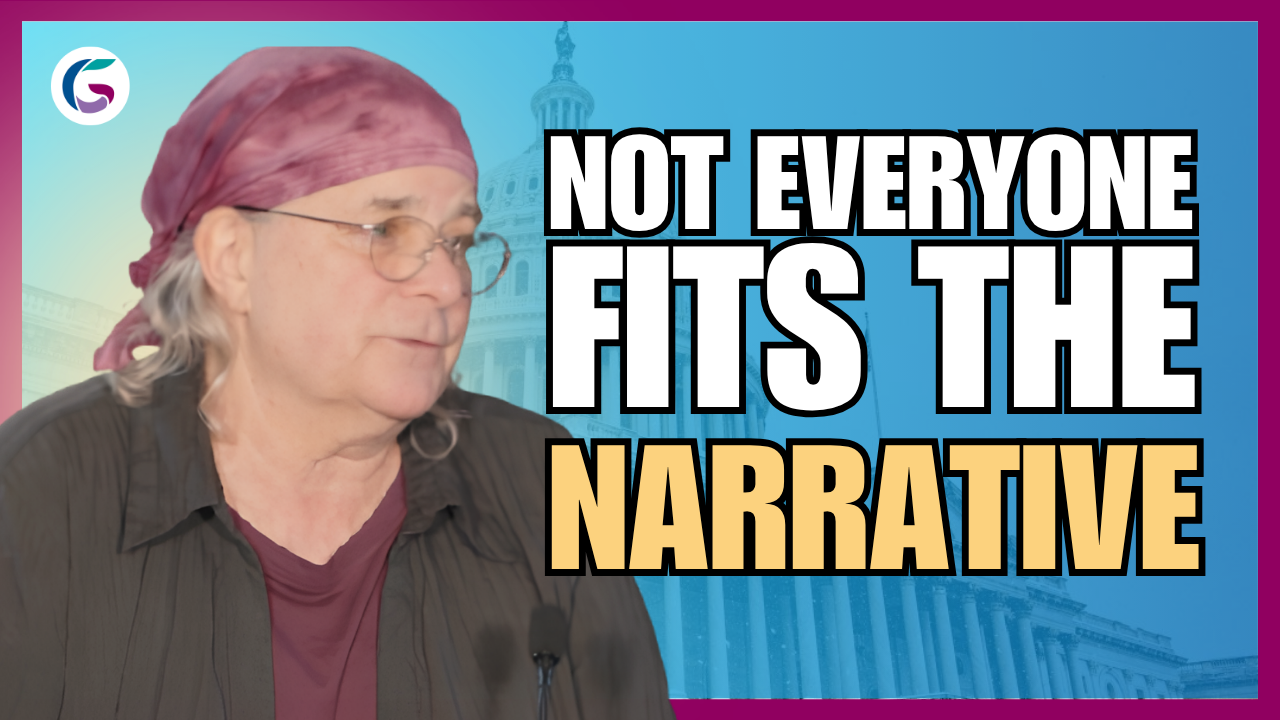
Jessi Harris’ speech on Detrans Awareness Day, and a review of her book, Down the Rabbit Hole
Jessi Harris spoke about her experience at Detrans Awareness Day 2026. Her ground-breaking book, Down the Rabbit Hole, is reviewed below by Nancy McDermott.
DOWN THE RABBIT HOLE: An Elder Lesbian’s 30-Year Journey to Detransition
“Ultimately, what we all wanted was to be recognized, appreciated, and loved.’ – Jessi Harris
Long before the “T” appended itself to LGB — and even before such acronyms existed — lesbians and gay men struggled to live in the world. Before the 1970s, homosexuality was a secret hiding in plain sight. It was threaded through culture, uneasily and yet somehow essential, because it is part of the human experience. It was not openly acknowledged and was still very much taboo. Its most obvious signifier, gender nonconformity, set people on edge and put a target on the back of anyone who didn’t seem to “fit in.” During the intense, politicized social conformity of the Cold War era, same-sex attraction was perceived as a threat. Jessi Harris is a 70-year-old detransitioner and lesbian elder whose life overlaps with one of the most extraordinary periods in Western history: the long, uneven attempt to acknowledge homosexuality and bring it into the mainstream.
No Country for Butch Women
Harris begins her story in November 1963 with the assassination of John F. Kennedy, when she was just eight years old. “Although I wasn’t aware of it,” she reflects, “I was being raised in a decade of incredible social and civil unrest.” Kennedy’s death heralded a great unraveling of American life, and she and her family were at the bleeding edge.
The daughter of an Air Force officer, Harris’s family was obliged to uproot every few years, shuffling between remote bases in Alaska, Texas, and points in between. This nomadic life made it hard to form lasting friendships or navigate the ordinary awkwardness of adolescence. Such instability would become more common in later decades, but in the 1960s it was unusual. The stress and isolation drove her mother to drink, and Harris grew up feeling like a perpetual outsider. She was acutely aware of the things that set her and her family apart —being Jewish while celebrating Christmas and Easter, and most painfully, her own gender nonconformity. She preferred hockey, baseball, and masculine clothing to hopscotch, jump rope, and the other things girls were supposed to want.
Without a stable niche or a friend group to fall back on, she was bullied. At eleven, she was sexually assaulted by a group of boys and ignored when she tried to tell adults what had happened. She despaired of ever having control over her life and wished she hadn’t been born a girl. Her family offered little comfort. In addition to her mother’s drinking, her father became so abusive after a tour of Vietnam that Harris called Child Protective Services to stop him from harming her younger brother. A social worker came, there was an interview, and nothing came of it. The matter was never discussed again, and her father simply learned to hide it better.
Coming of Age
By the early 1970s, Harris had left home and made her way to San Francisco, where she met her first dykes. “I didn’t understand it at the time, but something known as “gaydar” told me they were the kind of women I wanted in my world.” It would be a few more years before she understood herself as a lesbian. In the interim, she married and gave birth to her daughter, Dia.
Harris’s experiences over the next decade are a harsh reminder of how difficult life could be for lesbians, and especially for lesbian mothers. Very few lived openly, and those who were brave or reckless enough to do so faced discrimination in jobs, housing, and above all in custody cases. Harris lived under near-constant threat of losing Dia, since, as a lesbian, she was automatically considered an unfit mother. Small things, like the side-eye from a bible-reading stranger in the laundromat, filled her with dread, and she lost a job for refusing to conform by wearing a skirt. She began to fantasize about “living where no one could find me.” For a time, that meant relocating to the wilds of Alaska. Eventually, she would reach for a more drastic solution.
“Why Do You Want to Become Someone That You Do Not Like?”
The 1980s were the best of times and the worst of times for gay Americans. As the civil rights movement gathered momentum, more people were willing to be open about their sexuality. Gay culture was coming out of the closet. For Harris, that visibility also brought unwanted attention — particularly from men who asked intrusive questions about sex, and whose curiosity might curdle into hostility after a few drinks and escalate into gay-bashing. Then, one evening in 1985, while working in a lesbian bar in Portland, Oregon, she overheard someone talking about medical transition. One of the regulars announced she was considering a sex-change operation to become a man. Harris caught only fragments of the conversation, but the idea lodged itself in the back of her mind.
After she and her partner, Cherri, moved out of the city and into a small town, Harris grew discouraged. Getting and keeping work as a masculine woman was difficult. When she went to apply as a long-haul trucker, the man in charge took one look at her and said, “We don’t hire dykes here.” It was around this time that she happened on a television talk show featuring a female-to-male transsexual named Jason, who also ran a gender clinic in Washington. She got in touch with him. Cherri was uneasy and asked her point-blank why she would want to become a man when she didn’t even like men. It was a reasonable question, but one Harris was not prepared to sit with. She began attending the counseling sessions that were then mandatory before medical transition.
Joining the Boys’ Club
Changing sex markers in Oregon in 1987 was relatively easy. Harris updated her Social Security card and driver’s license and retook a long-haul driving course she had already completed so that the certificate would appear in her new name. Other things were less straightforward.
The effects of Testosterone made her masculine enough that strangers didn’t look twice, but anyone who spent real time with her sensed something was off. The male co-workers at the trucking company where she found work never guessed her secret, but they were uneasy around her and began a low-grade hazing, looking for ways to get a rise out of her. Life as a man had its own indignities. She hated the men’s room. She struggled to connect with male co-workers. Her insurance premiums went up. She developed male-pattern baldness. Testosterone gave her heart disease.
Her relationships suffered too. She and Cherri broke up, and finding new partners became complicated. Her lesbian friends saw her transition as a betrayal. Her siblings, who had accepted her as a lesbian without much trouble, were unsettled because they felt they had lost their sister. The lesbians she met couldn’t understand why a “man” was paying them attention. Gay men were baffled by her lack of interest in them. Doctors had to recalibrate when the man who walked into their office started describing “women’s troubles.” Nurses were thrown by the “man” on the ward recovering from a hysterectomy. In an echo of her childhood, she relocated from city to countryside and from state to state, looking for a fresh start.
Back to Basics
In 2010, Harris moved from rural Wisconsin to Seattle, where she found work at a community health clinic on Capitol Hill, the city’s gay neighborhood. The world had shifted dramatically in the years since her transition. It was the first job in which she had ever been able to be openly gay and openly trans at the same time. A new generation of LGBT people had moved beyond the gender binary altogether, and there was, for the first time, a space that seemed to fit her.
But she began to feel uneasy. The lesbian culture she remembered had been absorbed into something called “queer”, which held that anyone could be anything. Suddenly, “lesbian” was a free-floating identity anyone could claim. This meant that lesbians — women who love other biological women — could be recast as bigots, transphobes, and, most strangely of all, as homophobic for simply preferring biological women over trans-identified. It was then that Harris decided it was time to detransition and reclaim her life as a lesbian and her place as a woman.
Down the Rabbit Hole is an important chapter in the history of butch lesbians. Harris’s story exposes a sad irony: that the attempt to liberate gender nonconforming people through abolishing the gender binary has, in many ways, simply replaced one form of coercion with another. But it is a hopeful story too. Harris is living proof that it is never too late to reclaim your womanhood — even, and maybe especially, if it happens to be a masculine one.
Buy the book here.
Genspect publishes a variety of authors with different perspectives. Any opinions expressed in this article are the author’s and do not necessarily reflect Genspect’s official position. For more on Genspect, visit our FAQs.