




Nevertheless, She Persisted: The UK’s 2025 Year in Review
By Jo Richardson

A win is not a win without persistence. The Supreme Court’s April 2025 ruling – that sex means biological sex under the Equality Act 2010 – was a landmark victory for women’s sex-based rights. Yet, without relentless pressure, it risks remaining words on paper. The same holds in youth ‘gender medicine’: the Cass Report halted routine puberty blockers, but institutions push to restart them through trials. Progress demands we keep going.
Raise a concern about safeguarding, or single-sex rights, and the issue itself disappears. What you say becomes less important than how you said it. The discussion shifts instantly to your tone, your motives, your affiliations. Your words are picked apart, not because they are wrong, but because they are verboten. And the cost of speaking is isolation.
This is not new. For years, when we asked basic questions about policy and law, we were smeared, sidelined, and told to be quiet for the sake of kindness. When Rosie Duffield stated plainly that women’s rights are based on sex, not identity, she was not debated on the substance of what she said. She was punished for saying it at all. She was treated as a liability by her own party and left to absorb the message that even elected women are disposable if they refuse to recite the approved language. Her treatment was not an aberration. It was a warning. It showed how quickly a woman could be reframed from colleague to problem, from representative to embarrassment, simply for insisting on material reality.
The law did not help. Public bodies acted as though legal ambiguity was the same as permission. Guidance documents replaced statutory duties. Workplace rules stood in for rights. And everywhere, women were told that their concerns were out of step with modern values, even when those values made no sense in practice.
For years, we have raised concerns and have been mocked, dismissed, or edged out. The Gender Recognition Reform Bill, passed in Scotland in 2022, was the culmination of that confidence. Self-ID presented as modern, compassionate, and beyond dispute. The material reality of women’s lives was treated as an awkward obstacle to be smoothed over or ignored.
When Westminster blocked the Bill, the response from SNP ministers was not reflection but indignation. The claim was that Scotland is different, kinder, more progressive, more just. That posture held for a while, mostly because Scottish institutions had already adopted self-ID in practice through internal guidance and policy. The ground had shifted before the law had even caught up.
What changed in April 2025 wasn’t the argument. We heard every version of it before. What changed was that, for the first time, the people in charge could no longer pretend the law was still on their side.
On 16 April 2025, the UK Supreme Court handed down its judgment in For Women Scotland Ltd v Scottish Ministers. It confirmed what many of us had always understood: for the purposes of the Equality Act, sex means biological sex. It wasn’t a radical ruling. It didn’t introduce anything new or unexpected. It refused to maintain the legal fiction that had taken hold in policy and public life.
Three women brought the case: Trina Budge, Susan Smith, and Marion Calder, who had been caricatured for years as troublemakers. (I include their fourth champion, the wonderful and much-missed Magdalen Berns.) People told them they were fixated, obsessed, or acting in bad faith. But they understood something essential: if sex loses meaning in law, then sex-based rights collapse in practice. The highest court in the land agreed with them. The ruling made explicit what many institutions had quietly refused to admit for years.
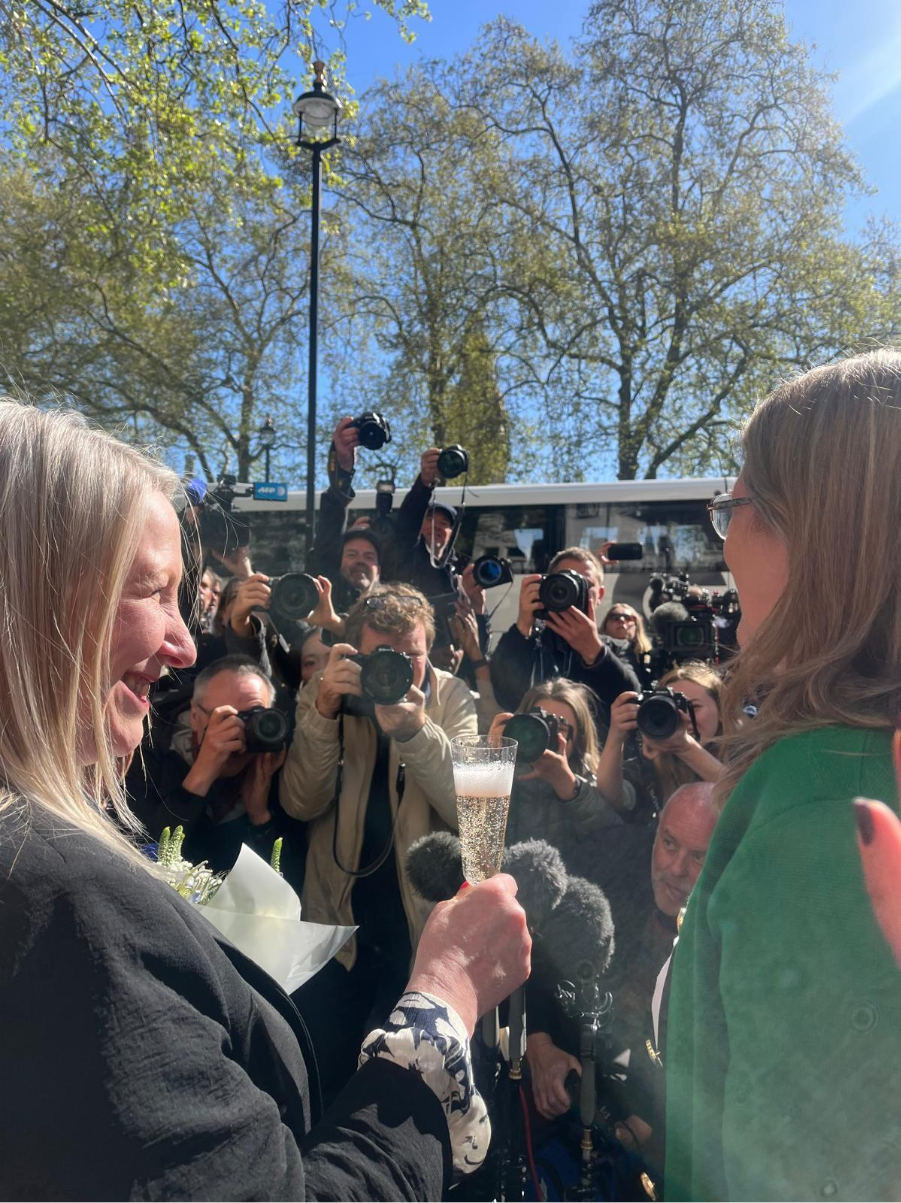
There was quiet. A small pause that follows when something obvious is finally spoken aloud. Then comes the familiar tactics: the three D’s: delay, deflection, denial.
Dragging Their Feet
When the Supreme Court clarified the meaning of sex under the Equality Act, Labour was already in government. The ruling arrived on their watch. Ministers acknowledged it, but did not mandate compliance. Instead, implementation was deferred to guidance and consultation, leaving public bodies free to delay or ignore its implications.
Across the UK, evasion hardened into policy. Employers continued to follow guidance written before the ruling. The Equality and Human Rights Commission, which should have issued a clear directive, opened a consultation instead and then extended it. Bridget Phillipson, Minister for Women and Equalities, has still not published final guidance, citing pregnant women needing the loo while at the theatre and other utter nonsense. This delay speaks volumes.
Clarity should have triggered compliance. Instead, it created more space for avoidance. The legal spell had broken. But politically and culturally, the institutions were still pretending nothing had changed.
One of the first tests came at the BBC. The corporation faced immediate questions about whether it would revise its editorial guidance in light of the ruling. It did not. At Woman’s Hour, a programme that should centre women’s experiences, the contradictions only deepened. Coverage of sex and gender continues to generate formal complaints. Language remains evasive. Reporters speak of debate, of ‘culture wars’, where there is already legal clarity, and of complexity where the law had made things plain. Universities did not revise their policies, NHS trusts did not update their guidance, and the civil service carried on as before. Every day that passed without compliance was a decision; every policy left unchanged was a statement that institutions would wait this out, would delay until the pressure eases, would hope that if they do nothing long enough, everyone will forget that the law changed at all.
Meanwhile, nothing changed in practice. Across the devolved nations, the ruling created no apparent shift. In Scotland, John Swinney’s SNP maintained that this was an administrative issue, something to be reviewed, not overturned. NHS boards, local councils, and universities were not instructed to change course. In Wales, ministers issued general statements about inclusion and moved on. Northern Ireland, where I live, exposed the problem in its most distilled form: not because the ruling did not apply, but because its tangled legal and constitutional landscape offered yet another excuse for inaction. The Windsor Framework, sold as a pragmatic solution to instability, added another layer of confusion to an already fragile system. While sex discrimination law remained broadly aligned with Great Britain, public bodies became increasingly adept at invoking jurisdictional complexity as a reason to do nothing.
What united all four nations was not policy coherence but avoidance. Each administration has its own language, its own justifications, its own pressures, but the effect is the same. The Supreme Court had spoken, and no one wanted to be the first to act on it. Labour’s refusal to lead at Westminster gave cover to every devolved government to delay, defer, and dissemble, while women navigated a legal landscape that existed largely on paper.
The cost of this falls on women. Hospitals continue to follow policies that erase sex in practice. Councils handle objections from women not as legal claims but as sensitive HR issues to be managed quietly. Employers insist that the ruling will be reflected in future guidance, eventually, when the time is right. Until then, we are told to sit on our hands and wait.
What this does is offload responsibility onto those least able to bear it. Women who asked for the law to be recognised found themselves isolated, forced into complaints procedures, grievance processes, and legal action to have their rights acknowledged. Legal fees run into tens of thousands. Sick leave and stress-related illness follow. Relationships strain under years of fighting institutions that should be on your side. Careers stall or end because you become known as difficult, as someone who raises concerns, as a woman who won’t let it go. There is the strange isolation of knowing that colleagues agree with you privately but will not say so publicly, and the exhaustion of explaining the same basic points over and over to people who have already decided not to hear you.
Meanwhile, Stonewall’s Diversity Champions scheme haemorrhaged members throughout 2025. No press releases. No explanations. Organisations that once proudly displayed their affiliation let it lapse. The framework that had once made it risky to speak about sex began to weaken: not because anyone stood up to it directly, but because institutions began to realise that the reputational and legal risk now pointed in the other direction.
In June, sport began to change. The Football Association announced that male players would no longer be eligible to participate in women’s football at any level in England, from grassroots to elite. It was a reversal of its previous position. Other governing bodies followed quickly, with little attempt to explain how they had defended the opposite for so long. What had once been framed as a moral imperative was now quietly dropped, as though the previous stance had never existed.
This did not happen because sporting institutions changed their minds. It happened because they couldn’t ignore what had become obvious: that male puberty confers permanent physical advantages, and inclusion policies based on identity alone were undermining fairness and safety.
For years, women and men had been saying this. The law caught up. The governing bodies followed, not with apology or reflection, but with quiet policy updates and a hope that no one would ask too many questions about the years in between.
The Women in the Front Lines
While some people spent the summer abroad, some of us were sitting in tribunal rooms. Annual leave now means attending hearings, reading bundles, and writing submissions. Lives put on hold to explain again why the law should be taken seriously.
In Darlington, eight nurses brought a case against County Durham and Darlington NHS Foundation Trust. They challenged a policy that allowed a male staff member, ‘Rose’ Henderson, to use the women’s changing rooms based on self-identification. The women who objected were not listened to. They were told to remove themselves. Their concerns were treated not as legitimate questions of privacy and safeguarding but as workplace disruptions to be managed.
The tribunal heard that dozens of women had raised concerns, that complaints had been made about Henderson’s behaviour, and that some women felt intimidated and distressed. None of it made a difference. Managers treated the women’s objections as a risk to be contained. In closing submissions, the nurses’ barrister described a system in which female staff were actively disadvantaged and penalised for objecting. The Trust’s defence was familiar by then: women asserting boundaries are portrayed as the problem. Male access to female space is treated as a default that cannot be questioned.
The same logic appeared in the case of Jennifer Melle, a senior nurse at St Helier Hospital. In May 2024, Melle referred to a male patient as ‘he’ and ‘Mr’ in a clinical context. The patient, a convicted paedophile transferred from a men’s prison, identified as a woman and overheard the exchange. He became aggressive, shouted racist abuse, and lunged at her while restrained.
Despite the behaviour, Melle was the one sanctioned. She received a final written warning. She was referred to the Nursing and Midwifery Council and investigated for professional misconduct. Her refusal to use female pronouns was treated as the problem. The context, the risk, the fact that the patient remained legally and medically male—none of it seemed to matter.
This is insane.
Maria Kelly’s case made the problem even plainer. She still works at Leonardo UK, a defence company in Edinburgh. When she learned that male colleagues were using the women’s toilets based on self-identification, she asked what the policy was. She did not confront anyone. She did not raise a complaint. She asked a question.
What followed were months of HR meetings and legal statements. She was repeatedly told that excluding males from the women’s toilets would be unlawful. The message was clear: stop asking.
Her tribunal took place in late September and early October, months after the Supreme Court had confirmed that sex in the Equality Act means biological sex, and the judgment went against her in early December. The tribunal concluded that being required to share toilets with men was not degrading, that women’s discomfort only matters if enough of them complain, and that because staff at Leonardo were vetted, there was no risk. The toilet access policy, the judge wrote, was a proportionate means of achieving an inclusive workplace environment.
Maria is appealing and is represented by Naomi Cunningham. Her case raises a fundamental question: whether a tribunal can disregard the Supreme Court when it finds the ruling inconvenient.
Maria personally supported me through my case. She is steady and generous. She knows the law. She understands the cost of insisting on it. And she chose to insist anyway.
My Ordeal
What follows is my experience of the process, not a judgment on the tribunal’s findings, which were still awaited at the time of writing.
By the time my own employment tribunal arrived, nothing about it felt abstract or theoretical anymore. Everything that had unfolded since the Supreme Court ruling—the delays, the evasions, the institutional refusals to act—collapsed into something immediate and bodily.
The previous years had already been consumed by it, but the hearing itself took over completely. Two whole weeks of my life disappeared into that room. Nothing else could coexist alongside it. Sleep and appetite went first. Family life, work, ordinary routines—all slid to the margins. The days were filled with witness statements and bundles and email trails, with the constant replaying of conversations I thought I had finished with long ago.
There was a particular kind of disorientation in listening to distorted versions of events being described as settled fact. Hearing my own conduct reshaped into a story I barely recognised, and watching that version being treated as credible, not because it made sense, but because it fit a pre-existing idea of what a woman like me was supposed to be. Alongside the formal evidence came a stream of complaints from people I had never worked with, never spoken to, never met. Their statements were treated as meaningful even when they described no actual contact with me. One complaint came from a trans-identified male who wrote at length about my character and my alleged motivations. The email contained no direct allegation of misconduct, just the assertion that my refusal to prioritise gender identity over sex was evidence of prejudice. It ended tellingly with the phrase ‘Hope this helps.’
There were more complaints from others who are ideologically aligned. Lola Petticrew, who identifies as non-binary and appears in Say Nothing, filed one. Her male fiancé did too. Friends of hers added theirs. None of them witnessed any events relevant to the case. None described behaviour or interaction. What they provided was an interpretation. Their words were treated as evidence, not because they showed anything factual but because they were numerous and unanimous. Volume stood in for proximity. Alignment stood in for truth.
Running parallel to this was the effort to cast me as politically suspect. The phrase ‘far right’ was not used as a description. It was a signal. It said that my position should be dismissed without engagement. That it was not worthy of debate. That no serious person should have to answer it on the merits.
I was compared to Sarah Palin, a ‘moose-hunter’. I was compared to an armed dissident. The act of stating that women have the right to sex-based boundaries was treated as a threat in itself. The comparison came from the author, Laurence McKeown, who collapsed the distinction between speech and violence, between belief and insurgency. He compared women like me to armed dissidents, not metaphorically but literally.
In one of the more surreal moments, the documentary filmmaker, Mark Cousins, explained feminism to my barrister, Naomi Cunningham. He spoke under oath. He told her what women’s rights are supposed to mean. He told her why women’s rights do not include the right to exclude male bodies from female spaces. Men were there to decide the boundaries. The system was comfortable with this. The same logic runs through the Leonardo judgment, where women’s discomfort doesn’t matter unless enough of them complain, and through the NHS Fife judgment, where harassment can be found and harm acknowledged, but the policy that caused it is allowed to stand, and through Jennifer Melle’s case, where a male prisoner who lunged at a nurse is protected by policy. In contrast, the nurse who called him male is sanctioned. The law is being rewritten in real time by people who have decided that sex-based rights are negotiable, conditional, and less important than the feelings of men who identify as women.
These two weeks made something clear: this system is not designed to punish extremism. It is intended to punish refusal. Refusal to speak in the approved way. Refusal to affirm what you do not believe. Refusal to accept that sex does not matter. Refusal to lie. That is the breach. The cost of that breach is not symbolic. It is time, money, health, and reputation. It is the steady erosion of trust in the institutions that once told you they were here to protect you.
Nick Wallis covered the case. He sat through the hearings, took notes, and live-tweeted what happened. For a journalist who exposed one of the biggest miscarriages of justice in British history, the Post Office Scandal, for him to treat this as a story worth his time meant something. It meant this wasn’t just a workplace dispute.
What made it bearable was the representation I received. Without lawyers willing to take these cases seriously, without incredible women like Naomi Cunningham and Dr Charlotte Elves, most women would go through this entirely alone. They understand the law. They understand the stakes. They do not treat sex-based rights as a legal technicality. They understand why this matters, and the two of them make it possible to stay upright in a system that punishes you for doing just that.
Sandie Peggie
The most disturbing illustration of institutional failure remains Sandie Peggie v NHS Fife. The tribunal found that NHS Fife harassed Sandie in the way it handled her concerns about sharing a female changing room with a male doctor who identifies as a woman. This finding alone should have prompted serious reflection, even reform. It is not a marginal conclusion. It is an acknowledgement of real harm.
But the rest of the judgment tied itself in knots. The tribunal admitted that Sandie was mistreated. It acknowledged that she was put in a position that undermined her privacy and dignity. And then, in the same document, it undermined the meaning of sex-based boundaries. It introduced the phrase ‘not inherently unlawful’ as a way to avoid saying what was obvious. It misquoted case law so severely that a Certificate of Correction had to be issued.
Thankfully, Sandie and her team are appealing. The appeal is being led by Ben Cooper KC, with Naomi Cunningham and Dr Charlotte Elves on her legal team. This matters far beyond her own case. It asks whether sex-based rights in the workplace are real or rhetorical. Whether a tribunal can find harassment, admit harm, and still offer no protection. Whether an institution can violate dignity and get away with it by claiming it was trying to be inclusive.
I was there when the appeal was announced. What I remember was the quiet seriousness. Sandie stood calmly, supported by her family. Her husband, Darren, and her family were steady and protective. Her solicitor, Margaret Gribbon, was clear and focused. They didn’t posture or dramatise. They understood what was at stake, and they carried it without spectacle. I saw how Sandie shook, talking about her dad, who passed away two days before the tribunal began. He was unbelievably proud of the strong daughter he raised.
There was no desire for headlines. This was about something far more basic: that the law should mean something in practice, that women should not have to choose between employment and dignity, that boundaries are not bigotry, and that safeguarding should not be treated as cruelty.
Sandie’s case has exposed the system. A woman can win a finding of mistreatment and still be left unprotected. She can go through every step correctly, every channel, every formality, and still be told that her concerns are less important than someone else’s identity. That harm can be acknowledged without a remedy. That the law might be on her side, but the system is not.
Good, Bad, and Ugly Episodes
In August, Harriet Haynes, a male pool player with a Gender Recognition Certificate, sued the English Blackball Pool Federation for excluding him from women’s competitions. The court dismissed the claim. It ruled that the exclusion was based on biological sex and was the only reasonable way to ensure fair competition. It was the first time a court applied the Supreme Court’s clarification directly to a discrimination case. And it held. The judgment was not abstract. It had practical force. The law was not a theory. It could be used.
In Surrey, Stephen Ireland, a co-founder of Pride in Surrey, was convicted at Guildford Crown Court of serious child sexual offences involving a 12-year-old boy. Another volunteer with the organisation, David Sutton, was convicted of crimes involving indecent images and extreme pornography. Surrey Police described Ireland as a sexual predator. Pride in Surrey collapsed. Julie Bindel’s podcast covers this in incredible detail.
By this point in the year, more Pride events began to fold quietly across the UK. Many lost funding. Some lost volunteers. Some splintered. Some stopped. I used to support Pride. Many of us did. It once stood for something recognisable. It had edges and a shape. It was about rights, dignity, and protection. But something changed once Dentons had their grip on it. What has come to dominate under the banner of TQIA+ ideology is not the same movement. It turns every issue into a loyalty test. And one of the first things lost in any loyalty test is safeguarding.
Medicine moves faster than politics, although not fast enough to prevent serious and lasting harm. By 2025, the Cass Review can no longer be dismissed as marginal or disputed. Routine prescribing of puberty blockers for under-18s stops across the NHS. The language around treatment shifts. Certainty evaporates. Those who once spoke with total confidence hedge, rephrase, or fall silent.
What remains indefensible is the conduct of the unions and professional bodies that claim to speak for staff and patients. The BMA is central to this failure, but it is not alone. UNISON, the RCN, and other health-sector unions line up behind a political narrative and treat dissent as misconduct. Instead of defending evidence-based medicine and safeguarding, they issue statements, pass motions, and apply pressure designed to close down debate. Legitimate clinical concern is reframed as bigotry. Risk is minimised. Harm is denied.
I have supported trade unions for most of my adult life. I believe in collective protection, solidarity, and the idea that workers are stronger together. But many of us women can no longer recognise ourselves in these institutions. They are increasingly ruled by men and their ideological handmaidens, insulated from the women they claim to represent, hostile to scrutiny, and contemptuous of dissent. They no longer act as a counterweight to power but as its enforcers. When unions side with dogma over evidence and silence women who raise safeguarding concerns, they forfeit the trust they were built on. The damage does not stop at credibility. It lands on children, patients, and clinicians who are left unprotected while institutions congratulate themselves for being on the right side of history.
The shift has been quiet but real. Clinics that previously operated under an affirmation model slowed down. Pathways were revised. Safeguarding became more visible in official statements. But even in this environment, new attempts are being made to restart the same practices under different names, and this even though Sweden, Finland, and Norway have all restricted or banned the use of puberty blockers for minors after their own reviews found the evidence base weak or non-existent. These are countries that led the way in ‘gender-affirming care’, and they pulled back not because of political pressure but because the medical evidence does not support what was being done to children. The UK should be learning from it, but institutions here are looking for ways to continue.
The PATHWAYS puberty blocker trial was announced, funded to the tune of £10.5 million. It has been framed as ethical research. It proposes to restart the use of puberty blockers for 226 children under controlled conditions. It is presented as cautious and scientific. But the fundamentals have not changed. These are children under 16. After an FOI, Emma Hilton discovered this is also a rolling programme.
The long-term risks are not unknown. They are known to be profound. The loss of bone density. The disruption of normal sexual development. The potential impact on fertility and brain maturation. These are not speculative. They are documented. Calling it research does not resolve the ethical problem. You cannot ethically experiment on children by halting a developmental process that happens once in a lifetime. You cannot obtain informed consent for outcomes that a child cannot fully understand.
Genspect is clear about this: not one child should be put on a puberty blocker trial. Not one.
The Health Secretary, Wes Streeting, expressed discomfort. That dissonance became familiar. Ministers spoke with caution, but institutions continued as if the warnings were optional. Medicine has adjusted its language, but not always its practice.
In September, five months after the Supreme Court ruling, Graham Linehan was arrested at Heathrow Airport on suspicion of inciting violence over posts about trans ideology. The details of the posts were not especially relevant here, and in any case, the Crown Prosecution Service concluded that there was no realistic prospect of conviction. The case was dropped.
What mattered was not his reputation or his tone. This was not about whether people found him likable or abrasive. What mattered was the reflex. He was arrested at an international airport over speech about sex and gender, months after the highest court in the country had clarified the legal definition of sex. The law was settled. The court had spoken. And yet here was a case in which formal police powers were deployed first, with justification examined later, if at all.
The arrest is not an isolated incident. It is part of a wider pattern: one in which speech about sex and gender was policed more aggressively than speech about almost any other subject. The assumption, whether explicit or unspoken, was that disagreement was dangerous, that dissent had to be managed, that some topics were not just sensitive but off limits. It created a chilling effect. People saw what happened when someone prominent was arrested, even briefly, and drew the obvious conclusion: better to say nothing.
Legal clarity did not immediately change institutional culture. It did not reverse years of internal training, policy writing, and HR guidance that treated sex-based language as suspect and gender identity as untouchable. Police forces, like many other public bodies, had adopted frameworks rooted in ideological assumptions rather than legal obligations. Even after the Supreme Court ruling, those assumptions persisted and continued to shape decisions.
By the end of 2025, the impact of the Supreme Court judgment began to reach organisations that explicitly identify as women’s organisations. Girlguiding announced that trans girls and young women would no longer be eligible to join as new members. The Women’s Institute followed soon after, stating that it would no longer accept trans women as members from April 2026. Both organisations presented the decisions as necessary responses to the legal landscape. Both stopped short of defending the principle of female-only spaces outright. Their language was apologetic. But the change happened.
The shift has not come from political pressure or activist campaigning. It came from the fact that they were now legally exposed. For years, they operated under assumptions that were never formally tested. Now they were. And the law was clear. They adjusted because they had to.
Sex Matters brought a legal challenge concerning the Ladies’ Pond on Hampstead Heath. It is a voluntary, non-competitive female-only swimming space. The Corporation of London said it was reviewing policies in response to the Supreme Court ruling. But the public reaction showed how contested even a small female boundary remains. The backlash was immediate and aggressive. It was not about the specific site. It was about the idea that any space should be reserved for women based on sex. That principle continued to provoke outrage even when the law supported it.
In sport, the change became more visible. World Aquatics strengthened its policies protecting the female category. British Swimming followed. The Football Association had already moved in June. British Cycling implemented new rules. England Hockey updated its policy in September. Rugby authorities restricted the female category on safety grounds. Lord Coe continued to defend World Athletics’ policy on the international stage.Statements that were once seen as provocative became routine. It was no longer controversial to say that male puberty confers advantages that cannot be undone. It was no longer dismissed as unscientific or hostile. Governing bodies said it plainly. The debate moved, not because the facts changed but because institutions were forced to act on them.
None of this happens by accident. It doesn’t come from goodwill. It does not result from persuasion. It stems from persistence, legal pressure, and women refusing to stop. It happens because people kept going long after it would have been easier to give up.
None of this happens without resistance. The case brought by Maya Forstater establishes that gender-critical beliefs are protected under the Equality Act. That ruling becomes a foundation for many others. It does not resolve every issue, but it makes it harder for employers to pretend that belief in biological sex is inherently hateful or beyond the limits of respectable opinion. It creates room to stand.
Politicians have started to speak more plainly. Not always loudly, and not always early. But over time, positions that were once attacked were quietly adopted. The tone is flat. But the words are repeated. The legal framework becomes harder to deny.
In the media, SEEN in Journalism becomes a reference point. It refuses to participate in the soft professional gaslighting that so many women face. It records what is happening. It names what others are encouraged to blur. In the arts, Freedom in the Arts does the same. It documents what happens when institutions decide that certain views make you unhireable, unwelcome, or unmentionable. It treats cancellation not as gossip but as a method, not as drama but as enforcement.
Some of the women who were punished earliest are now being quietly vindicated. Rosie Duffield was treated as a problem to be managed, an inconvenience to be isolated, a woman to be worn down until she stopped speaking. Nothing she said has been disproved. What has changed is not the truth of her position, but the willingness of institutions to keep pretending it was indefensible. The cost she paid was real. The apology will never come.
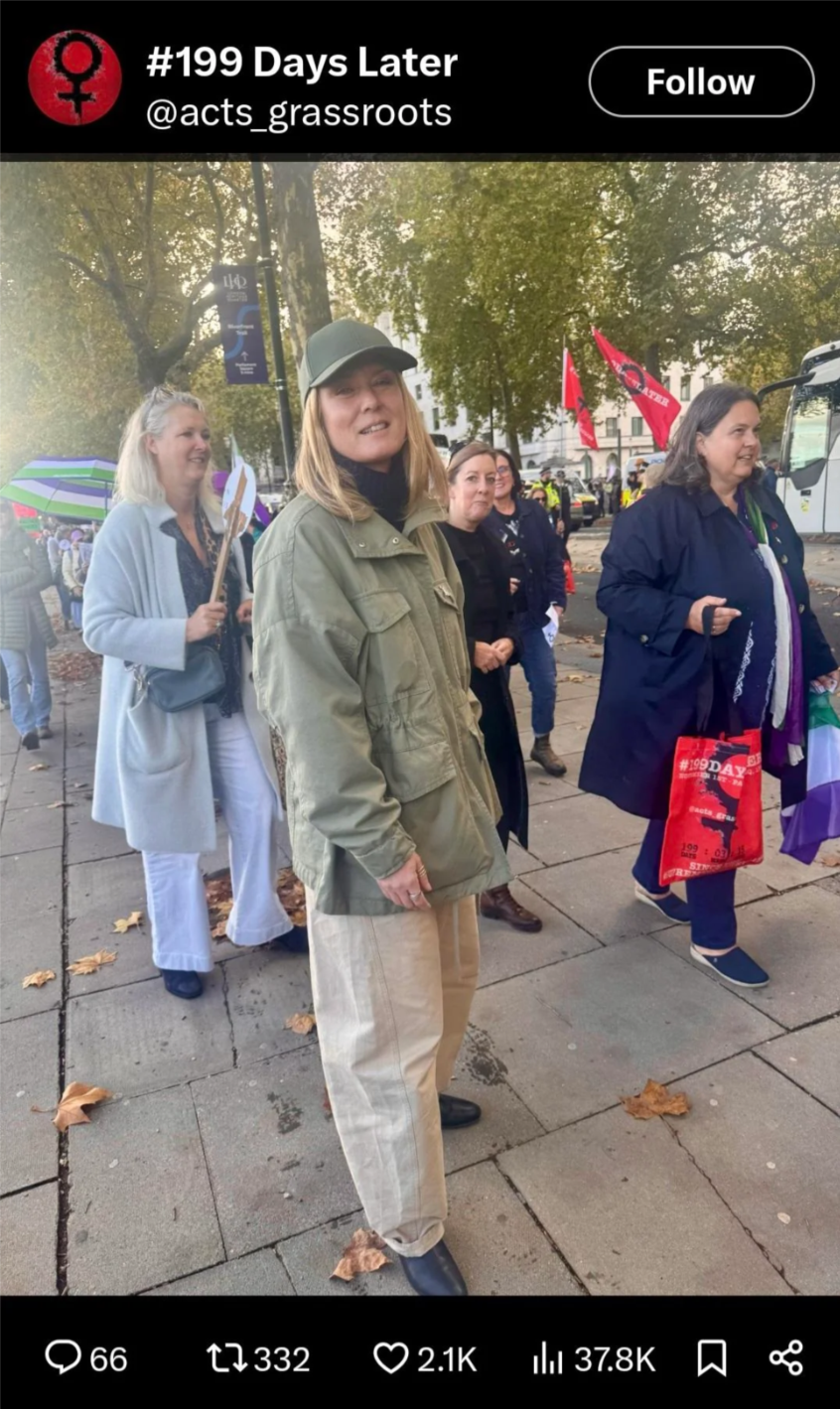
I felt this shift in a specific moment. Róisín Murphy, who had faced industry backlash for stating the reality of biological sex, appeared quietly at 199 Days, the protest marking the number of days since the Supreme Court ruling. She did not arrive with the press. She didn’t perform. She just showed up. She was one of us. In a culture where silence has become the default, physical presence means something. Solidarity is not abstract. It is a body standing beside you.
There have been rallies outside courtrooms, outside Parliament, in quiet streets and crowded stations. Women stand in the cold with thermos flasks and handmade signs. They share train journeys, courtroom galleries, and waiting rooms. They exchange case law and tea. They explain what happened to them. They offer advice and shelter. They laugh in disbelief. They cry in private. They come back. Again and again, they come back.
By the end of 2025, a woman’s ability to rely on sex-based protections depends less on the law than on her postcode, her employer, and her willingness to risk professional ruin. The law is clear. The system is fragmented. Compliance is uneven. Enforcement is rare. Institutional courage remains in short supply. Equality before the law is looking threadbare.
And yet that fragmentation makes something else visible. It reveals in detail that the problem was never legal uncertainty. It is political will. Where institutions want to act, they find a way. Where they do not, they find reasons to wait.
What 2025 changed was not public consensus, not institutional accountability (at least not yet). What changed was certainty. The law stopped pretending. Medicine slowed down. Some institutions began to hesitate. And in that hesitation, space opened up.
The spell does not break because power concedes. It breaks because reality refuses to cooperate. Because women and men continue to say what we know to be true. We do not stop. Because we are still here.
This year has not delivered closure. It hasn’t restored trust or repaired the damage done. But it made one thing impossible to ignore: the institutions are not coming to save us. They have shown us, over and over, that they will yield only when forced to. That is not cynicism. It is clarity.
So we insist. We persist. We insist that sex matters. We insist that safeguarding is not hate. We insist that women do not need permission to speak about our lives. We insist that reality cannot be rewritten to spare institutional embarrassment.
Keep going. Keep telling the truth. Maria Kelly’s appeal will test whether a tribunal can ignore the Supreme Court, and Sandie Peggie’s appeal will ask whether harassment findings mean anything if the harassing policy is allowed to stand. More women will bring cases. More institutions will be forced to choose between the law and their ideology. The pressure must be maintained, the questions must keep being asked, the costs must keep being counted and published, and the women who are punished must not be left to fight alone. The law is clear, and the fight now is to make institutions obey it.
They can drag their feet. But we are already walking.
Sara Morrison is the Director of Genspect UK and Ireland