




Manufacturing Consensus: How Corporations Shape Cultural Norms
By Genspect
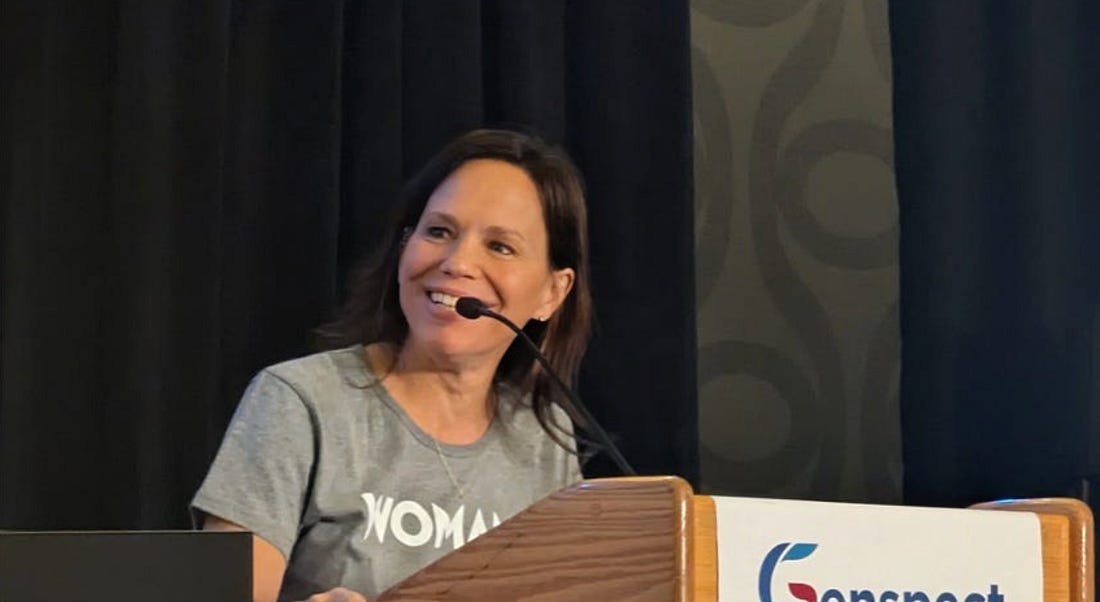
If you don’t know me, I’ll give you the 2 minutes of background before I start. I was an internationally competitive gymnast in the 80s, and the 1986 national champion. I left the sport battered and broken, but soldiered on. I went to college at that place in Palo Alto. Then I moved to San Francisco afterwards. I lived there for about 35 years. I was a left-of-center Democrat until I wasn’t.
After college, I became a fashion executive. I worked at Levi’s for 23 years. I went all the way up the ladder. And then I got myself cancelled for being a COVID dissident. During my time at Levi’s, I also wrote a book and a movie about abuse in sports. I was the first gymnast to talk about it nearly 20 years ago. Then, after being fully cancelled for my COVID dissenting ways in 2022, I launched XX-XY Athletics, the only brand standing up for women’s sports.
Yes, cancellation is real. I am not allowed anywhere near a corporate boardroom or even an interview at an established company or a conference with corporate executives. I’m evil. I love it. I’ve come to embrace it.
Yes, I know, sports are the tip of the spear with the “gender issue.” It is not the whole story. And people get mad at me on our side because they think I’m too focused on sports. But I’m a marketer, and I know how to drive awareness and brand affinity, and we need to stay focused to do that. So, I’m focused on this issue in our messaging.
Sports are the very public expression of gender crazy, and we had an inciting event at the 2022 NCAA swim finals that alerted people to the problem. We have a brilliant, charismatic spokesperson in Riley Gaines, who speaks in plain language and says what is real. This inciting incident mobilized people. And Riley activated it.
And when the lie that underpins the whole sports thing crumbles, it all falls like a house of cards. That lie: that anyone can switch sexes. That there is no difference between male and female bodies. That men can be women if they just say they are. When that goes because of sports, the whole thing shatters.
Ok, that’s me.
I’m a bit of a fish out of water here. I’m not a doctor, a therapist, or an academic. I’m a business person—a brand builder. I’m a capitalist with no advanced degrees. The horror!
So why am I here? I mean, who cares what some brand lady says, right? Here’s what I want to talk about:
THE INEXTRICABLE LINK BETWEEN COMMERCE AND CULTURE.
Culture and societal trends shape business strategy. That’s how you get woke capitalism, which I’m going to skip over mostly. You can buy my book if you want to know my thoughts on that.
But sometimes, brands shape culture and what we believe.
When I was at Levi’s as the Chief Marketing Officer, I made it our mission to be at the center of culture. That’s when we were at our best and most loved.
When the brand fell out of cultural favor, out of the cultural spotlight, the business declined. And that is what had happened between 1998 and 2013. Enter me — as chief marketing officer.
At the time, I reminded my team that at Woodstock, people were either wearing Levi’s or nothing at all. During my 8-year run as CMO, that became true at Coachella as well. Because we made it true, it was no accident when Levi’s was at the center of culture again.
When the Berlin Wall fell in 1989, there were photographs taken of men atop the wall wearing Levi’s — a symbol of freedom and rugged individuality around the world, at the time. That was not product placement. That was reality.
When the brand was at its biggest and best in the mid-90s, “grunge” was all the rage — and its stars like Kurt Cobain wore Levi’s on stage. When the biggest and most influential original voices in music got on stage, they wore Levi’s. And so did their fans.
Sometimes the culture influences the direction that brands take. Brands are followers after all.
But sometimes brands contribute to driving the culture.
To overlook the inextricable link between culture and capitalism would be willful blindness. A brand leader ignoring this fact would be failing to utilize all of the tools at her disposal to make a brand relevant. And anyone attempting to influence culture would be remiss to ignore the role of brands. And other tools of culture.
This is my wheelhouse.
We need tools of culture on our side. That is well done, elevated, not cheesy, shitty merch, bad ads, and low-quality content.
Our movement needs strong brands. Without them, we are fighting a battle with both arms tied behind our backs.
Take note: It wasn’t until gay marriage became the law of the land that brands en masse started their rainbow stuff. Brands were following the culture here. But the brands and their rainbow t-shirts helped to cement support for gay marriage and LGB rights in the public consciousness.
Anyone wearing one of these tees was saying, “I’m on the right side of history.” Or thought they were.
Enter TQIA “rights,” and the culture has been ill-equipped to cite how this is any different than LGB equality.
All my “liberal” Gen X cohort views TQIA “rights” and LGB equality as exactly the same. And therefore view anyone who opposes “gender affirming care”, self-ID, or boys in girls’ sports as bigots akin to those who were against gay marriage. They want to continue to be on “the right side of history.”
Except they aren’t. It’s not the same. TQIA is demanding more than equality. They are demanding we bend reality to their will. And they demand that we take women’s rights away to offer what they say is equality — but is really more than equality — to boys and men.
They sterilize children in the name of medical care. They insist that “incorrect pronouns” as applied to mass shooters is bigotry. Or violence. They are so afraid of being called “transphobes” that they’ll fight for the right of convicted male sex offenders to be in women’s prisons. They’ve lost their minds. We know this.
But what if we made it cool to be on our team?
We need to wrest the culture back with the full force that it has been taken from us. We need legislation, yes. But politics and legislation are downstream from culture, and we ceded that more than a decade ago.
We need to train the public’s eye on the girls and women who lose safety, privacy, and fairness because boys enter their sports and spaces.
The activists demand that we look at the boys who are insisting that they are discriminated against. They want us to feel sorry for the boys, and only the boys.
But I want to elevate the stories of the girls. The ones who were injured, like Payton McNabb. The ones who lost races, medals, and trophies. The ones who had their privacy stolen. The ones who speak up at school board meetings across the country and lose friends when they do. I want to do for those girls what Nike did for Caster Semenya back in 2018.
XX-XY Athletics
This is why I started XX-XY Athletics. All of the athletic brands are either silent or on the wrong side of the issue of protecting women’s sports. They are absolute hypocrites in that they profit off of championing female athletes while not supporting them at all. Remember when Nike fired Allyson Felix because she was pregnant?
Inspecting Gender is a reader-supported publication. To receive new posts and support our work, consider becoming a free or paid subscriber.
Has a single brand spoken out about males in women’s sports? Except us? No. In fact, Nike promoted Caster Semenya with a series of ads back in 2018-2019. I’m not gonna play the ad, but I’m going to read you a few lines from it:
Would it be easier for you if I wasn’t so fast
Would it be simpler if I stopped winning
Would you be more comfortable if I was less proud.
No. It would be more comfortable if you competed in men’s, Caster. Because you’re a man. But then we’d have never heard of you because in the 2016 Olympics in your event (the 800 meters), which you won with a time of 1:55.28, the bronze medal in men’s was 10 seconds faster. In fact, the top 10 high school boys in the US were faster. The 10th place HS boy in this event beat you by more than 4 seconds. It is hard to say how deep into the high school field of boys we’d need to go to find someone who wouldn’t have beaten Semenya in the 2016 Olympics.
So that Nike ad hits different now.
To be clear: Nike, our issue isn’t that this male athlete is proud. It is that he demanded to compete in women’s sports, screamed sexism and racism when anyone pointed out that he has testicles and is violating a basic tenet of reality: if you have testicles, you’re a man.
Our issue is that you, Nike, spent tens of millions of dollars to cement the idea that Semenya is just a different kind of woman in the public’s consciousness and convinced everyday folks that anyone who argues is just a bigot. And in so doing, you manufactured consensus by ensuring that anyone who thinks, who knows — rightly so — that Semenya is a man, stays quiet.
In those same Olympics, in that same event, there was a podium sweep by three athletes who had DSDs. They were all men. Three men won three medals in the women’s 800 meters.
But it never happens right?
I know they aren’t “trans”, but it is relevant. Because the lie underneath it all is the same — you are what you say you are. If a man says he’s a woman, he is.
No.
Semenya is a man. Whether he admits that or not. There is video of him saying who cares if I have more testosterone!
We do! We care. Women care. You’re a man. Stay out of our sports.
But Nike decided to defend Semenya as just another kind of woman, and, in doing so, said outright that anyone who said otherwise was obviously a bigot and misogynist.
Nike is the biggest athletic company in the world. It is larger than the NFL and the NBA combined.
The press then carried the water of the sports behemoth even further. Here’s a few headlines about the Semenya ad:
- Semenya: Proving that believe in yourself pays off (no, being a man competing in women’s does)
- Nike Spotlight’s Semenya’s Rise! (no, Nike spotlights his gaslighting)
- Nike’s Latest Ad Features Another Athlete Taking a Stand. (you mean cheating?)
But just like that, the idea cemented in the broad culture was that anyone who says they are a woman is one. High testosterone? So what. All women are different!
Nike didn’t start this. But they certainly carried it forward into the culture. And they haven’t stopped since. Long gone are the days when they ran an ad in 2011 called “If you let me play” defending girls’ participation in sports by citing all of the benefits that come along with that — better self-esteem, better body image, less depression, higher likelihood to graduate from high school and to not get pregnant as a teenager.
Now Nike funds studies to get to the bottom of how much we can cripple young boys so that it might be considered kind of fair for them to compete in women’s sports. As if women and girls are just hampered boys and men. As if those boys’ whole bodies don’t matter.
Brands Influence Culture
Why are we letting the left use brands as a tool of culture and not fighting back with our own brands?
That’s where we come in.
We don’t have Nike budgets, but we have virality and popular opinion, and we’re feisty and not afraid to hit back. We’re athletes. And we’re not going to let other brands manufacture consensus and make the 80% too afraid to speak up.
We have to change the cultural conversation in addition to the laws. In fact, when we do that, the laws will change.
The last few months have seen a spate of brand/business intersection points. Cracker Barrel thought they were adhering to culture vibes by taking the old guy out of their logo and they learned quickly, the hard way, that they were not.
American Eagle Outfitters put a hot girl in jeans. And it worked. Crazy!
And Google admits they kicked people off their platform under pressure from the government during covid.
Culture meets commerce. Again.
So that’s why I do it. That is why we’re here.
I don’t care that some folks on our own side don’t think we have a place in this movement. That we’re too late or too focused on sports or any of it. Go away. I have a unique skillset and I’m going to use it to help build broad public support.
I am not a doctor or a lawyer or a therapist. I don’t know how to do that stuff. You guys do. But I do know that brands matter. Like it or not. Capitalist or not. Brands influence the culture. And I’m pretty good at it.
And I will not let the other side have all that influence without fighting back on the terms that they defined.
Let me end with a story.
I wear our clothes all the time around Denver. Obviously. Nine times out of 10 when I do, someone leans in to tell me that they agree with me. And just like that, the Overton Window widens. Sometimes though, they say the opposite.
About a year ago, my daughter was wearing our logo tee at her soccer practice. A mom who I had known for a few years approached me. Oh no, I thought. Here we go.
I was right. She opened with: I’m not sure if you know what that shirt means.
I do.
Well, it is very offensive.
I wanted to run away, but I knew I had to have the hard conversation like I tell other people to do.
I don’t think so, I care about girls and protecting their sports and spaces. Girls deserve safety and fairness.
She went on to spew all the tropes and clichés about genital checks, and some girls are different and more masculine, gender non-conforming girls will suffer.
I didn’t back down.
She relented, finally, unaccustomed to any push back. She said: Well, we both care about girls. I just care about all the girls.
I said, oh you mean the ones who are boys?
She decided it was of no use. I was intransigent. She ended with: I trust you’ll not have your daughter wear the shirt to practice anymore.
No, I’m not going to do that.
And that was that. And I went home and bought shirts for all the parents who agree with me that girls’ sports are for girls. And then handed them out at the next game.
They aren’t used to anyone pushing back. They wield their taglines, armed with emotional blackmail, and bully everyone into silence.
But we won’t comply.
Wear the shirt. Have the hard conversation. Do not let them bully you into silence.
Stand up.
Jennifer Sey is a retired U.S. National Champion gymnast, 7-time national team member, and 1986 All-Around Champion. She pioneered exposing gymnastics abuses in her 2008 memoir Chalked Up and the 2020 Emmy-winning Netflix documentary Athlete A. At Levi Strauss & Co. since 1999, she rose to Brand President and was named to Forbes’ Most Influential CMOs list. In 2020, she was the only C-suite executive opposing COVID lockdowns and school closures, detailed in her book Levi’s Unbuttoned. She resigned in 2022 and founded XX-XY Athletics, the only brand defending women’s sports.
Genspect publishes a variety of authors with different perspectives. Any opinions expressed in this article are the author’s and do not necessarily reflect Genspect’s official position. For more on Genspect, visit our FAQs.