




Is the “Supportive Environment” Driving Gender Medicalization?
By Hermes Postma
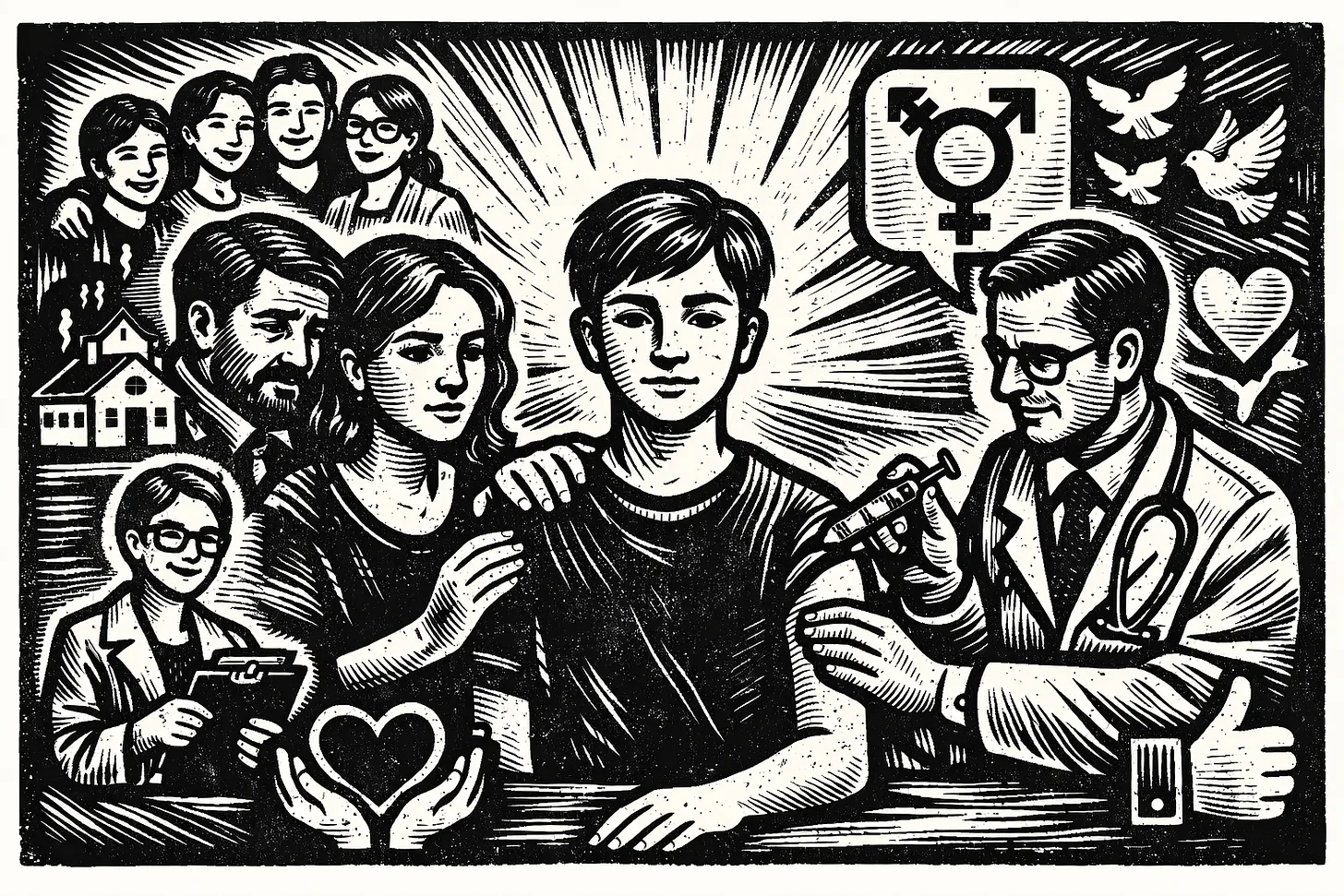
Hermes Postma writes about the “supportive environment” in the Dutch Protocol
In the debate surrounding medical transitions for adolescents with gender dysphoria, one question is often overshadowed by discussions about hormones, surgery, and desistance rates: what exactly is making the difference?
Is it the medical intervention itself — the puberty blockers, cross-sex hormones, and eventual surgeries — or is a large part of the reported positive outcomes attributable to something far less tangible: a supportive social environment?
The Dutch protocol, developed at the Amsterdam gender clinic (VU University Medical Center), has long served as the international gold standard for youth gender care. According to its own criteria, adolescents are only eligible for puberty suppression if they meet several conditions: they have experienced persistent gender dysphoria since childhood; they do not have any serious, interfering psychiatric problems; and they “live in a supportive environment”. This requirement is not presented as a nice bonus, but as a formal precondition. The protocol’s architects, including Annelou de Vries and Peggy Cohen-Kettenis, explicitly state that family and social support are necessary for the diagnostic process and treatment to proceed safely.
This makes intuitive sense. Gender dysphoria is deeply distressing, and transitioning — especially socially — often brings immediate relief when the young person feels seen, accepted, and affirmed by parents, peers, school, and therapists. The question is whether this social affirmation is merely a helpful backdrop or whether it is actually doing much of the therapeutic heavy lifting.
The Tension in Practice
In theory, a supportive environment serves as a protective factor. Loving gatekeepers who prevent young people from making rash decisions they might later regret. In practice, however, there are recurring reports — from parents and clinicians — of a different dynamic. When parents express hesitation, doubt, or concern about the speed or irreversibility of the medical pathway, these concerns are sometimes reframed not as legitimate caution but as something the parents themselves need to “work through” or overcome. The environment must be engineered to be supportive, rather than pausing treatment until families are genuinely convinced that it makes sense. This creates a subtle but important shift: instead of the medical team waiting for clear, stable family support, the team may actively work to generate or enforce that support as part of the process.
This blurring of lines raises a fundamental issue. If social acceptance is a formal requirement for starting an irreversible medical trajectory, then systematically downplaying or pathologizing parental caution undermines the very safeguard the protocol claims to uphold.
The Causality Problem
The more profound question is what actually produces the good outcomes? Studies from the Dutch clinic have shown improvements in psychological functioning after puberty suppression and later hormones. However, because virtually all participants received the treatment within a context of strong social affirmation and ongoing therapeutic support, it is extremely difficult to disentangle:
- The direct biological or neurological effects of the hormones themselves
- The relief that comes from social transition and being addressed in the desired gender
- The placebo-like effect of high expectations and hope
- The reduction in distress that occurs simply because the young person and family feel they are “doing something” and are supported in that choice
In short, is the body being changed to match the mind, or is the mind (and the distress) being profoundly influenced by the social environment that now fully affirms the new identity?
This is not a trivial philosophical point. For low-risk, fully reversible interventions, such uncertainty is acceptable. But puberty blockers followed by cross-sex hormones lead to permanent changes: infertility in many cases, loss of sexual function, altered bone density, and surgical alterations that cannot be undone. When the stakes are this high, attributing success primarily to the interventions when the social context does most of the work becomes ethically problematic. Informed consent requires a clear-eyed understanding of what is truly driving the improvement.
Critics of the Dutch approach (and of “gender-affirming care” more broadly) have pointed out that much of the evidence base suffers from this fundamental confounding effect. The original Dutch studies selected relatively stable, well-supported adolescents — precisely the group where social factors are likely to be protective. Newer, less carefully chosen cohorts show a dramatically different profile: more adolescent-onset cases (especially natal females), higher rates of autism, trauma, and mental health comorbidities. Whether the same protocol still “works” in the same way for this group is increasingly questioned, even by some of the original Dutch researchers.
What Are They Actually Doing?
So, to ask the blunt question: what are they actually doing in these clinics?
They are implementing a medical intervention (puberty suppression → hormones → surgery) under the explicit assumption that a supportive environment is present. At the same time, they often actively shape or demand that supportive environment as part of the treatment. The result is a powerful combination: biological alteration of the body + intensive social and psychological reinforcement of the new gender identity.
The successes observed may therefore be real for many patients — reduced dysphoria, better short-term mood, social integration — but it is likely the product of the interplay with social factors rather than the hormones alone. This does not mean the medical steps have zero effect. It does mean we should be far more humble and transparent about how much of the benefit is socially mediated.
Failing to make this distinction clear risks giving young people and their families an incomplete picture. They may believe the primary “cure” lies in altering the body, when a substantial part of the relief may come from the environment, as family members acquiesce to a young person’s demand to fully affirm the trans identity.
In medicine, especially when dealing with minors and irreversible interventions, intellectual honesty demands that we keep asking the hard question: Is the treatment working because we are changing the body, or because we (collectively) are changing the story the young person is allowed to live in?
Until that question is answered with better disentangled research — rather than poorly designed “before-and-after” studies — caution, genuine exploratory therapy, and a serious weighing of social versus medical factors are not signs of transphobia. They are signs of responsible, evidence-based medicine.
Genspect publishes a variety of authors with different perspectives. Any opinions expressed in this article are the author’s and do not necessarily reflect Genspect’s official position. For more on Genspect, visit our FAQs.