




Gender Ideology and the Breakdown of the Chain of Trust in Irish Education: Part 2
By An Cailín Ciúin

In Part 1 of this series, we explored extreme gender ideology being promoted by activists in Irish schools and showed the upward trend in numbers of Irish students experiencing both gender identity issues, and mental health issues. In this follow-up, we’ll examine activist influence and the lack of evidence underpinning a sex-education resource issued by the Irish Department of Health that promotes gender ideology to pre-pubescent children.
There is a chain of trust in education. Children believe what adults teach them and parents trust that schools will provide age-appropriate evidence-informed factual education to their children. This chain of trust has been broken.
Busy Bodies: Gender Ideology in a Booklet About Puberty
In 2020, the Health Service Executive (HSE, the Irish equivalent of the UK National Health Service) issued an updated version of Busy Bodies, a resource to support parents and teachers, providing information on puberty to children aged between eight and twelve years of age.
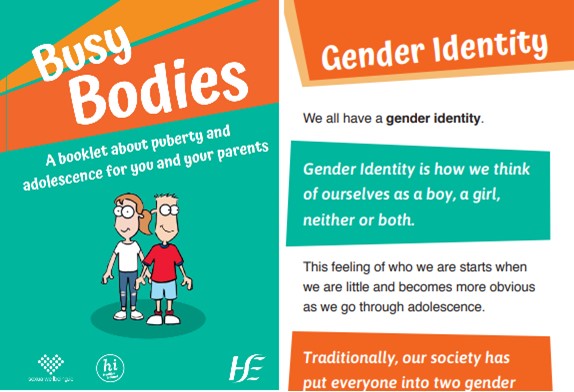
The updated version of Busy Bodies introduces a new chapter on gender identity. This new material teaches children that “we all have a gender identity”, that “gender identity is how we think of ourselves as a boy, a girl, neither or both” and that “[i]f a person has a deep sense that their gender identity is different from the gender they were given at birth, they may describe themselves as transgender”.This is all in a resource the HSE says was “designed to provide information on the physical and emotional changes that children may experience during puberty, to reassure them that puberty is a normal part of growing up”. Including ideology stated as fact in such a resource is not only grossly irresponsible, it is a breach of parents’ trust.
Identity formation is an important psychosocial stage of development for young people between twelve and twenty-five years old. Encouraging children between the ages of eight and twelve to ruminate about their identities before those identities have started to develop risks interfering in this natural part of growing up.
The content in this booklet, even to the layman, clearly encourages children to think deeply about how their sexed bodies align with how they feel inside. It prompts them to question their bodies at puberty, a confusing and challenging time for many young people. Busy Bodies (2020) instructs children to think of themselves as “a boy, a girl, neither or both” based on feelings in their head. Rather than encouraging children to appreciate and accept their healthy growing bodies in all of their diversity, these ideological statements suggest to children – many of whom will still believe in Santa Claus – that it is possible to opt in or out of being male or female. Busy Bodies is misleading children to believe that it is possible to be neither a boy or girl, or be both a boy and girl at the same time—it isn’t. Every child is either a boy or a girl.
Here are the facts these children should be taught: There is no right or wrong way to be a boy or a girl. All of us experience and express varying degrees of masculinity and femininity in a multitude of different ways. Sex is observed at birth, or even before. Humans cannot change sex, and sex is a significant factor affecting health throughout a person’s life.
Examining BelongTo’s Role in Busy Bodies
In 2023, a parent lodged a formal complaint about the introduction of gender ideology to Busy Bodies (2020). The HSE responded that Busy Bodies (2020) was developed in collaboration with an advisory group including stakeholders who “provided oversight and oversight from a range of perspectives”. Included in the advisory group was BelongTo, a non-government youth service organisation that promotes extreme gender ideology in Irish schools under the banner of anti-bullying.
Responses to Freedom of Information (FOI) requests show that the HSE’s draft wording on gender identity in Busy Bodies had initially included more factual information about sex and gender, but BelongTo proposed extensive wording changes. The ideological statements “we all have a gender identity” and “gender identity is how we think of ourselves as a boy, a girl, neither or both” were suggested by BelongTo.
The FOI revealed that when suggesting wording about gender identity for Busy Bodies (2020), a BelongTo representative commented that they were “Trying to keep is [sic] positive and not scary”. The BelongTo representative clearly knew that hearing about complex gender identity concepts could be scary for a child. An eight-year-old learning from Busy Bodies (2020) about the small number of people “whose bodies change in ways that don’t match your sense of self” might wonder, Could this happen to me? Could this happen to my friends? It is incredibly scary and distressing to feel alienated from your body, as anyone who has experienced gender dysphoria or body dysmorphia can attest. Unfortunately, no one in the advisory group acted upon this moment of insight to pause and proceed with caution before introducing these scary concepts into Busy Bodies.
The HSE’s response to the official complaint about Busy Bodies (2020) said that “approving the content involved a robust process of discussion and review.” The FOI revealed that the review was anything but “robust”. The HSE accepted BelongTo’s suggestions without question; furthermore, they failed to carry out any due diligence regarding evidence to support BelongTo’s ideological suggestions and the impact they could have on impressionable children.
Lack of Evidence to Support the introduction of Gender Ideology
The FOI shows that during the drafting of Busy Bodies, BelongTo cited All Together Now, a pilot programme for nine- to twelve-year-olds intended to tackle homophobic and transphobic bullying in schools and enhance pupils’ sense of belonging and self-esteem, as justification for some of the gender identity wording. BelongTo said that because All Together Now was produced by BelongTo “at the request of DES” (the Department of Education and Skills), “they are ok with the language”.
All Together Now was developed by three academics from Dublin City University (DCU) appointed by BelongTo, in collaboration with an Advisory Group involving BelongTo, and funded by the Department of Education. It was piloted in fourteen primary schools in Ireland in 2016, and this pilot was evaluated based only upon feedback from teachers and principals. There is no reliable evidence that All Together Now achieved its stated aim of enhancing pupils’ sense of belonging and self-esteem: no outcome measures were collected for the children who took part in the programme. This means that any benefits and harms of All Together Now for child participants are unknown. The Department of Education’s best practice guidance notes that well-intentioned programmes in schools to address serious issues such as suicide can have positive outcomes for some students, but can have unintended negative consequences for others. Research shows that even benign-sounding interventions like mindfulness in schools can have unintended negative impacts on the students most at risk of mental health issues, so the lack of student outcome measures for All Together Now is a significant omission.
Ethical approval for any research involving human participants—particularly research involving children who are classified as a vulnerable group from an ethics perspective—is a pre-requisite for academic research. The All Together Now Pilot report does not include any details of submission, review or approval of the All Together Now pilot study from a Research Ethics Committee. TUSLA, the Irish state agency responsible for child welfare, provide very strict guidance on the use of children as research participants. The All Together Now Pilot report stated that BelongTo, along with other members of the Advisory Group, were in favour of the ethically questionable approach of passive consent from parents for participation of their children in the programme. Passive consent is where parents sign a form to opt their child out, as opposed to active consent, where parents sign a form to opt their child in.
Despite lack of evidence of positive or negative outcomes for children and questionable ethics of the pilot, the Department of Education promotes All Together Now as an anti-bullying resource for Irish Primary schools, a further breach of parents’ trust.
The Role of International Organisations
In addition to following BelongTo’s lead, the HSE’s response to the official complaint about gender ideology in Busy Bodies (2020) was that “the information presented was compatible with the approach recommended by guidance from reputable organisations”. The HSE cited three documents: from the World Health Organisation (WHO), the United Nations Educational, Scientific and Cultural Organization (UNESCO), and the United Nations Population Fund (UNFPA).
The most recently published UN guidance document that the HSE cited was published in 2020 and claimed on the cover to be an “evidence-informed approach”. However, the section in the document on gender identity admits that “in the absence of extensive published literature … most of the recommendations in this section are based on interviews with transgender organizations and representative community members” (p. 35). This means that the guidance on gender identity is not evidence-informed, it is activist-informed.
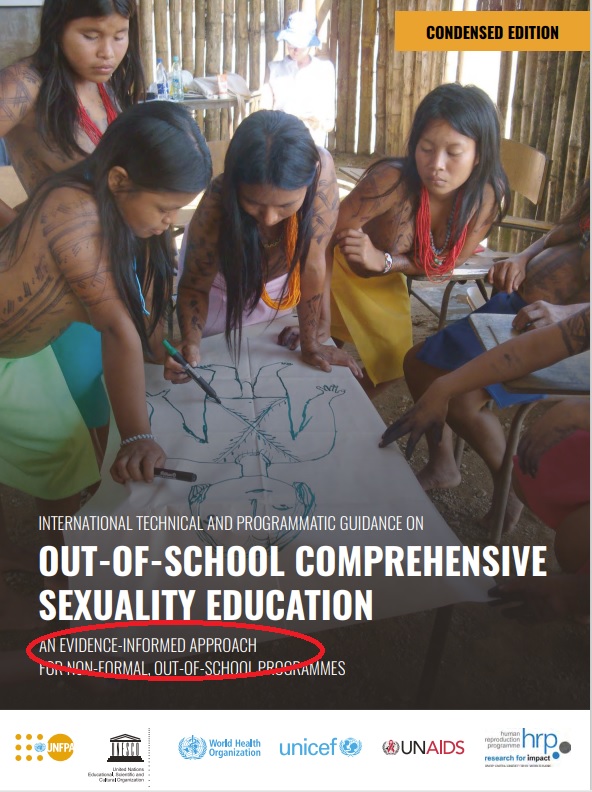
The lack of evidence and influence of activists is evident in some of the eyebrow-raising guidance in the UN document. For example, it suggests that those planning an education programme on gender identity should “use technology and social media, where possible and appropriate” as “some young transgender people already use technology and websites like YouTube for information on being transgender, transitioning etc.“.
YouTube is a notoriously unreliable source of information, and educators planning programmes on gender identity are not qualified to judge the validity, reliability, and safety of information about being transgender posted there. Moreover, children and young people are very susceptible to social influence; a recent study found a sudden increase of teenagers exhibiting symptoms of Tourette’s Syndrome after watching YouTube videos of a social media influencer who has Tourette’s. Viral videos from influencers describing their dissociative identity disorder (DID) on TikTok are believed to be a factor in an increase in adolescents presenting at mental health clinics with self-diagnosed DID. A study on adolescents who displayed sudden late-onset gender dysphoria found that 63% exhibited an increase in social media/internet use prior to disclosure of a transgender identity. At a time when we urgently need schools to be a source of factual information on sex and gender, those that follow this UN activist-informed guidance risk fuelling the spread of misinformation from social media.
Another recommendation in the UN guidance on sex education regarding gender identity is in direct conflict with the learning outcomes of “understanding and being able to explain human sexual reproduction” within the Irish National Council for Curriculum and Assessment (NCCA) science curricula for both primary and secondary schools. The UN document says “when talking about sexual and reproductive anatomy, label diagrams inclusively: Diagrams should not be labelled as male and female”. It is impossible for a child to understand and be able to explain human sexual reproduction without labelling diagrams as male and female. There is a reason they are known as the “facts of life”: they are biological facts.
As these examples illustrate, one of the key problems with recommendations “based on interviews with transgender organizations and representative community members” is that these organisations are only concerned about what they believe is in the best interests of the small minority group that they represent. Those beliefs, however, may not be in the best interests of the wider student body. It is unacceptable for Departments of Health or Education to develop guidance for all students that only considers the needs of a small minority group and does not consider impacts on the rest of the student population.
Responses to complaints to the HSE and the NCCA about Busy Bodies (2020) show that neither of these government bodies carried out any impact assessments prior to the introduction of gender ideology into Busy Bodies (2020). In fact, it does not appear that anyone in government with responsibility for Education or Health has ever carried out an impact assessment on the impact of the introduction of gender ideology to Irish schools and no-one in government is tracking outcomes of teaching this ideology. As Part 1 of this series showed, data are emerging that suggest that the spread of gender ideology into Irish schools is correlated with growing numbers of students who do not identify with their birth sex, who identify their gender identity as a major stressor, and who have poorer mental health than their peers.
The Irish Government’s Responsibility to Children and Parents
Irish parents have strong legal and constitutional rights regarding how their children are educated. Enshrined in article 42 of the Irish constitution is parents’ right to be the primary educators of their children. Furthermore, the Irish Education Act (1998) states that schools must consult with parents on the provision of health education and on the social and personal development of students.
A recent public consultation on changes to the Social, Personal and Health Education curriculum for twelve- to fifteen-year-olds reported Irish parents’ concerns about schools teaching gender ideology to their children: “the most common cause of concern related to references to gender identities within the draft specification. A number of parents … pointed out that gender identity is a highly contested and sensitive topic. Some assert that this topic should not be included in the curriculum, as they hold the view that it may lead to questioning, confusion and even harm for some adolescents” (p. 7).
This article has shown that there is no evidence demonstrating benefits of teaching gender ideology to children and there is emerging evidence of harm. The Irish government can no longer claim ignorance or abdicate responsibility to international organisations or to activist groups. Schools are not the only vector spreading gender ideology, but education is the one place where practical steps can be taken to stop the spread of ideological beliefs as facts. In short, here is what needs to happen:
- The Irish government must urgently issue guidance to schools to stop the teaching of unevidenced concepts relating to gender identity that seem to be contributing to growing gender confusion and distress in young people.
- The Irish government must commission independent research to develop an evidence-informed approach to teaching children how to navigate sex, gender and all aspects of their identity in a confusing modern world—an approach that maximises positive mental health outcomes and minimises negative mental health outcomes both for children experiencing distress relating to their gender and for the wider school community.
The time to act is now.
If you are an Irish parent concerned about the impact of the teaching of gender ideology on your child email info@genspect.org to learn more about our campaigns and events.
As an alternative to gender ideology, Genspect provides Guidance for Schools to help deal with issues of gender sensitively and equitably, without putting staff or students at undue risk.
Header image by Jackson Simmer on Unsplash