




Critique of JAMA article on the impact of media reports
By Jo Richardson

By JL Cederblom, an independent researcher, republished with permission.
This paper (Association of Media Coverage on Transgender Health With Referrals to Child and Adolescent Gender Identity Clinics in Sweden) is rather interesting. It was published a few days ago and made headlines right away, but I hadn’t read it until now.
It takes its format from a previous paper but looks at specifically the [Swedish investigative documentary] Trans Train report, and its impact on referrals.
However, right from the start things are strange. For everything negative you can say about Pang et al.’s competence, they did actually frame their data in fair temporal context. The Swedish paper does not do this at all, choosing to begin from 2017.
This is, of course, nonsensical – if you look at it in context (such as this report of incidence of diagnosed cases of F64 codes – it’s not entirely clear how this is applied in Sweden, and not directly referrals, but the trend is the point here) it becomes apparent what’s wrong.
No one of sound mind would look at those charts and say “looks like it’s going to be a steady ride from here on, let’s just write our paper based on that premise based on absolutely nothing”.
It’s not too common outside of this field to simply completely undermine a paper by slightly expanding the X-axis. I would be extremely embarrassed as the editor or reviewers of this paper.

Of course, the fundamental classification as “positive” or “negative” is nonsense. The reporting was accurate, which should be the important part. A medical journal publishing a piece encouraging writers to be less truthful is extremely concerning.
There is all sorts of silly little nonsense in the paper, besides the whole “all our premises are unsubstantiated speculation” thing, but my favorite is probably the final two paragraphs.
“We can’t draw conclusions, but it may indicate, therefore let’s draw conclusions where it indicates an association.”
How does one write something this self-defeating? Is it natural talent? Hard work? Are they malicious or genuinely spectacularly incompetent? Or both?
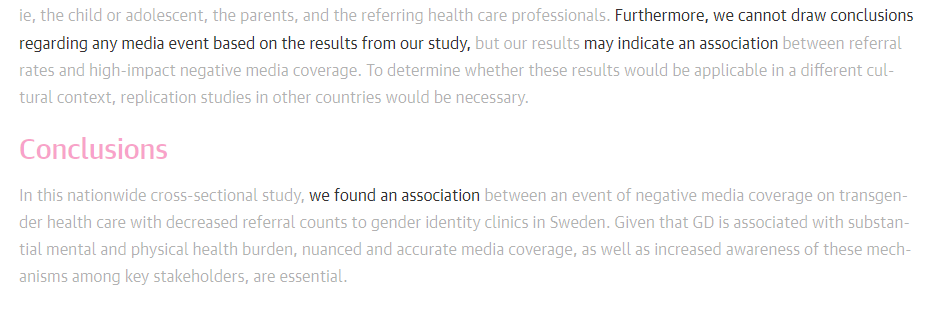
What did the reviewers comment on this? JAMA definitely needs to embrace open peer review. Whatever they did, they failed at their task. Or, more likely, they approve of this kind of blatant nonsense because they are fundamentally at odds with science.
What did the editor, Frederick Rivara, think when he approved this? Apparently their mission statement suggests they aim for the “dissemination of high-quality, innovative, general medical research and commentary.”
Where’s that Mission Accomplished banner when you need it?
The thing is that it’s not even good. It’s not well constructed pseudoscience. It has no merit, absolutely reeks of activism and anyone with any degree of familiarity with the issue can smell it a mile away.