




The Moral Collapse of the Transatlantic Elite
By Nancy McDermott

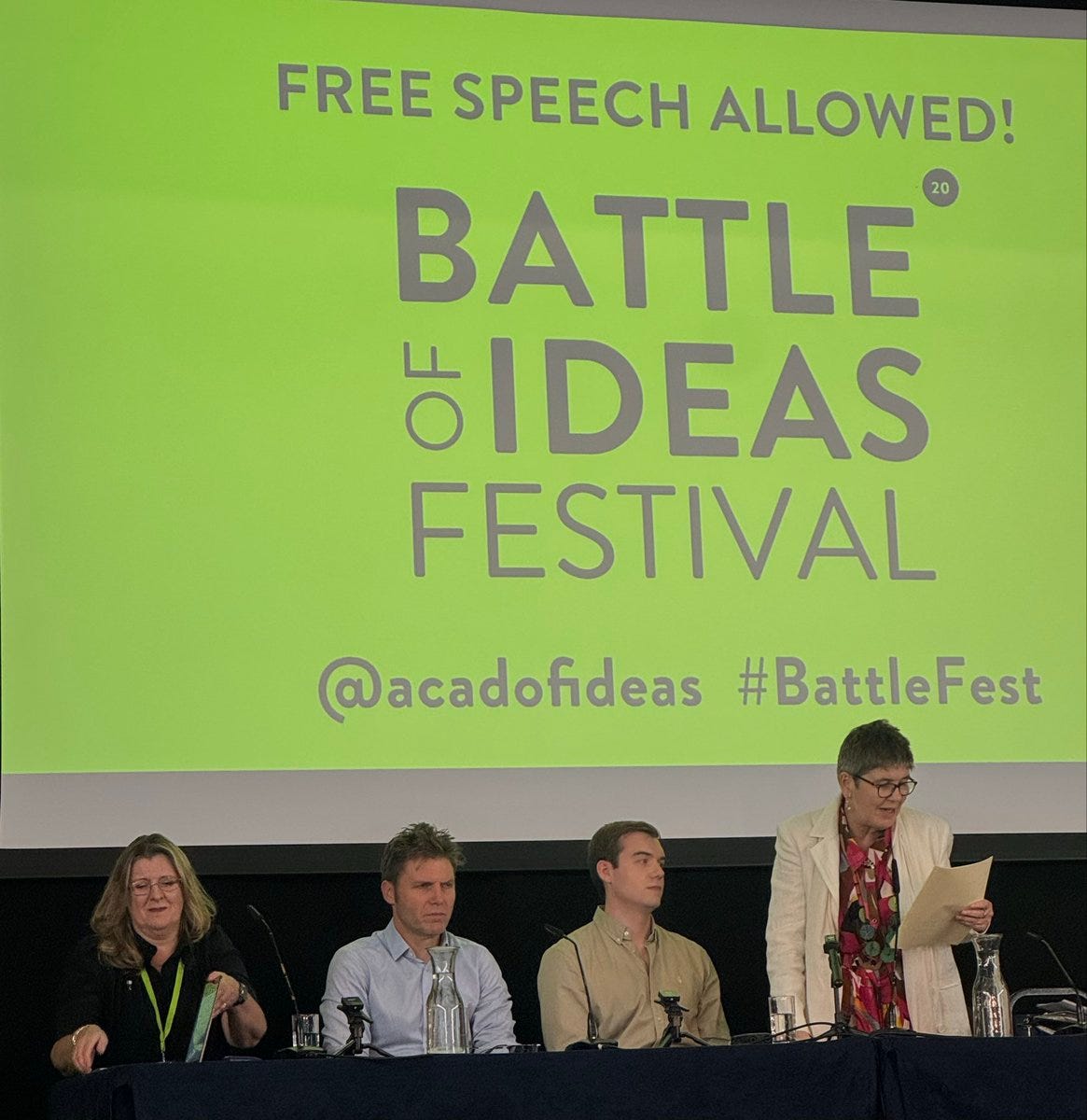
Genspect is getting back into the swing of things after the Battle of Ideas (BOI) in London. The event, taking place a few weeks after The Bigger Picture Conference, provided an opportunity to gauge the fightback against daft ideas on both sides of the Atlantic. The BOI was somewhat more relaxed than the Bigger Picture Conference — no one was going through a metal detector or glancing worriedly at the surrounding rooftops.
And yet, moving through the crowd, it was common to hear snatches of conversation or interviews in which people remarked on how relieved they were to be somewhere they could express their opinions freely, a hint of the ominous developments beyond the conference. There was the horrific attack against Manchester Synagogue coupled with pro-Hamas demonstrations in the heart of London, and the rise of the Orwellian “non-crime hate incident,” in which police swoop down on citizens for their use of hurtful words. Just as the assassination of Charlie Kirk had struck an ominous note in the run-up to the Albuquerque conference just a month earlier, there was an undercurrent of clear-eyed sobriety about the state of the world, coupled with determination.
The most striking common theme was the problem of elite accountability. Nowhere is this more apparent than in the press. In Britain as in the US, the press no longer acts as the Fourth Estate, a critical component of democracy, but as an arm of elite opinion. The most shocking example is the media’s attitude to a decades-long scandal of Pakistani Grooming gangs responsible for the rape and exploitation of thousands of young girls; police and councils buried reports to avoid “racism” charges. With the notable exception of Charlie Peters, the British press stayed quiet. It took Elon Musk’s intervention on X to shame politicians and the media into responding. The mainstream media in the US and the Irish Press have been similarly gaslighting regarding gender ideology and self-identity.
Given elite indifference to public concern, it is not surprising that there have been cascading policy failures regarding sex-based rights. It does not matter whether it is an official recommendation like the UK’s Cass Review or one of Trump’s executive orders; in the US, elites in government and other institutions look for a workaround.
This might take the form of continuing the use of puberty blockers and cross-sex hormones, as Dr. Eithan Haim, the Texas Children’s Hospital whistleblower, explained at the Bigger Picture Conference, or, as in the UK, through bureaucratic sleight of hand or the pretense that the puberty blocker study might magically become ethical. Indeed, even as Charlie Peters rehearsed the sorry history of official indifference to the Grooming Gangs scandal in Parker Morris Hall, elsewhere in Westminster, yet another official enquiry lurched toward oblivion as politicians scrambled to broaden it out in an attempt to avoid reckoning with the specific role played by Pakistani immigrants. We later learned in a Beyond TERF Island that the situation isn’t much better in Europe, according to Faika El-Nagashi of The Athena Forum, who explained on the Beyond TERF Island panel that bureaucrats intentionally mislead member states into believing that their policies must be trans-inclusive, or use their control over funding to make organizations comply.

How did we get here? Like the Bigger Picture conference, the question of changes in the broader culture was much on the minds of the organizers. The conference’s format, honed over two decades, provided ample space for discussion of topics such as the worrisome role of therapists in schools, the widening gulf between young men and women, and the inability to defend the nation’s foundational values and social mores. There were strands on education, women’s freedom, modern dilemmas, and more. Genspect USA’s Nancy McDermott spoke on the panel on Gentle Parenting v. Smacking, and Stella O’Malley was a panelist for No More Normal: Mental Health in an Age of Over-Diagnosis and Beyond TERF Island: gender identity worldwide sessions.
It is one thing to be critical of the slippage of things like freedom of speech when everyone assumes it is a good thing. It is another when institutions —from Parliament to the police —believe that speech must be curtailed in the name of kindness. At least in the US, foundational freedoms are enshrined in a written constitution for all to see, which may be one reason “lawfare” plays such an outsized role.
We have reached the moment in the story where the monster is revealed: the transatlantic elite. These were the people entrusted to run our institutions and the state, to look after our health, our children, our legacy. It is sobering to think that they aren’t capable of protecting children from grooming gangs, experimental medical procedures, or instilling a love of country, family, or the quiet virtues like tolerance and good faith that once held a civilization together. It is daunting, but if the Bigger Picture conference and the BOI proved anything, it was that ordinary people, once they see the pattern, can still refuse to look away.
We may be starting late, and we may face an uphill struggle against the hostility of ideologues, the dirty tricks of bureaucrats, the complacency of self-serving politicians, the collapse of the media, and the inertia of those who don’t want to know. But we are determined — and we’re just getting started.
Nancy McDermott is the Director of Genspect USA and the author of The Problem with Parenting