



Single Sex Toilets are No Joke
By Catherine Monaghan
This week Irish comedian Graham Linehan was arrested in the UK for tweets stating in no uncertain terms that men should not be in women’s spaces. It’s a position that many people agree with and that until recently wasn’t remotely controversial. The following tweet has been criticised for inciting violence:

If you remove the term “trans-identified”, I suspect most women have been given similar advice by their parents or partners: If you come across a man in a women-only space, he is likely a threat and shouldn’t be there. Make a scene, call the cops and if all else fails, punch him in the balls.
Single-sex spaces are essential in order for women and their dependents to be able to safely and freely navigate social life and society. We need to know we’ll have access to safe and private toilets, changing rooms, and hospital wards. Some unfortunate women will need access to women’s refuges, hostels, and prisons. Having been granted single-sex spaces most of us now take them for granted, but they are no longer a given.
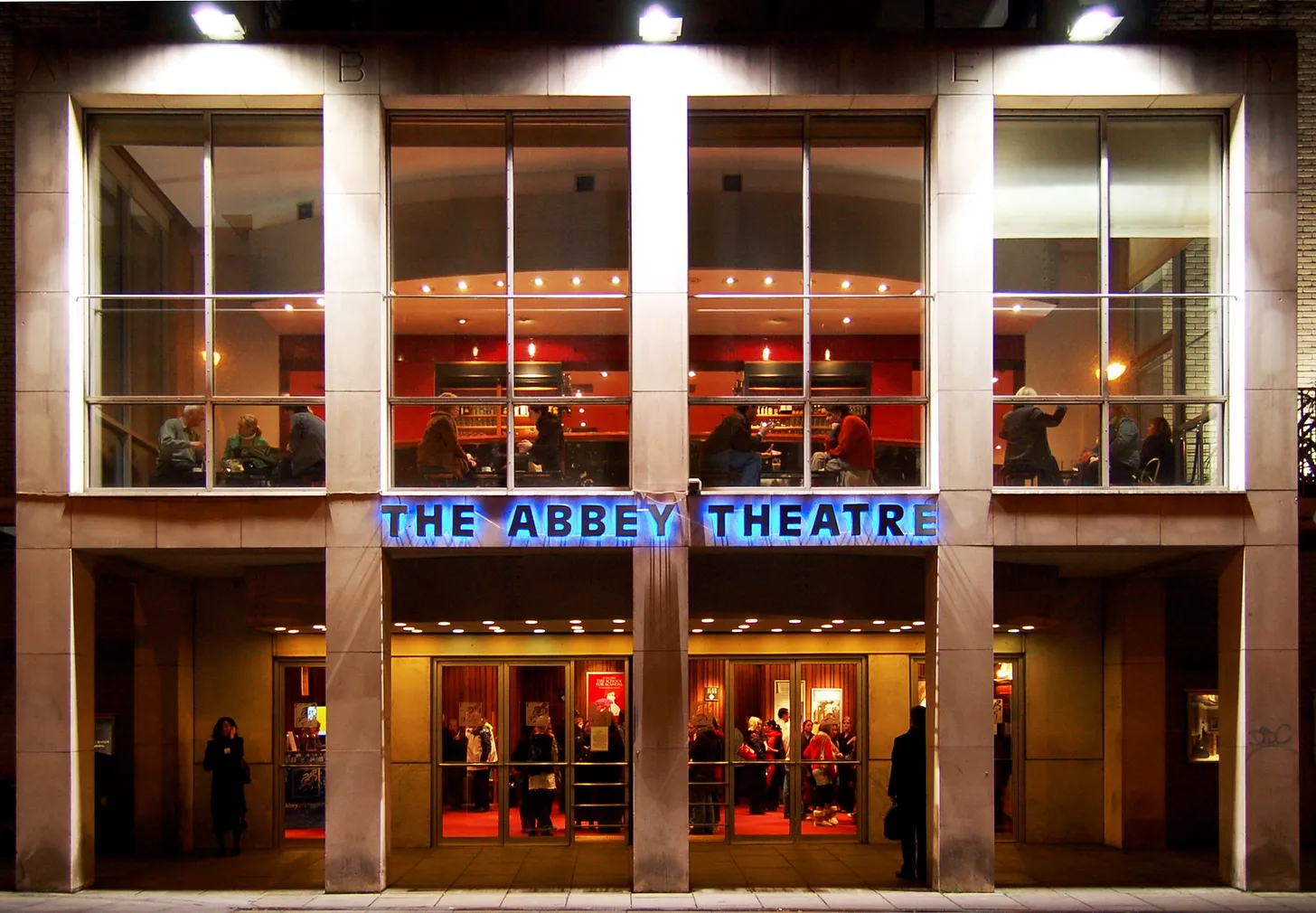
The commentary around the issue got me thinking about the time I attended a play at the Abbey Theatre in Dublin. The Abbey, Ireland’s national theatre, is a beautiful venue and partially funded by the taxpayer via the Arts Council of Ireland. The play was great, but I was unpleasantly surprised to find that the facilities were “gender-neutral”.
Free-for-all
There were three sets of toilets, all of which had several cubicles and one of which also had urinals. Standing in line for a cubicle, watching others join the queue, I spotted many a confused face presumably wondering if they’d come to the wrong place for some intermission relief. Some went back out to check the sign on the wall, only to return looking no less baffled. Nobody actually said anything, although there were a few raised eyebrows.
Why are all of the toilets in the Abbey gender-neutral? What does this achieve, and who does it appease? Most of us are aware on some level that to openly ask these questions is now a bit taboo.
And yet, we all know that there are very good reasons why women need women’s toilets. The same reasons that we needed them fifty years ago – safety, dignity, and privacy at a time when we are vulnerable – still exist today. Presumably those reasons will still exist fifty years from now.
Statistically, the overwhelming majority of sexual offences are carried out by men and the overwhelming majority of victims are women and girls. Most women do not want to put themselves or their children in a position where they might be isolated or exposed around a man they don’t know. This is just common sense.

#Not All Men
If it needs saying, most men are good men but women can’t spot the bad ones just by looking so we exclude all men from women’s toilets, change-rooms, dormitories, refuges, and other spaces where we might be vulnerable. The same logic applies to men who identify as women – we can’t tell the good ones from the bad ones just by looking so we must exclude all of them from women’s single sex spaces. Most men understand and respect this, and most men also say they’d prefer single sex toilets.
This poses a problem for a small number of people – men who identify as women, or women who identify as men. The purpose of gender-neutral toilets is, one assumes, to resolve this issue. Unfortunately though, this creates a problem for women – a much larger group of people.
Women’s Troubles
Women fought long and hard for single sex public toilets, without which their lives were restricted, and it was only in the late 1800s that these facilities were introduced. If you haven’t heard the term “the urinary leash”, it refers to the constraint placed on women by lack of accessible toilets. Travel from home was limited to either how long a woman could hold on before needing a bathroom, or how far the nearest accessible toilet was. We’ve come a long way in the past hundred years but the urinary leash still applies to many women around the world today, especially in developing countries.
Where there are facilities, there is often a shortage of toilets for women compared to men, hence the ubiquitous queues for the ladies’. Public health experts say we should aim to have two female toilets for every one male toilet because women generally use toilets more frequently and for more reasons than men.
Women, especially during pregnancy, need to urinate more frequently than men, and it takes longer (not because we’re messing around in there – it just physically takes longer for a woman to empty her bladder).
Our biology dictates that we deal with issues to do with menstruation – changing tampons or sanitary pads, or dealing with unexpected bleeding or leaks. Some women now use moon cups which need to be washed in the sink between changes. At any one time, around a quarter of women of childbearing age are menstruating. Most women want privacy to deal with it.
Women are more likely than men to be caregivers to babies, children, the elderly or disabled so we need to ensure safety, privacy, and dignity not just for ourselves but for our dependents too.
Inclusion = Exclusion
Lack of single sex toilets excludes women (and men) who do not feel safe or comfortable sharing intimate spaces with the opposite sex. This includes women who are not permitted to share facilities for religious reasons – for example some Islamic, Hindu, and Jewish Orthodox women are forbidden to share toilet facilities with male strangers, especially when menstruating.
Gender-neutral toilets means less facilities for women, when what we really need is more.
Speak Up!
With all of this in mind, I wrote to the Abbey Theatre to let them know what I thought of their gender-neutral facilities. I relayed a few of the above points and suggested that, assuming 50% or so of their patrons are women, their requirements should be given serious consideration (in fact, a quick search online would indicate that women generally make up more than 50% of theatre audiences).
The response from the theatre left me with more questions than answers. They wrote:
“The introduction of all-gender bathrooms throughout the building reflects our ongoing commitment to access, inclusion and participation.”
Access, inclusion, and participation for who? There were already toilets for every body. As outlined above, some women (and men) will now have to self-exclude.
The theatre is under no legal obligation to make the facilities gender-neutral. In Ireland we have legislation, The Equal Status Act, 2000, which makes it clear that it’s reasonable to treat someone differently on the basis of gender “where embarrassment or infringement of privacy can reasonably be expected to result from the presence of a person of another gender” (page 11, 5.2.f). “Gender” in the Act refers to the male or female sex (page 8, 2.a). This means that it’s legal and reasonable to restrict entry to women’s toilets to women only (and the same goes for men’s toilets).
We also, however, have the Gender Recognition Act 2015 which allows anybody to legally change their sex simply by filling out a form online. This means that even where we do have single sex toilets, a man who identifies as a woman and has a Gender Recognition Certificate (GRC) is entitled to enter. (In fact, whether said man has a certificate or not is largely irrelevant because it’s not considered appropriate or lawful to ask someone to show a GRC.)
If you’re thinking that Ireland’s Gender Recognition Act makes a farce of our Equal Status Act, you’re right. You can read more about Ireland’s highly “progressive” legislation here.
But let us return to the Abbey Theatre and our correspondence. They continued:
“All-gender bathrooms allow our visitors, patrons, staff and others to make an informed decision, based on their personal preference.”
How is there an option to make an informed decision based on personal preference when there are only gender-neutral bathrooms and no single sex facilities available? Patrons have no choice but to use shared facilities!
And finally, they said:
“We had also been dealing with an issue of queues at intervals and all-gender bathrooms have improved this problem.”
Here’s a suggestion: why not make the men’s toilets gender-neutral and leave the women’s toilets for the women? Many of the men won’t like it, but at least they don’t have to worry about their safety. And it will make more toilets available for women without obliging all of the women to share with men.
I replied to the Abbey with the above questions and suggestions but have yet to receive a response.
The Abbey, our national theatre and partially funded by the taxes we pay, is prioritising the wishes of a tiny minority of people who believe or pretend to believe that biological sex is irrelevant over the practical needs of women (who comprise more than 50% of their patronage) and the safeguarding of children.
The general public and the institutions that support Irish society have been insidiously indoctrinated into gender ideology. Some people actually believe the doctrine – that boy/girl, man/woman, both or neither is based on how you feel rather than your actual biology. Most people know that biology still matters – that men and women are fundamentally different and have sex-specific needs, and that it’s not possible to change sex – but they also know that to say as much is to invite accusations of transphobia, or worse.

There are few who haven’t heard of author JK Rowling’s infamous “transphobia” and the attempts to cancel her for expressing the view that women are entitled to single sex spaces (she remains mercifully uncancellable). Closer to home, Irish author John Boyne was recently the subject of controversy for his gender critical views – the Polari Prize, a literary award for LGBTQ+ writers, was cancelled for this year after other authors and industry figures objected to his inclusion on the longlist of nominees. In April this year a member of Irish parliament, TD David Cullinane (Sinn Féin), praised the UK Supreme Court ruling affirming that the terms “woman” and “sex” refer to biological sex, a clarification that effectively ensures women’s single-sex spaces can exclude trans-identified males. He called it “common sense.” The backlash was swift with Trans and Intersex Pride Dublin threatening to ban Sinn Féin from its Pride parade. Cullinane deleted the post and issued an apology for causing hurt and offence. And now, Graham Linehan arrested for tweets!
The public castigation of well-known people who refuse to toe the line should sound a loud alarm for the rest of us. Yet, we continue to accept without objection the disingenuous denial of biological reality by our leaders and institutions. We continue to allow incursions into women’s (and thus children’s) spaces. We continue to allow this ideology that has no basis in fact or evidence to become embedded in school curriculum and policy. We mostly just raise our eyebrows while saying nothing.
If you come across a situation like this and you’re not happy with it, call it out. Write an email, tweet about it, or call the venue and let them know how you feel.
Catherine Monaghan is an Irish women’s rights activist and founding member of Wicklow Women 4 Women.
Genspect publishes a variety of authors with different perspectives. Any opinions expressed in this article are the author’s and do not necessarily reflect Genspect’s official position. For more on Genspect, visit our FAQs.
Graham Linehan will be speaking at The Bigger Picture Conference in Albuquerque, New Mexico on September 27th and 28th. Tickets selling fast – secure your seat now.