




Closing Clinics and Loopholes
By Nancy McDermott

“I’m glad that isn’t happening anymore.” My “normie” friend was remarking on the news that another hospital would no longer offer puberty blockers, cross-sex hormones, or surgeries to minors — she pays attention to that sort of thing now. I felt bad telling her it’s still going on, and just down the road.
In one sense, this was gratifying. I recalled her look of disbelief six years ago when I first explained the gruesome details of exactly what pediatric transition entails. It must have sounded outlandish at the time, but the steady drip of information in the interim, coupled with more coverage of the related issue of men in women’s sports and prisons, has made all the difference. More people sense something is wrong and are happy to see a change in course. The problem is that clinics are only a small part of the problem — just the tip of the iceberg. There is so much more lurking just below the surface.
Good News and Bad
First, the good news. In response to the Trump Administration’s executive order prohibiting hospitals from receiving federal funding if they provide so-called “gender-affirming care” to minors, a growing number of pediatric gender clinics around the country are closing. This includes LA Children’s Hospital’s Center for Transyouth Health and Development; Children’s National Hospital in Washington, D.C.; University of Chicago Medicine; Kaiser Permanente in San Francisco, and, most recently, Connecticut Children’s Medical Center. The threat of losing federal funding hits these institutions where they hurt.
The bad news is that this isn’t over — not by a long shot. In some ways, it is just beginning. Gender zealots will stop at nothing to keep medically transitioning kids. They will exploit any weakness in regulation or oversight. They will bend the law, and some are prepared to break it. How are they doing it? It starts with a cautionary tale from the UK.
Whither TERF Island?
Following the publication of the Cass Review report in April 2024, the UK’s National Health Service closed its Gender Identity Development Service (GIDS) and implemented multiple safeguards to protect children from irreversible medical procedures. At the time, it seemed like the beginning of the end of the medical scandal. It wasn’t.
The first blow came with NHS England’s announcement of the ill-conceived Puberty Blocker Study, which created a loophole that would allow clinicians to continue prescribing these drugs to children so long as they were part of the study. The next arrived last week when the High Court rejected a complaint against the licensing of Gender Plus Healthcare, a private clinic set up by former Tavistock clinicians (read more here).
It turns out that private clinics, regulated by the Care Quality Commission (CQC), can operate without the rigorous standards of the NHS and, as was the case with Gender Plus, receive an “outstanding” rating so long as they adhere to the technical requirements of the CQC. This meant Gender Plus, which was set up by former GIDS clinicians, could carry on operating in the same reckless way they always had, as if the NHS reforms had never happened.
The Wild West
While the UK grapples with loopholes created by private clinics, the United States faces an even more troubling landscape due to its decentralized healthcare system and varying state laws. This patchwork of regulation creates a “Wild West” environment where activists and providers exploit gaps with greater ease.
Clinics in the United States are licensed at the state level and operate in accordance with local laws. This means that, unless specifically prohibited, those with enough money to pay out of pocket—or whose insurance plans cover gender procedures—may obtain puberty blockers, hormones, and surgeries. While 27 states have passed bans or restrictions on transition for minors, loopholes persist.
For instance, providers in some of these states have exploited grandfather clauses that allow them to continue treatment for patients who were receiving treatment before the bans took effect. In other states, Arkansas, for instance, clinicians rushed to initiate treatments with minors before their state’s ban was enforced. Other places have focused on providing services like mental health counseling or primary care, which are not prohibited. They then refer their patients to providers in permissive states like California or Minnesota, where medicalization is still legal. Another potential loophole exists in states with exemptions for “medically necessary” treatments, such as the use of puberty blockers for conditions like precocious puberty, written into their legislation. An increase in the number of cases of such conditions might be overlooked without robust regulatory oversight.
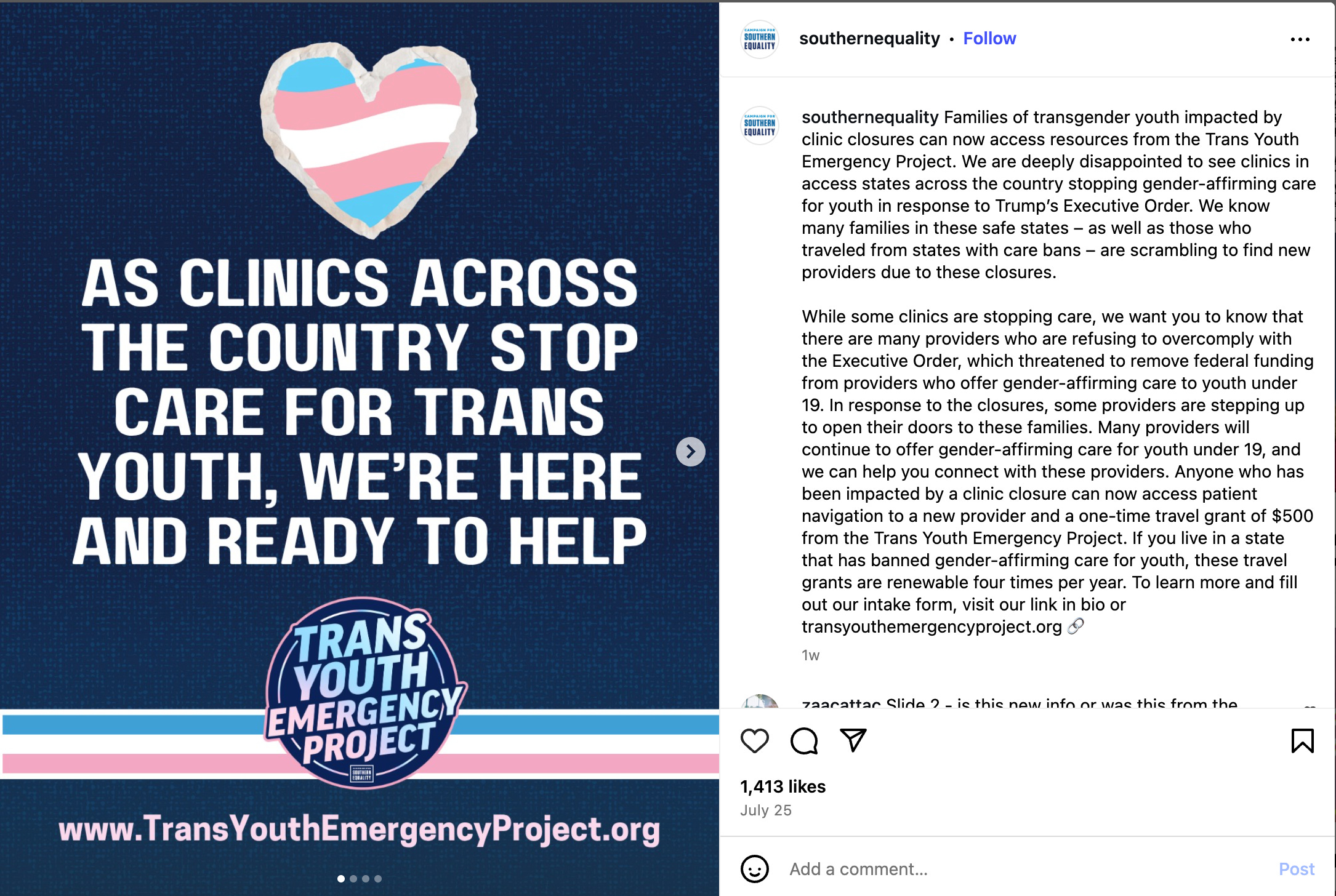
While many telehealth providers (Folx Health, Plume, Planned Parenthood) claim they do not provide hormones to those under 18, a minor who is legally “emancipated” (i.e., a teenager who is legally freed from parental control and supervision) can, with proof of their status, seek cross-sex hormones from online providers in trans sanctuary states such as New York. For minors in states with bans, nonprofits and charity care programs like Trans Youth Equality Foundation offer advice and sometimes funding to travel to permissive states where they can transition.
Outlaws
Rogue providers may use illegal or ethically questionable methods to circumvent bans. In March 2022, Texas Children’s Hospital (TCH) announced it would stop gender-affirming hormone therapy for minors after Texas cracked down on the practice. Dr. Eithan Haim then a medical resident, discovered that a colleague had inserted a hormone-releasing implant into the arm of an 11-year-old girl after TCH’s announcement. The procedure was likely disguised as treatment for an endocrine disorder to skirt the ban. Dr. Haim discovered that the frequency of such procedures rose drastically after TCH’s announcement, indicating that potentially hundreds more children received such interventions for gender dysphoria. Providers making use of similar mislabeling or off-record prescriptions risk felony charges and up to seven years in prison, but some, like those at TCH, are willing to take the risk.
The Biggest Loophole of All
The phenomenon of “trans sanctuary states” like California, Minnesota, Washington, and New York poses a significant challenge to enforcing restrictions on pediatric gender interventions in the United States. These states have enacted laws, such as California’s SB 107 (2022), that protect access to puberty blockers, cross-sex hormones, and surgeries for minors, and shield families and providers from out-of-state legal actions when they have sought treatment in-person across state lines. Should minors run away to such a state, a network of charities, social services, and NGOs is only too happy to facilitate their transition, as this recent exposé of organizations in New York City reveals. If things are allowed to continue as they are, the United States will Balkanize into regional hubs where anything goes, and everyone else.
ICE BERG, RIGHT AHEAD
While the leadership of the Trump administration has been transformative, it is not enough. Even victories in state legislatures are subject to the vagaries of politics, with no guarantees that governors will sign bills restricting bans on pediatric transition into law. So, how do we right the ship? Here are a few ideas.
Consistent Oversight
In the UK, ensuring consistent oversight requires reforming or replacing the Care Quality Commission (CQC) to prioritize medical expertise over regulatory specialization. The body regulating private clinics must base its oversight on a deep understanding of medical practices, particularly for treatments like puberty blockers, hormones, and surgeries for minors, to ensure patient safety and evidence-based care. In the US, consistent oversight demands a unified federal policy to address the disparities created by varying state laws.
The Trump Administration’s executive action targeting federal funding for these treatments is a step forward, but it was unable to regulate private clinics, which may operate independently of federal funding. A federal ban on pediatric use of puberty blockers, hormones, and related surgeries by Congress would face legal challenges, with opponents citing states’ rights and medical autonomy. However, the recent United States v. Skrmetti (2024) ruling, which upheld Tennessee’s restrictions on these treatments for minors, suggests that activists’ arguments are often weak and lack robust legal grounding, making the case for a federal policy a debate worth pursuing.
Targeting Fraud — Of All Kinds
To deter rogue providers, stricter penalties should target mislabeling or falsifying records for treatments like puberty blockers and hormones for minors, as seen in the 2023 TCH case, where providers allegedly skirted state bans. Strong whistleblower protections are vital to encourage healthcare workers to report violations safely. Federal audits must focus on states with lax telehealth or private clinic oversight to enforce compliance with bans. Consumer fraud is another important arena. The FTC’s 2025 workshop on The Dangers of “Gender Affirming Care” for Minors highlights a path forward that enables investigations into providers who mislead families about the safety or necessity of treatments under existing consumer protection laws. Citizens should be empowered through anonymous online portals, dedicated hotlines, and advocacy group partnerships to report abuses.
Public Awareness
We must never underestimate the importance of public awareness. Lifting stories of detransitioners, whistleblowers, and evidence from the Cass Review, the recent HHS review, so that people can follow debates, can shift public opinion and pressure lawmakers to scrutinize claims about the efficacy of puberty blockers and hormones for minors. Such reviews, which highlighted gaps in evidence for these interventions, should be required reading for public servants engaging with families—including teachers, social workers, police, healthcare professionals, and judges—to ensure informed, evidence-based decision-making.
Just Tell the Truth
It occurred to me that my friend might not have paid attention to the clinic closures if I hadn’t risked sounding like a card-carrying conspiracy theorist six years ago. Her relief is good because it means that skepticism of pediatric transition is starting to become mainstream, but the undercurrents of activism and loopholes mean the course correction is only beginning. “That” is still happening. Lasting progress will require vigilance, stronger regulations, and open, honest debate.
Join Genspect at The Bigger Picture conference in Albuquerque, New Mexico, September 27–28, 2025, for an unflinching look at how far we’ve come and we need to do to make lasting change. restore it.
Tickets selling fast – secure your seat now!